
Army says more than 75,000 operations carried out as attacks and casualties hit record levels
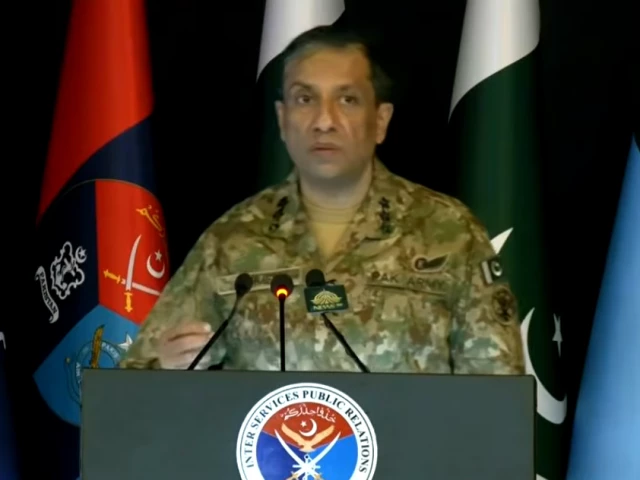
Pakistan’s Chief Military Spokesperson, Director General Inter-Services Public Relations, Lieutenant General Ahmed Sharif Chaudhry, will address a press conference on Tuesday. SCREENSHOT
Pakistan’s chief military spokesperson, Director General of Inter-Services Public Relations, Lt. Gen. Ahmed Sharif Chaudhry, said on Tuesday that 2025 was a “historic and important year” in the country’s fight against terrorism, as security forces carried out an unprecedented number of counter-terrorism operations amid a surge in attacks.
Addressing a press conference, Chaudhry said the aim of the briefing was to provide a comprehensive overview of counter-terrorism measures taken over the past year.
“This is the sole objective of this press conference, and I would request that we remain focused on the fight against terrorism, because terrorism is the biggest threat that the State of Pakistan is currently facing,” he said.
He said security forces carried out a massive nationwide campaign in 2025, carrying out on average more than 206 intelligence-based operations (IBOs) per day. By the end of the year, the total number of PCIs reached 75,175.
Most operations were carried out in Balochistan, where 58,778 PCIs took place. Khyber-Pakhtunkhwa follows with 14,658 operations, while 1,739 were carried out in the rest of the country.
Chaudhry said 5,397 terrorist incidents were reported across the country during the year. Khyber-Pakhtunkhwa was the worst affected, recording 3,811 incidents, or 71% of the total. Balochistan saw 1,557 incidents, or 29 percent, while only 29 incidents were reported in other parts of Pakistan.
He said security forces killed 2,597 militants during the year, including 1,803 in Khyber-Pakhtunkhwa and 784 in Balochistan. A total of 27 suicide bombers were reported, including 16 in Khyber-Pakhtunkhwa and 10 in Balochistan.
The military spokesperson said Fitna-al-Hindustan – a term he used to refer to Baloch militant groups – had no connection with Balochistan. He added that security forces were facing intense challenges, with 1,235 soldiers martyred during the operations.
Chaudhry said 2021 marked a turning point in the terrorism landscape following developments in Afghanistan. He pointed to the Doha agreement between the Afghan Taliban and the United States and its international partners, which included commitments to form an inclusive government, prevent the use of Afghan territory for terrorist purposes and protect women’s rights.
However, he said these commitments had not been met. No inclusive government was formed, Afghan territory was used by several militant groups and organizations such as the Balochistan Liberation Army (BLA) and Tehreek-e-Taliban Pakistan (TTP) started operating from Afghanistan, thereby posing a threat to Pakistan.
He added that due to the situation in Syria, around 2,500 militants recently moved to Afghanistan, claiming that they were neither Afghans nor Pakistanis.
Presenting data from 2021 to 2025, Chaudhry said terrorism-related incidents showed a steady and then sharp increase. In 2021, there were 761 incidents, with 193 militants killed and 592 security personnel martyred.

In 2022, the number of incidents increased to 1,020. Security forces killed 443 militants, while 644 personnel were martyred, it said.
The situation worsened in 2023, when the number of incidents rose to 1,811. During the year, 691 militants were killed and 980 military personnel lost their lives.
In 2024, the number of incidents further increased to 3,014. The number of militants killed rose to 1,053, while 989 security forces personnel were martyred, it said.
“The rise peaked in 2025,” Chaudhry said. “The number of incidents rose to 5,397, 2,597 militants were killed and the number of martyrs reached its highest level at 1,235.”
The connection with India
The DG ISPR said the second major factor in terrorism was the war economy. Citing recent reports, he said about $147 billion had been spent on Afghanistan’s reconstruction, adding that questions were now being asked about where that money was going.
He explained that when this flow of money stops, groups that survive on a war economy try to keep it alive by spreading conflict and terrorism in the region.
Referring to what he called new investment patterns linked to terrorism, the military spokesperson said the most important pattern affecting Pakistan was with India. He said the operational base of these groups was in Afghanistan, while funding and support came from India.
He also said $7.2 billion in U.S. military equipment, including advanced weapons, remained in Afghanistan.
Chaudhry added that political and internal facilitation also took place during the same period and said that Pakistan had taken a strong stand against these elements in 2023.
The DG ISPR further said that a false narrative suggested that the fight against terrorism was a war fought only by the army. He emphasized that this was not just a military war, but a people’s war and a struggle of every child of the nation.
He warned that if the nation does not stand united against terrorism, its consequences will be felt in homes, schools, markets and offices, with attacks carried out in everyday public spaces.
Major attacks of 2025
A series of major terrorist attacks have been reported across the country in 2025, targeting military installations, law enforcement, civilians and children.
On March 4, Bannu cantonment in Khyber-Pakhtunkhwa was attacked, targeting the army. The incident left 18 martyrs dead, including five members of the security forces and 13 civilians. Security forces killed 16 militants.
A week later, on March 11, the Jaffar Express was attacked in Bolan, targeting civilians. The assault killed 25 people – four law enforcement personnel and 21 civilians – while 33 militants were killed, making it one of the deadliest attacks of the year.
On March 16, a civilian bus carrying Frontier Corps personnel was attacked in Nushki, killing five people, including three law enforcement personnel and two civilians. Security forces killed three militants.
The violence then spread to children. On May 21, a school bus was attacked in Khuzdar, killing five civilians. One activist was killed in the incident.

After a brief lull, attacks resumed in September. On September 2, the Frontier Corps North headquarters in Bannu was targeted, leaving six security personnel martyred. Five militants were killed. Later that month, on September 30, an attack on the Frontier Corps headquarters in Quetta killed 11 people, including three law enforcement personnel and eight civilians, while six militants were killed.
In October, activists targeted law enforcement training centers. On October 10, a police academy in Dera Ismail Khan was attacked, killing seven people – six law enforcement personnel and one civilian. Five militants were killed.
November was marked by new attacks. On November 10, a cadet college in Wana was targeted, killing five people, including three law enforcement personnel and two civilians. Five militants were killed. The next day, on November 11, an attack on the Islamabad court complex killed 11 civilians, while one militant was killed.
The last recorded incident occurred on November 24 in Peshawar, where a second attack on the Frontier Corps North headquarters killed three law enforcement personnel. Three militants were killed during the operation.
– This is a developing story and will be updated accordingly


