
Says cabinet world interested in Pakistani military equipment; Wants work on Karachi-Chaman Expressway to be expedited
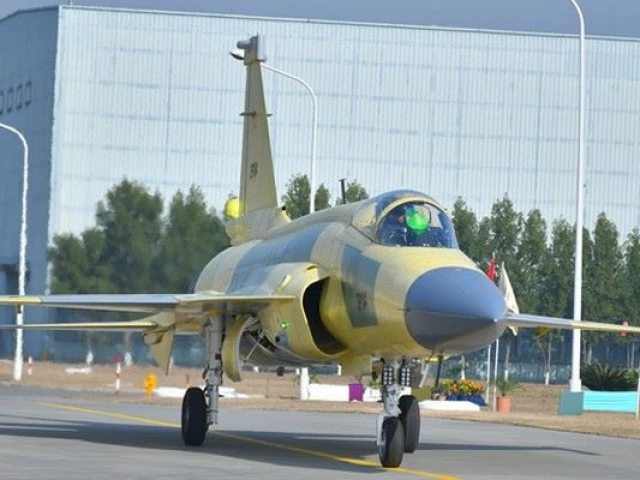
The JF-17 Thunder is an advanced, lightweight, all-weather, day/night, multirole combat aircraft; developed as a joint venture between Pakistan Aeronautical Complex (PAC), Kamra and Chengdu Aircraft Industry Corporation (CAC) of China. PHOTO: Pakistan Aviation Complex Website
ISLAMABAD:
Prime Minister Shehbaz Sharif on Wednesday highlighted growing international interest in acquiring defense equipment and military hardware from Pakistan, revealing that several countries were “actively” engaged in negotiations to purchase combat aircraft.
Addressing the cabinet, the prime minister highlighted that the demand for Pakistani defense equipment had increased following the country’s success in Marka-e-Haq – the four-day military conflict with India in May last year.
Shehbaz said the improved performance of Pakistan’s armed forces has translated into commercial interest, which would boost national defense production and bring tangible benefits to the national economy.
While exchanging views on the overall political and security situation during the cabinet meeting, the Prime Minister paid tribute to the armed forces and law enforcement agencies for their sacrifices and sustained efforts in the fight against terrorism across the country.
The Prime Minister’s remarks confirmed the statement made earlier by Defense Production Minister Raza Hayat Harraj who had confirmed that Pakistan was in talks with several countries for the sale of JF-17 Thunder fighter jets.
Harraj had told BBC Urdu that many countries had expressed interest in the plane but refused to name them or disclose the level of negotiations, saying such negotiations were sensitive and could not be publicly detailed.
Alongside defense issues in the cabinet, Prime Minister Shehbaz announced the acceleration of work on the much-awaited Karachi-Chaman Expressway, often referred to as the “bloody road” due to frequent fatal accidents, saying construction would now be completed within a year instead of two.
He said the nearly 850-kilometer highway, costing about Rs400 billion, would be fully funded by the federal government, adding that savings generated by maintaining fuel prices during the global oil crisis were being redirected to transform the road into a prosperity corridor.
Focusing on Balochistan, the Prime Minister said a Rs75 billion agriculture program had been completed, including Rs50 billion provided by the federal government, aimed at tackling power theft through solarization and enabling farmers to irrigate their lands independently.
He also announced progress in the province’s daanish schools, saying contractors had been mobilized and seven schools would be completed by the end of the year to expand access to quality education.
Expressing satisfaction over improved economic stability, the Prime Minister said the government would now take further developmental measures to place Pakistan firmly on the path of progress and prosperity.
The federal cabinet, meanwhile, looked into several administrative issues, ordering that the draft Private Hajj Policy for 2027-2030 be sent to the Hajj Policy Committee for further deliberations, including on third-party registration and monitoring of private operators.
The cabinet also ratified the decisions made by the Ministerial Committee on Energy during its meeting on December 24, 2025, as well as the approvals made by the Economic Coordination Committee during its session on December 23, 2025.


