
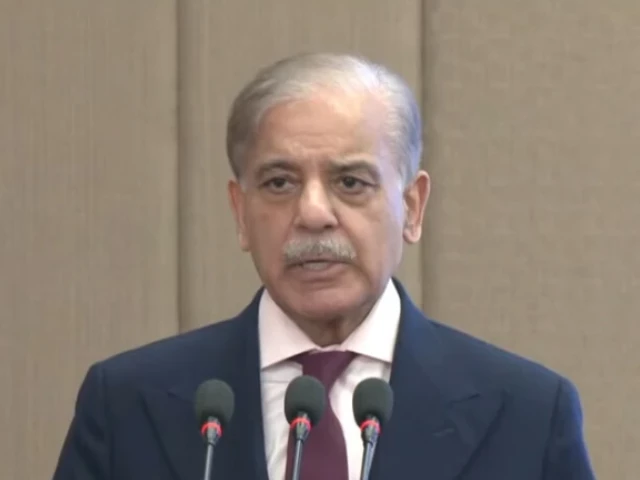
Prime Minister Shehbaz Sharif speaks during a ceremony in Islamabad marking International Youth Day, August 12, 2025. Photo: Express
Prime Minister Shehbaz Sharif confirmed a staff-level agreement with the International Monetary Fund for a disbursement of $1.2 billion and expressed hope that it would be the last such program for Pakistan.
Chairing a cabinet meeting on Thursday, he said the time had come “to free ourselves from the burden of debt”. Hard work is the first condition of national independence and dignity,” Shehbaz said, adding that Pakistan’s economic stability would strengthen its voice and respect in the world.
The IMF on Wednesday announced the agreement to release the next loan tranches of $1.2 billion after Islamabad, for now, accepted the old pre-flood fiscal targets and released the governance report ahead of the board meeting.
After board approval, Pakistan will have access to about $1 billion under the EFF and another $200 million under the RSF, Iva Petrova said. In total, the IMF will disburse $3.1 billion under the EFF out of the $7 billion planned.
Learn more: IMF releases $1.2 billion after government reviews pre-flood promises
Pakistan and the IMF negotiated for three weeks to reach a staff-level agreement. One irritant was the lack of finalization of fiscal figures reflecting the impact of the floods on the budget.
Additionally, the IMF on Tuesday forecast Pakistan’s economic growth rate of 3.6 percent for the current fiscal year, with Finance Minister Muhammad Aurangzeb expressing hope that a staff-level agreement with the lender for two tranches worth $1.2 billion would be reached this week.
The IMF released the Washington World Economic Outlook report, which put Pakistan’s economic growth rate at 3.6 percent. But it specifies that Pakistan’s economic projections “do not yet reflect the impact of floods in summer 2025, the impact of which is still being assessed.”
Read also: IMF forecasts Pakistan’s growth at 3.6%
The negative implications of the floods on economic growth, inflation, the budget and the external sector are one of the outstanding issues hampering the finalization of the staff-level agreement for the completion of the second review of the bailout plan, according to government sources.
Contrary to forecasts of economic growth of 3.6%, the sources said that during last week’s inconclusive discussions, IMF staff had forecast growth of 3% to 3.5%.
They said the IMF believes the recent floods have weighed on the economic outlook, particularly for the agricultural sector, given the damage to Kharif’s main crops.
The government has already adjusted its ambitious target downward from 4.2% to 3.5% while the World Bank made a forecast of 2.6% for the same reason.


