
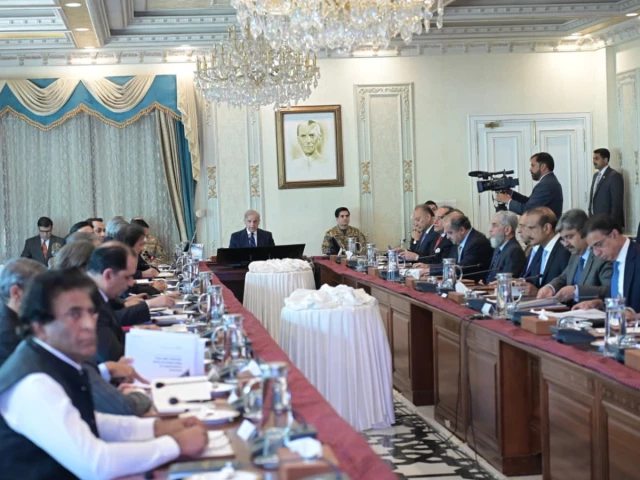
He expressed his satisfaction with the strategy developed for the food supply of the Gulf countries and the progress made so far.
Prime Minister Shehbaz chaired a high-level meeting to review Gulf food export plan, order faster decisions and port efficiency. PHOTO: EXPRESS
Prime Minister Shehbaz Sharif on Wednesday chaired a high-level meeting to review food supplies to Gulf countries and assess Pakistan’s ports and maritime operations in the context of the current regional situation.
The Prime Minister expressed satisfaction with the strategy developed for the supply of food products to the Gulf States and the progress made so far, praising the performance of the relevant departments and officials.
He ordered all relevant departments to remain in close coordination with the Gulf countries regarding the supply of necessary food items and their food security. Referring to the current regional situation and disruption of global supply lines, he said meeting the food needs of Gulf countries was Pakistan’s responsibility.
Sharif asked authorities to accelerate exports of surplus food products to Gulf markets without affecting domestic food needs, while ensuring strict control of supply and demand in the country. He warned that delays in decision-making at the government level would not be tolerated and those responsible would be held to account.
Read: PM Shehbaz bans high-octane fuels in government vehicles as levy climbs to Rs305
The Prime Minister also directed the preparation of a comprehensive plan to increase flight operations at Karachi, Gwadar and other major international airports.
During the briefing, the officials informed the meeting that a special committee formed to promote exports to Gulf countries had approved the export of 40 food items. These include rice, cooking oil, sugar, meat, poultry, milk powder, dairy products, fruits and vegetables.
A database of exporters has also been prepared, while no additional tax will be imposed on the export of vegetables, fruits and meat. Officials said the open air and sea routes would be used for food exports, as well as business-to-business meetings and webinars with Gulf partners.
The meeting was further told that Karachi and Port Qasim remained fully operational during the Eid ul-Fitr holidays. To improve transshipment capacity, off-dock terminals were allowed to handle transshipment, with necessary changes made to customs legislation.
Transport rates at ports have been reduced by up to 60 percent and export facilitation offices have been activated. Tankers carrying crude oil benefit from priority berthing at ports.
Learn more: Prime Minister Shehbaz calls Iranian President and calls for de-escalation and return to diplomacy
The meeting was attended by Deputy Prime Minister and Foreign Minister Ishaq Dar, Defense Minister Khawaja Asif, Planning Minister Ahsan Iqbal, Law Minister Azam Nazeer Tarar, Economic Affairs Minister Ahad Khan Cheema, Finance Minister Muhammad Aurangzeb, National Food Security Minister Rana Tanveer Hussain, Information Minister Attaullah Tarar, Business Minister Junaid Anwar Chaudhry, Special Assistant to Prime Minister Haroon Akhtar Khan and senior officials.


