
Calls on the Afghan regime to address Pakistan’s security concerns; Reiterates Pakistan’s call for peaceful resolution of disputes
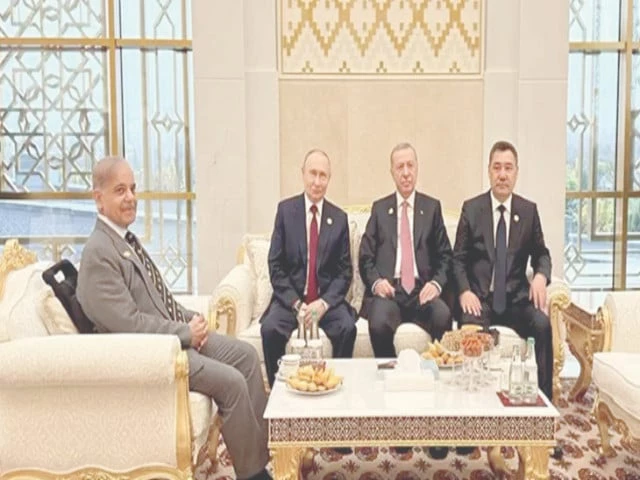
Prime Minister Shehbaz Sharif exchanges pleasantries with world leaders in Ashgabat. Photo: APP
ACHEGABAT:
Prime Minister Shehbaz Sharif on Friday reaffirmed Pakistan’s commitment to peaceful resolution of global disputes, while urging the international community to put pressure on the Afghan Taliban to honor its international obligations and curb terrorist groups operating from Afghan soil.
“Peaceful resolution of disputes is the cornerstone of Pakistan’s foreign diplomacy. It is in the same spirit that Pakistan supported the Gaza Peace Plan and its subsequent approval by the UN Security Council,” the Prime Minister said in his speech at the international forum organized within the framework of the International Year of Peace and Trust 2025, the International Day of Neutrality and the anniversary of Turkmenistan’s permanent neutrality.
The Prime Minister highlighted that Pakistan began the year by assuming its place as a non-permanent member of the United Nations Security Council, where the country strived to maintain global peace and security.
“As we persevere in this quest for peace, the scourge of terrorism is once again rearing its head, and this time, unfortunately, on Afghan soil,” he said, urging the international community to put pressure on the Afghan Taliban regime to respect its international obligations and commitments and rein in terrorist elements operating from its territory.
At the same time, he expressed gratitude to brotherly countries – Qatar, Turkey, Saudi Arabia, the United Arab Emirates and Iran – for their sincere desire and efforts to achieve a permanent ceasefire, “which, as I speak, is still very fragile.”
He said the unanimous adoption of United Nations Security Council (UNSC) Resolution 2788 earlier this year was a strong support to Pakistan’s vision for peaceful resolution of disputes.
The Prime Minister hoped that as a member of the Group of Eight Arab Islamic countries, ongoing peace efforts in the Middle East would protect and save the lives of innocent Palestinians, ensuring a lasting and permanent ceasefire, allowing the flow of essential humanitarian aid and assisting in the reconstruction of Gaza.
He also reaffirmed Pakistan’s commitment to supporting all efforts to uphold the inalienable right to self-determination of the Palestinian people, as well as the brave and resilient people of Kashmir.
The Prime Minister stressed that the search for lasting peace was intrinsically linked to the path to sustainable development. In this regard, the 2030 Agenda for Sustainable Development presents a universal project for a better and peaceful world. The socio-economic development and well-being of our population are the first priority of my government.
“We have made significant progress in several key areas, including advancing financial inclusion, bringing women and marginalized people into the economic mainstream,” he said, adding that in the face of global warming, Pakistan had demonstrated its strong commitment to adopting cleaner and greener solutions, transforming our landscape and setting a global example in ecosystem restoration. “However, like many developing countries, our quest for sustainable development faces headwinds from climate-driven disasters and inequalities in international economic relations.”
Prime Minister Shehbaz Sharif said Pakistan suffered devastating floods in 2023, faced loss of lives and economic losses, and then again this year faced catastrophic situations due to the ravages of climate change.
The Prime Minister added that climate change, poverty and inequality were not isolated challenges. These are transnational threats that require international solutions based on shared responsibility and common purpose.
“Access to advanced technologies, particularly digital technologies, must also be equitable and without any form of discrimination,” he added.
He also called on world leaders to make this forum a real call to action and urgent action for a new paradigm of international relations, where we move from a zero-sum mentality to focused cooperation.
“Let’s invest in connectivity, not just as a means of moving goods, but as a bridge for people, ideas and prosperity.”
Earlier, the Prime Minister congratulated the leadership of Turkmenistan on the 30th anniversary of its permanent neutrality and the success of its initiative to designate 2025 as the International Year of Peace and Trust by the United Nations.


