
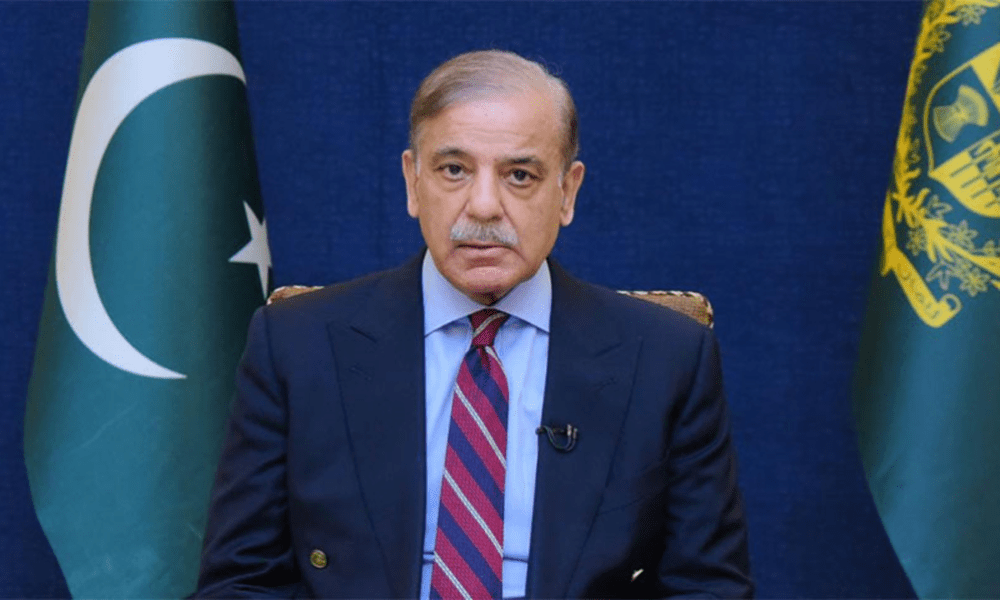
Prime Minister Shehbaz Sharif reaffirmed his commitment to gender equality on Saturday, said women’s empowerment could only be carried out by providing them with equal access to education, skills development and employment possibilities.
“It is our mission and an unwavering commitment to ensure the emancipation of the female population of the country,” he said in his speech here during an event of International Women’s Day, marked on a global scale on 8th March to celebrate women’s achievements and make an appeal to their rights.
Eminent women in various fields, including members of the cabinet, legislators, entrepreneurs and activists, joined the event in the Prime Minister’s House, which was organized by the Ministry of Human Rights and the National Commission on the Statute of Women (NCWS) in collaboration with the United Nations (UNFPA) Fund.
The Prime Minister, on this occasion, launched the very first gender parity report of the capital prepared by NCSW and UNFPA, which identifies the challenges and recommends solutions in key areas such as education, health, governance, political representation and justice.
Prime Minister Sharif said his government would collaborate with the provinces for collective action to promote the integration of women in programs contributing to the national economy.
He announced the creation of an endowment fund for women working in order to support women who work and help them compete with contemporary challenges.
He described the empowerment packaging of PM women a “revolutionary stage in the elimination of discrimination against women” in the fields of employment and to make special arrangements to provide them with installations to normal with men.
“Our population of women at fifty percent can be transformed into a productive workforce if it gives a platform field,” he said.
To facilitate women who work, he stressed that daycare centers were created in public and private services in Islamabad, with a plan to further extend the scope of facilities.
The Prime Minister regretted that a large number of highly qualified women in the country have left professional careers in their struggle to balance work and families, resulting in enormous loss of skilled human resources.
“My message to [women] The segment must manifest itself and join hospitals, banks and other professions of their expertise in order to contribute positively to the national economy, “he said.
Prime Minister Sharif paid tribute to the country’s female champions, which played a leading role in forming the landscape of women’s empowerment.
In this regard, he particularly named the main women of the Pakistani movement Fatima Jinnah and Begum Raa’na Liaquat Ali Khan, Benazir Bhutto as the first woman Prime Minister of Pakistan and the Muslim world, Begum Nusrat Bhutto and Begum Kulsum Nawaz as the Icons of the Resistance, the Dictate, the social social social social and Dr. Rut Jahangir, the youngest computer expert in the country Arfa Karim, former president of the National Assembly, Dr Fehmida Mirza, the first female minister in chief of Punjab Maryam Nawaz, the first woman judge of the judge of the High Court of Lahore, Aalia Neelum and the first woman judge of the Supreme Court Ayesha Malik.
“These” girls of the nation “are a remarkable symbol of the empowerment of women who has made their mark in their respective fields,” he said.
Shehbaz Sharif recalled the measures taken for the emancipation of women during the previous triples of his ruling party, in particular the creation of the first anti-violence centers in Punjab, improved women of women in government boards, the increased reduction for students of such schools.
The Minister of Law, Justice and the Human right, Azam Nazeer Tarar, said in accordance with the Directive of PM Shehbaz Sharif, the ministries and the departments were charged last year to provide inclusive policies. The initiative, he said, successfully led to a higher proportion of the representation of women in ministerial commissions.
He pointed out that Pakistan was classified 145th out of 146 countries on the world gaps between the sexes, alongside Afghanistan, which “did not reflect a real image and was contrary to the reality of the soil”. He called on the organizations concerned to revisit the classification and expressed the government’s will to share the required data.
The UN resident coordinator, Mohamed Yahya, said that the UN had been committed to supporting Pakistan to achieve the 2030 sustainable development objectives linked to the sex plan.
He said that gender equality should be recognized not as a specific question for women, but as a human problem. The launch of the Islamabad sex parity report is important to identify challenges that still need attention, he added.
The special president of the Special Committee on Gender Integration, Dr. Nafisa Shah, said that the representation of women in various organizations and government departments remained below the targeted reference of 33%. It called on their essential representation for effective governance and development of fluid policies.
The president of the NCSW Umme-E-Laila spoke of the parity situation between the sexes of Pakistan, saying that women broke barriers in several sectors. As a self -employment stage, she highlighted the launch of pink bus for exclusively commuters and the “Women on Wheels” project which provided skills to women for their easy and independent mobility.
The President of the Pakistan Security Commission (SECP) AKIF Saeed said that as part of the PM’s empowerment package, the SECP was responsible for appointing private companies that had implemented family policies in their workplace. He said that companies would serve models in promoting a safe work environment.
The Prime Minister has given family prices to 10 best private companies, including Alpha Beta Core Solutions, Arfa Karim Technology Incubator, Aviation Mro, Blink Capital, Funverks Global, Gift EDUCUAL, KISTPAY, LAIBA Enterprises, Ladies Fund Energy and Li & Fung Pakistan.
The prices were based on an online survey and a rating matrix prepared by SECP in collaboration with UN women and Pakistan Business Council. More than 230 companies participated in the investigation launched in 2024, 10 of which are pressed thanks to a transparent process.


