
The Prime Minister called the regulatory framework a ‘quantum leap’, saying it would facilitate business, industry, agriculture and FDI
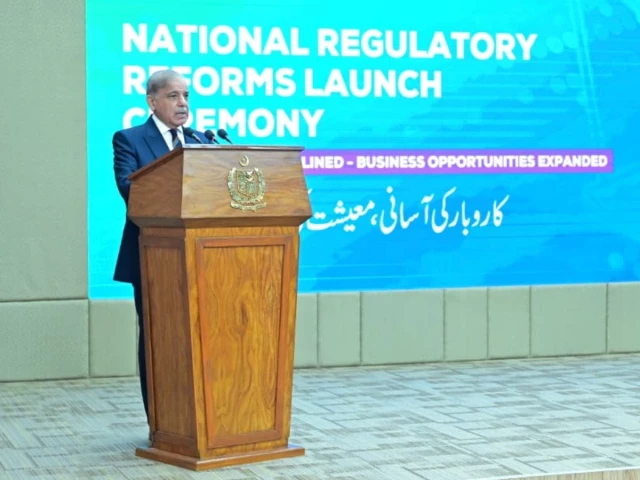
Prime Minister Shehbaz Sharif addresses the launching ceremony of national regulatory reforms in Islamabad. Photo: PID
Prime Minister Shehbaz Sharif said Pakistan had emerged from severe economic distress thanks to the efforts of his government and economic team, saying the economy was in a precarious state when the government took office and the country was close to a financial default.
“We were on the verge of a financial default. Our inflation was galloping and our policy rate was crippling. So one could not imagine any kind of investment in Pakistan, let alone FDI. And business in the country was in turmoil. But we did not lose hope,” Prime Minister Shehbaz said during his speech at the launch ceremony of national regulatory reforms on Saturday.
He added that the challenges were daunting, but they were overcome through teamwork, planning and hard work. “Of course, these were very frightening challenges, at first glance, but through exceptional teamwork, excellent planning and tireless efforts, the country emerged from economic difficulties,” he said.
Prime Minister Shehbaz stressed the need to continue working hard to achieve future goals and turn ambitions into reality. “And it was the commitment, the unwavering determination to walk this very difficult path over the last year and a half. And here we are. And today, Alhamdulillah, we are now discussing how to move forward and develop our economy,” he added.
The Prime Minister also spoke about the approval of a tranche of $1.2 billion by the International Monetary Fund, calling it a positive development. He said excessive regulations had previously harmed industrialists, businessmen and the economy as a whole, discouraging domestic and foreign investment.
The government, he explained, is now working to attract foreign investment in the agriculture, information technology and mining and minerals sectors. Highlighting Pakistan’s demographic profile, Shehbaz said the country’s large youth population was being offered vocational training with international certification.
“They will find productive jobs not only in Pakistan but abroad, making Pakistan richer and more prosperous,” he said.
Calling the new regulatory framework a “quantum leap”, he said it would facilitate business, industry, agriculture and foreign direct investment from Europe, the Far East and the Middle East, while reducing inefficiency, corruption and waste.
“So I think today is a great day that we can announce and let the nation, 240 million people, know that the government is fully aware of the challenge of the day and they are ready to walk with it at whatever speed they want us to walk,” he said.
Prime Minister Shehbaz commended the federal and provincial teams for their coordinated efforts and thanked the British government and UK International Development for their support.
He said Britain remained a key partner, alongside Middle Eastern allies such as Saudi Arabia, and described Pakistan’s relations with the United States as positive.
Speaking at the event, Special Assistant to the Prime Minister Haroon Akhtar said the reforms marked a fundamental change in governance. “Today marked more than a political moment because it marked a turning of the page,” he said, describing the transition from a regulatory state to a developmental state.
He said the reforms were based on three pillars: tariff rationalization, regulatory modernization and export-led industrial recovery. Under the new national tariff policy, he said, the government is moving towards predictability, competitiveness and elimination of arbitrary duties.
British Minister of State for International Development Baroness Jenny Chapman said Pakistan has strong entrepreneurial potential, abundant natural resources and a strategic position in global trade.
Calling the reforms a positive achievement, she said the ambitions were shared by both countries. “And the ties between our people also play a huge role in trade and investment flows between our two countries. Trade now stands at £5.5 billion a year. We have a new trade dialogue and we support Pakistan’s efforts to work with the 1.6 million strong Pakistani diaspora in the UK to unlock private capital,” she said.


