
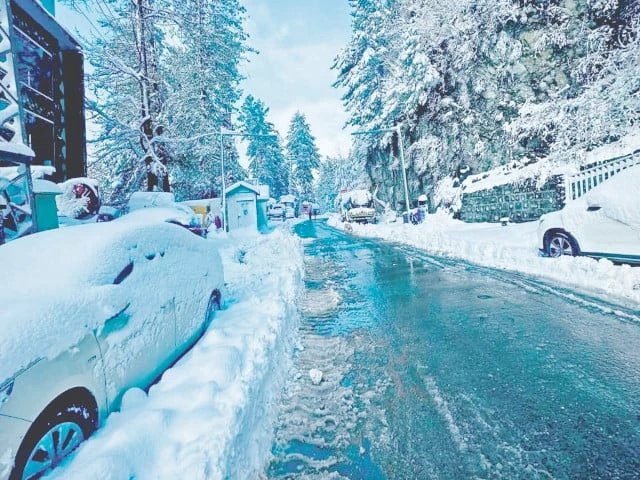
Snow covers roads, vehicles and trees in Galiyat, Abbottabad, pushing temperatures below zero. Photo: PPI
ISLAMABAD:
Heavy snowfall and freezing temperatures have crippled life in Pakistan’s upper regions, leaving roads blocked, tourists stranded and rescue operations underway, as the Pakistan Meteorological Department (PMD) warned that another westerly weather system would bring more rain and snow overnight Sunday (today) into Tuesday.
According to the PMD, a new westerly wave is expected to enter the west of the country on January 25 and spread to upper areas by January 26, bringing rain, wind and thunderstorms to the plains and snowfall to mountainous areas.
Authorities in KP, GB, Kashmir, northern Balochistan and Punjab have been placed on high alert, fearing road closures, landslides and avalanches.
Meanwhile, life has already been severely disrupted by the continuing wave of extreme weather conditions. In multiple incidents linked to snow and slippery conditions, at least two people lost their lives, while dozens were injured in road accidents, including in Balochistan.
In upper parts of the country, heavy snow blocked key highways and isolated isolated communities, leaving residents and tourists stranded.
In northern Balochistan, a snowstorm continues to lash upper districts, with dozens of vehicles stranded on the Quetta-Ziarat highway, while more than 100 tourists remained stuck in vehicles in and around Chaman.
Traffic on the N-50 highway was suspended in several places, disrupting interprovincial travel. Due to heavy snowfall and icy conditions, nine separate accidents were reported on the N-50, injuring 27 people.
At Kojak Top, freezing winds from Siberia caused temperatures to drop to minus 12 degrees Celsius, greatly intensifying the cold. Near Shela Bagh, several vehicles collided due to slippery conditions, leaving two people dead and seven injured.
In Balochistan, temperatures plummeted to minus 12 degrees Celsius, freezing running water and water pipes in Quetta, Kalat, Chaman and Ziarat, triggering severe shortages of drinking water. Despite the decrease in snowfall, the intense cold and Siberian winds persist.
Quetta also recorded its first snowfall of the season, adding to cold-related challenges in urban areas.
Water froze in ponds, on roads and in open areas, while the Quetta-Ziarat highway remained snow-covered in several places. Authorities imposed a 24-hour ban on tourists traveling to Ziarat, while the N-50 Zhob highway remained blocked in several places.
Meanwhile, according to the PMD, rains accompanied by strong winds and thunderstorms are expected in Balochistan on the night of January 25-26, while upper Sindh may also receive rain on January 26.
From January 26 to 27, rain and snow are expected in Britain, Kashmir, Chitral, Dir, Swat, Shangla, Kohistan, Murree and Galiyat with intermittent intervals.
Several districts of Khyber Pakhtunkhwa, including Mansehra, Upper Galiyat, Shangla, Lower Dir, Mohmand, Orakzai, Kalam, Chitral and Khyber, experienced heavy snowfall.
In the Tirah Valley, rain and snow left around 100 vehicles stranded, while 35 people were moved to safer locations.
The 1122 rescue teams continued their operations in snow-covered areas of the Tirah Valley, rescuing stranded people and vehicles. Around 55 people traveling in 20 vehicles were rescued from Sandana, with teams from Khyber, Peshawar, Swabi and Nowshera participating.


