
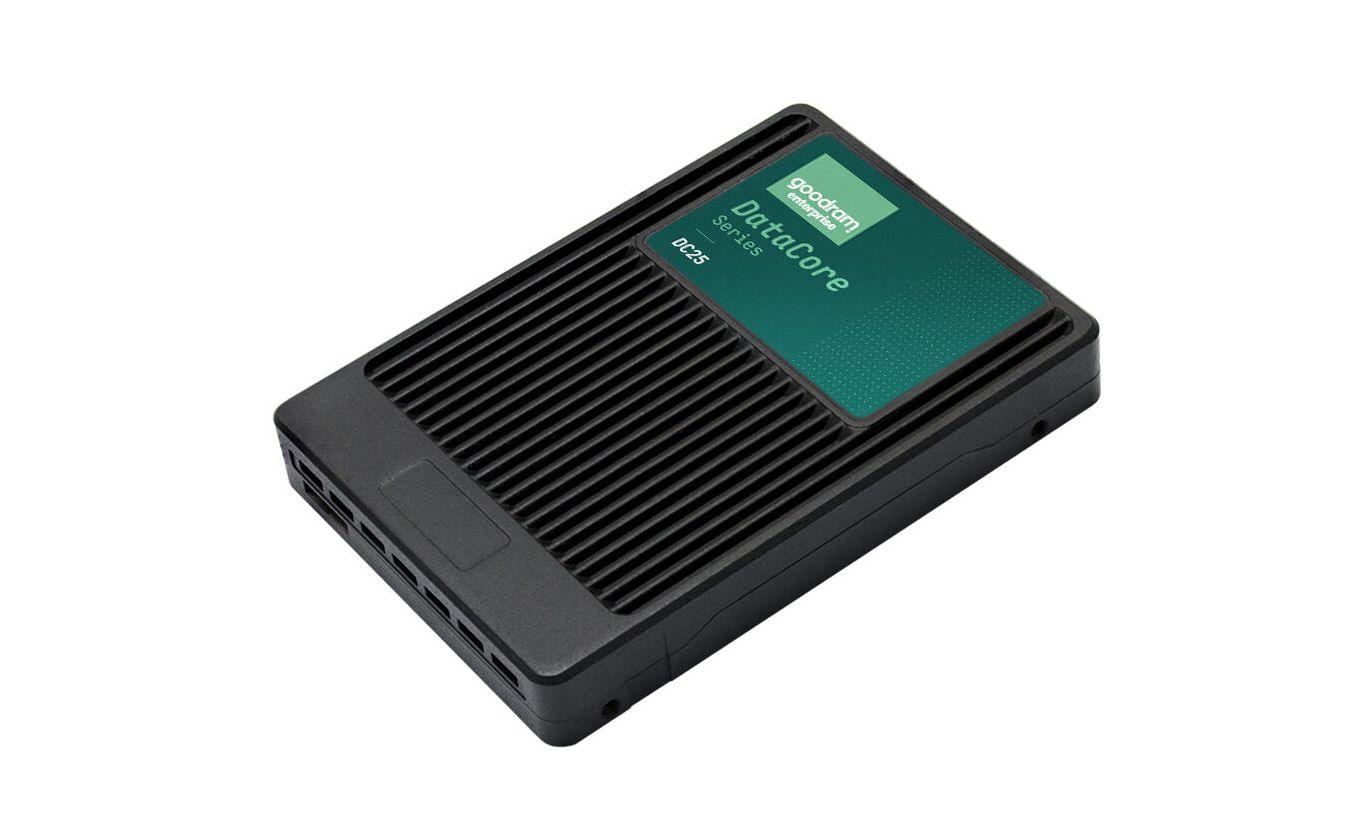
- Polish storage vendor introduces 122.88TB PCIe 5.0 SSD for immersion-cooled servers
- Drive targets ultra-high capacity workloads with QLC NAND and modest endurance ratings
- Launch appears quietly in technical documents rather than as part of a major industry announcement
A little-known Polish storage company has quietly introduced an enterprise SSD designed for immersion-cooled data centers, offering capacities far beyond what most operators use today.
Goodram Enterprise, which operates as a data center-focused arm of Wilk Elektronik, has added a 122.88TB PCIe 5.0 drive to its portfolio. The large SSD appears in technical documentation rather than a high-profile launch.
The drive belongs to the DC25F series and uses QLC NAND in E3.S and E3.L formats. Both versions target servers designed for direct liquid immersion rather than conventional air cooling.
Built to tolerate long-term immersion
Sequential performance is listed at up to 14.6 GB/s for reads and 3.2 GB/s for writes. Random performance numbers are around 3,000,000 IOPS for reads and 35,000 IOPS for writes, so it’s clearly built for capacity rather than speed.
Endurance is rated at 0.3 disk writes per day over five years. This puts it in line with other ultra-high capacity enterprise QLC drives aimed at cold and hot data tiers.
The immersion angle is at the heart of the design. Goodram Enterprise says its enterprise SSDs have been validated with dielectric fluids commonly used in immersion cooling tanks, including Shell and Chevron formulations.
Immersion cooling exposes hardware to chemical, thermal, and material stresses that do not exist in air-cooled racks. The company says its drives are designed to tolerate long-term immersion without electrical degradation.
The 122.88TB model sits alongside a wider range of PCIe Gen4 and Gen5 enterprise SSDs. Capacities in the range range from less than 2TB to over 120TB, covering TLC and QLC options.
Although immersion cooling remains niche outside of large-scale and research deployments, interest continues to grow as rack power density increases. PCIe 5.0 SSDs add additional thermal pressure, making liquid-based approaches more attractive.
What stands out is how little attention this version received. There was no major announcement cycle, despite the capacity and interface combination placing the drive among the largest PCIe 5.0 SSDs released so far.
Separate efforts elsewhere show that immersion and liquid cooling for storage are not limited to a single vendor or approach.
DapuStor has spoken publicly about deploying immersion enterprise SSDs in telecom server platforms, while Solidigm demonstrated liquid-cooled NVMe drives designed for dense AI servers, using cold plates rather than fluid inside the drive itself.
Previous experiments from PC-focused vendors like XPG have also explored water-cooled PCIe 5.0 SSDs, although these targeted enthusiast systems rather than data centers.
Follow TechRadar on Google News And add us as your favorite source to get our news, reviews and expert opinions in your feeds. Make sure to click the Follow button!
And of course you can too follow TechRadar on TikTok for news, reviews, unboxings in video form and receive regular updates from us on WhatsApp Also.


