
Shehbaz Sharif says Pakistan overcame near default in 2023 through collective efforts aimed at economic stability
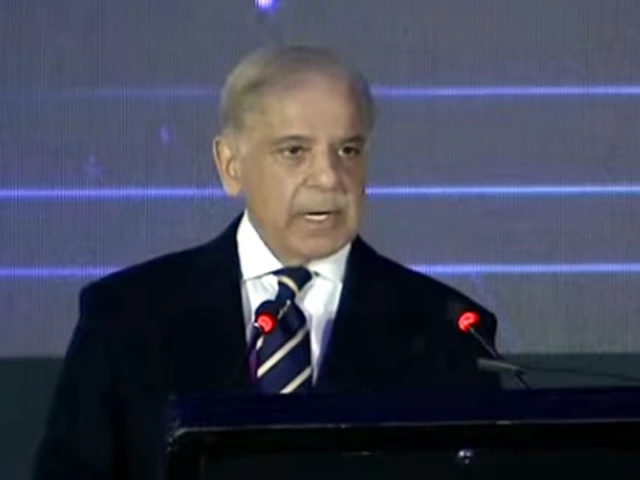
Prime Minister Shehbaz Sharif speaking at the opening ceremony of Indus AI Week in Islamabad. PHOTO: RADIO PAKISTAN
Prime Minister Shehbaz Sharif on Wednesday stressed the need for a “whole-of-government approach” to address Pakistan’s economic challenges, calling on all stakeholders to work collectively towards sustainable growth.
“Though the journey may be long, arduous and thorny, we have accepted the challenge. Pakistan will soon find its rightful place,” the Prime Minister said at the inaugural session of the Pakistan Governance Forum 2026 in Islamabad.
Reflecting on Pakistan’s near-default situation in June 2023, he said that through divine guidance and collective efforts, the country had been pulled back from the brink. He commended the federal and provincial governments, as well as the military, for stabilizing the macroeconomic situation over the past two years.
“We were on the verge of default, but today the macroeconomic situation has stabilized and inflation, which hovered around 35%, has been reduced to less than 7%,” he said. He added that the policy rate had been reduced to 10.5 per cent and stressed the need for gradual growth in exports to unlock Pakistan’s economic potential.
The prime minister highlighted the government’s internal reforms, noting that the International Monetary Fund (IMF) had no role in these measures, which were necessary to avoid a boom-bust cycle. He also cited a 9 rupees per unit reduction in electricity prices, investment initiatives in solar energy and measures to combat electricity theft, which costs the country around 200 billion rupees annually.
Prime Minister Shehbaz said the closure of corrupt entities such as the Utility Stores Corporation and the Pakistan Works Department had saved the nation billions. He also highlighted the Ramazan package, which distributes Rs 38 billion to deserving families through digital wallets, calling the process transparent.
Learn more: PM Shehbaz says Pakistan is out of economic crisis
“The role of government is not to do business but to help the private sector, exporters and investors support productivity and growth,” he said. The Prime Minister emphasized that resource-rich Pakistan could surpass other countries in terms of economic strength through joint efforts.
He also called for widening the tax net, noting that the current tax-to-GDP ratio stands at 10.5 percent, and encouraged growth in exports, investments and foreign direct investment. The Prime Minister hailed the 34% growth in the IT sector and highlighted the need to invest in technical and vocational training, while highlighting the transformative potential of IT and AI-enabled initiatives.
He concluded by congratulating Planning Minister Ahsan Iqbal for the Uraan Pakistan initiative and expressed confidence that the whole-of-government approach would succeed.
Read also: The Prime Minister relies on the IMF plan to support the economy
In his speech, Iqbal said the forum was designed to generate concrete solutions through debates and shared perspectives. He stressed that good governance must be merit-based, transparent and citizen-driven, and noted that the Uraan Pakistan initiative serves as a transition strategy for the economy.
Highlighting the government’s achievements in the last two years, Iqbal said, “If the path of transformation is pursued with full capacity and positive synergy, Pakistan could become a $1 trillion economy by 2035.”
The forum was attended by key government officials, provincial ministers, diplomats, business leaders, experts and traders.


