
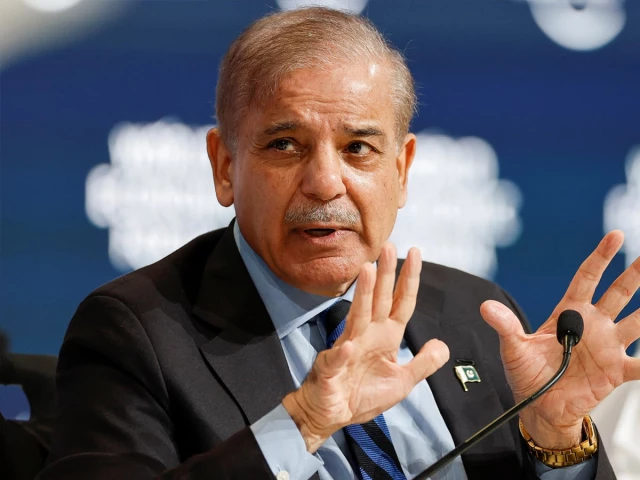
Prime Minister Shehbaz Sharif. Photo: Reuters
ISLAMABAD:
Prime Minister Shehbaz Sharif has constituted a National Coordination and Management Council (NCMC) to address the impact of the war in the Middle East on the country’s economy and internal security, in a move that will also ensure faster decision-making in times of uncertainty.
The council was created hours before Pakistan negotiated a ceasefire. But at the first meeting of its executive committee, held on Wednesday, the council decided that it would continue its work while the danger of war persists.
It may be several weeks before the economy returns to normal functioning, even if the ceasefire turns into a permanent peace agreement.
Economic Affairs Minister Ahad Khan Cheema and Lieutenant General Zafar Iqbal are appointed as co-chairs of the council’s executive committee, which represents all federal departments, provincial governments and special areas.
At an initial executive committee meeting, the council authorized the export of surplus fuel oil after fully taking into account local energy production needs. At least two refineries have raised the issue of limited storage capacity, necessitating the export of excess volumes.
According to the notification, the Prime Minister constituted the NCMC as a central platform, comprising representatives of all federal and provincial stakeholders, to facilitate informed policy decision-making and ensure effective implementation at all levels in response to the economic challenges arising from the Gulf conflict.
The council was given the mandate to manage internal security, including possible internal displacement and refugees due to any untoward situation. He was also tasked with narrative management and disinformation control.
The council is responsible for the management and implementation of financial, economic and commercial policy measures.
Government sources said that over the past two days, civil-military authorities have been scrambling to develop plans to secure energy supplies in case the United States follows through on its threat to attack energy infrastructure and Iran retaliates by attacking energy infrastructure in the Middle East.
Pakistan has explored the possibility of importing fuel from Russia, Nigeria and some other countries. Besides cost, the major problem was the duration of cargo travel, which could have climbed to 30 to 35 days for an oil tanker due to possible closure of supply routes, officials said.
Officials said about five different committees were formed during the last month of the war. These committees, on the one hand, helped address issues that arose in their respective areas, but on the other hand, fragmented decision-making.
Finance Minister Muhammad Aurangzeb chaired the committee to monitor and secure fuel supply and did a remarkable job in ensuring that there was no shortage across the country. However, Deputy Prime Minister Ishaq Dar chaired another committee, tasked with finalizing a plan for providing targeted subsidies.
The Ministry of Information Technology was separately studying the issue of disbursement of these grants while a maritime affairs committee was handling logistical matters. Another committee was working to resolve issues that might hamper Pakistan’s exports due to the war.
The officials said that all these committees were being dissolved and henceforth these decisions would be taken at the forum of the National Coordination and Management Council.
According to the terms of reference, the board would monitor macroeconomic and commodity indicators and ensure that foreign exchange reserves remain stable and there is no sporadic movement in the value of the rupee against the US currency.
Oil and raw materials management would be carried out through digitized national dashboards and decisions would be made to address any supply bottlenecks.
Pakistan’s foreign exchange reserves have remained largely stable during the war, but the country is now set to repay $4.8 billion in debt this month.
Foreign remittances, which remain the main source of reserve stability, declined by 5% in March despite the Eid factor, due to uncertainties in the Middle East markets.
The central bank said workers’ remittances totaled $3.8 billion, down 5% from the same month last year. But these increased by 16.5% on a monthly basis compared to February’s $3.2 billion in revenue.
In total, workers’ remittances rose 8.2 percent to $30.3 billion in the July-March period, compared to $28 billion received during the same period last year.
Remittances in March 2026 came mainly from Saudi Arabia ($918.4 million), the United Arab Emirates ($824 million) and the United Kingdom ($587.3 million).
Officials said the newly established council would ensure real-time scenario modeling, analysis of oil shocks, remittance disruptions, transportation cost hikes and availability of essential commodities.
According to its other mandate, the council would seek to diversify trade by identifying potential export markets, alternative import sources, import conditions, use of port infrastructure and merchant shipping.
The council will work towards energy security by maintaining strategic fuel reserves, adjusting prices, accelerating alternative purchases and providing additional grants for specific emergency expenditures.
He would take responsibility for rationalizing spending and oversee austerity and energy-saving measures.
In the event of an extreme situation, the council has been mandated to implement rationing of essential products. The council would identify vulnerabilities in social communities for targeted subsidies and social safety nets.


