
The President also congratulates Mojtaba Khamenei; He hopes the Ayatollah will guide the country towards stability; Dar talks about war
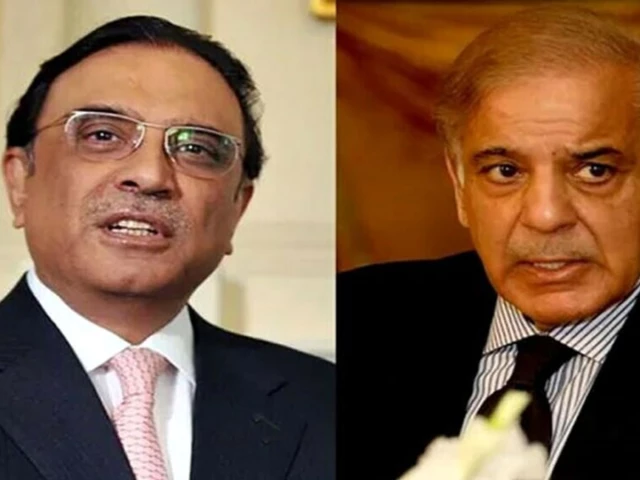
President Asif Ali Zardari on the left and Prime Minister Shehbaz Sharif on the right
ISLAMABAD:
Pakistani leaders on Tuesday praised Iran’s new Supreme Leader Mojtaba Hosseini Khamenei for a decision aimed at maintaining a delicate balance at a time when the raging conflict between Tehran and the US-Israeli alliance continues to reshape the regional security landscape.
President Asif Ali Zardari and Prime Minister Shehbaz Sharif wrote separately to Mojtaba Khamenei, following her ascension to the post of supreme leader following the assassination of her father, Ayatollah Ali Khamenei.
Islamabad’s carefully calibrated move comes at a time when Pakistan is trying not only to maintain its neutrality in a rapidly escalating regional war, but also to reach out to its friends in the region and beyond, seeking de-escalation and stability in the Middle East.
“President Asif Ali Zardari conveyed his best wishes to Ayatollah Seyyed Mojtaba Hosseini Khamenei following his election and appointment as Supreme Leader of the Islamic Republic of Iran,” said a press release issued Tuesday by the media wing of the President’s Secretariat.
“The President noted that the region is facing serious tensions and conflicts. He expressed hope that the situation will stabilize and the living conditions of the region’s populations will improve,” the press release added.
Furthermore, in the letter published by the Prime Minister’s Office, Prime Minister Shehbaz expresses “his deepest condolences and prayers” for the death of Ayatollah Ali Khamenei, while extending his best wishes to Mojtaba Khamenei.
“The martyrdom of Ayatollah Seyyed Ali Khamenei has deeply saddened the people of Pakistan, who stand in solidarity with the leaders and people of Iran in this difficult time,” the Prime Minister said.
Shehbaz expressed hope that Iran’s new leader would guide his country “toward peace, stability, dignity and prosperity in the years to come.” Earlier, in an article on X, Shehbaz reiterated Pakistan’s condolences and praised Mojtaba Khamenei for shouldering a “heavy responsibility”.
Without naming the United States, Shehbaz’s carefully worded message reflects Pakistan’s attempt to maintain diplomatic balance as tensions in the Middle East escalate amid an ongoing military confrontation between Iran and the US-Israel alliance.
Islamabad has so far avoided publicly taking sides in the conflict, calling for restraint and dialogue. At the same time, Islamabad is working behind the scenes seeking de-escalation between Iran and the Gulf countries.
In this regard, the Ministry of Foreign Affairs said in an article published on X on Tuesday that Deputy Prime Minister and Foreign Minister Ishaq Dar had telephone conversations with Foreign Ministers Wang Yi of China, Faisal bin Farhan Al Saud of Saudi Arabia and Abdullatif bin Rashid Al Zayani of Bahrain.
During these conversations, the Foreign Ministry said Dar exchanged views on the evolving regional situation and broader global developments. He shares Pakistan’s view and highlights the urgent need to ease tensions in the region.
The Foreign Ministry said Foreign Minister Wang and Vice Premier Dar stressed the importance of de-escalation and the need to continue dialogue and diplomacy in accordance with the principles of the United Nations Charter.
“Foreign Minister Wang Yi appreciated Pakistan’s constructive efforts to promote de-escalation and stability in the region,” he said, adding that the two sides reiterated their common commitment to further deepen bilateral cooperation and agreed to stay in close contact.
Dar also discussed developments in the Middle East and the wider region in a phone call with Prince Faisal bin Farhan Al Saud. “The two leaders exchanged views on the ongoing deliberations at the UN Security Council,” the foreign ministry said.
During the call, according to the Foreign Ministry, Dar stressed the importance of continued coordination and diplomatic engagement to support de-escalation and promote peace and stability in the region and beyond.
Last night, Dar spoke to Bahrain Foreign Minister Al Zayani and conveyed Pakistan’s grave concern over recent attacks in the region, particularly in Bahrain. He Dar reiterated Pakistan’s support for Bahrain and stressed the need for de-escalation, dialogue and initiatives to promote regional peace and stability.
Pakistan and Iran share a border of almost 900 kilometers and have deep historical, cultural and religious ties. At the same time, Pakistan also maintains close strategic relations with the United States and strong political and economic ties with the Gulf Arab states.
Observers say the messages to Iran’s supreme leader demonstrate the continuity of Pakistan’s policy towards Iran, even as regional tensions escalate. This complex geopolitical positioning means that Islamabad must walk a fine diplomatic line during crises involving Tehran.
“The message of condolences and congratulations was necessary from a diplomatic point of view,” said a senior Pakistani official close to the matter. “Iran is a neighbor and an important regional country. But at the same time, Pakistan must maintain a balanced position in the ongoing conflict.”
Islamabad’s diplomatic engagement with Tehran reflects concern to prevent the regional crisis from spreading to neighboring states. Officials say Pakistan hopes Iran’s new leaders will pursue policies aimed at reducing tensions and stabilizing the region.
“Pakistan desires peace and stability in the region,” Prime Minister Shehbaz wrote in the letter to Iran’s Supreme Leader, expressing hope that Mojtaba Khamenei’s leadership would guide Iran towards prosperity and stability.
(WITH INPUT FROM THE APPLICATION)


