
The party says terrorism is a national, not political, issue, and calls for dialogue and political continuity
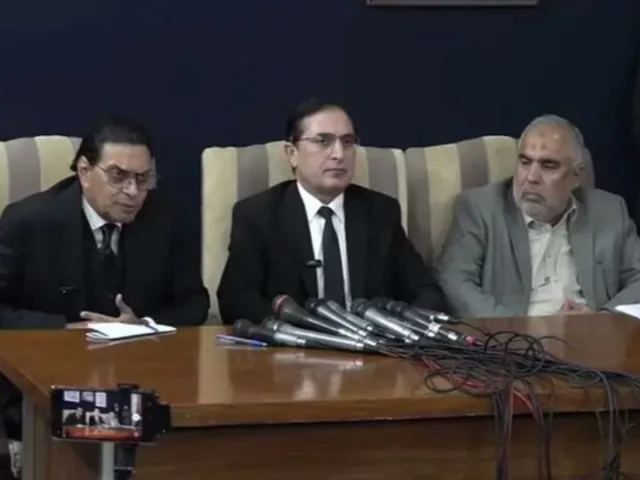
Press conference in Islamabad by PTI Chairman Barrister Gohar Ali Khan, senior leader Salman Akram Raja and former National Assembly Speaker Asad Qaiser, source:
The Pakistan Tehreek-e-Insaf (PTI) on Thursday strongly rejected allegations that it facilitated terrorism, saying the party has always considered terrorism to be a national threat and should not be politicized.
These remarks were made at a press conference in Islamabad by PTI Chairman Barrister Gohar Ali Khan, senior leader Salman Akram Raja and former National Assembly Speaker Asad Qaiser. The briefing follows comments from the army spokesperson, who previously accused a 2021 ruling political party – widely seen as a reference to the PTI – of “facilitating terrorists internally”.
Barrister Gohar said PTI’s stand on terrorism has always been clear. “Terrorism is a menace and it is the national responsibility to eliminate it from its roots,” he said. “Our position has always been that there should be no policy against terrorism. We need a single position and a unified national narrative.”
Read: DG ISPR blames rise in terrorism on political environment in KP
He said it was wrong to characterize the PTI or its Khyber-Pakhtunkhwa government as uncooperative. “This is far from the truth,” he said, pointing to a large jirga organized in the province in which several political parties participated. He added that the jirga emphasized that decisions should be taken in full confidence with the provincial assembly.
“Terrorists have no religion, no nationality, no borders. They do not discriminate between men and women. They attack our mosques and our Eidgahs, and we condemn every attack,” Gohar said. He added that questioning why the PTI was not the target of terrorists was “inappropriate and dangerous”.
“We believe that every time there is a terrorist attack somewhere, the entire country is targeted,” he said.
Gohar said the PTI government in KP had increased the capacity of the provincial police and spent Rs 40 billion for the purpose. “The top priority of the PTI and its government has always been the protection of life and property, and there can be no compromise on this,” he said.
He warned that blaming the PTI through press conferences and allegations was widening the gap between institutions and political forces. “This is detrimental to the nation at this time and should be avoided,” he said, adding that he hoped such press conferences would not be necessary in the future.
The PTI leaders were responding to remarks made two days earlier by Director General of Inter-Services Public Relations Lt Gen Ahmed Sharif Chaudhry, who questioned the PTI’s anti-terrorism narrative and linked the rise in militant violence in KP to what he described as a “politically permissive environment”. The military spokesperson said around 80 percent of the terrorist incidents took place in KP and alleged a political and terrorist nexus behind the surge in attacks.
Learn more: ‘Conducive environment’ behind KP terror wave, says DG ISPR
During the briefing, DG ISPR played video clips of senior PTI leaders and showed screenshots of statements attributed to PTI founder Imran Khan questioning their opposition to military operations. He said the party was resisting counterterrorism efforts and “seeking help from Afghanistan.”
Salman Akram Raja said it was completely wrong to portray the PTI founder as a sympathizer of terrorists. “We do not support terrorists. We only oppose the killing of innocent people,” he said. He asked who was supplying arms to Daesh, saying the issue had been raised with DG ISPR but without a clear answer.
He said wars are fought jointly by the armed forces and the people, and the PTI could help bridge the gap between the public and state institutions. “Drone attacks on weddings and attacks on mosques are unacceptable to us. That is why we say such operations are not acceptable,” he said, adding that Pakistan should ultimately engage with the Afghan government.
Raja said the PTI wanted continuity in policies and a comprehensive national policy on terrorism. He said economic deprivation was a major problem in the affected areas, where employment opportunities had not been created. “The PTI has been wrongly accused. We have delivered a message of unity,” he said, adding that the party opposed the move and wanted to protect citizens, whether the threats came from terrorists or the state.
Asad Qaiser said that no dialogue could be successful without the participation of Imran Khan. “This press conference is not against anyone,” he said. “We want strong institutions and a strong military, but the institutions must also operate within their constitutional limits. »
He said military operations had been going on in KP for 17-18 years, but terrorism had not ended and had instead increased. “If a policy is not successful, it must be changed,” he said, adding that decades of conflict fought in the name of jihad had damaged local culture and spread Kalashnikov culture due to the war in Afghanistan.
Qaiser also raised financial issues, saying the federation owed billions of rupees to KP, adding that the province was not getting its share and its development budget was being released intermittently.
“PTI is the largest political party in Pakistan, but there is a campaign against us and attempts to crush us,” he said. “Pakistan is our life and we oppose efforts to create hatred between the people and institutions. »
Barrister Gohar said that no political party in KP had been spared from terrorism and PTI did not want any interference from any country in the internal affairs of Pakistan. He said the PTI was currently not talking with anyone, adding that the mandate for any negotiations had been given by Imran Khan to Allama Raja Nasir Abbas and Mahmood Khan Achakzai.
He said the PTI had already initiated talks but nothing had come of it. “If nothing changes, why should we sit down again? he asked.
Gohar also said that the KP chief minister insisted that the voice of the people should be heard. “Institutions, their leaders and politicians are not the fathers of the nation; they are the servants of the people,” he said.
He added that the PTI had not sent any representative to the National Dialogue Committee formed the day before, although it had been invited to attend.


