
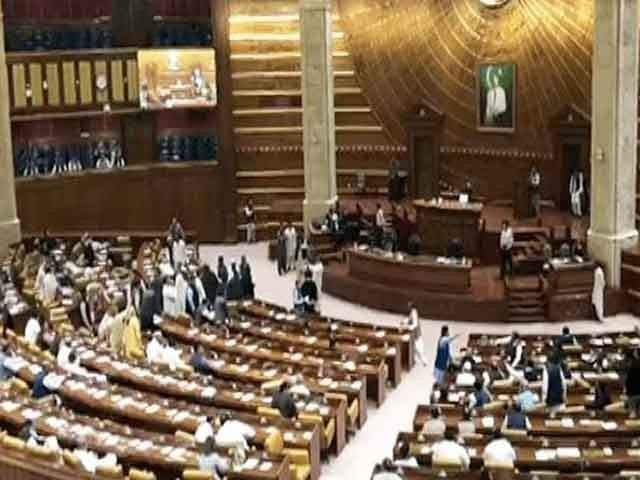
Punjab Assembly. PHOTO: FILE
LAHORE/ISLAMABAD:
With the embattled opposition party in the crosshairs of state scrutiny, government ministers on Tuesday appeared to move closer to approving punitive measures against the PTI, including the possibility of a ban on the party and the imposition of a governor’s rule in PTI-ruled Khyber-Pakhtunkhwa, while the Punjab Assembly passed a resolution seeking a ban on the party’s incarcerated leader.
The Punjab Assembly passed a resolution calling for the banning of the PTI founder and his party, accusing them of undermining national stability, fomenting disorder and acting in harmony with the country’s adversaries.
The resolution was moved by PML-N MP Tahir Parvez, who called for decisive action against leaders found guilty of making statements against the state, fomenting unrest or weakening the country’s security framework.
“The institutions that protect Pakistan on all fronts and have successfully countered an enemy five times its size, like India, are essential to the integrity and stability of the country,” the resolution said.
“A ban should be imposed on PTI and its founder Imran Khan for acting as a tool of the enemy state. He is also accused of making statements against the country and creating chaos.”
The resolution further demanded that all such leaders, regardless of their political or non-political affiliation, be prosecuted under the law and sentenced to punishment commensurate with their actions.
He also paid tribute to the officers and staff of institutions working for the stability and security of Pakistan, saluting both their leadership and sacrifices.
Azma Bukhari
Warning that the government’s patience with the PTI was wearing thin, Information Minister Azma Bokhari said and hinted at the possibility of a ban on the latter, alleging that the PTI’s own actions were gradually reducing the available options.
Speaking at a press conference in Lahore, the minister addressed speculation about a possible ban on PTI and imposition of governor’s rule in Khyber Pakhtunkhwa, saying her own political instincts were against such measures.
“As a political worker, I do not support any party being banned or the government being imposed,” she said.
However, she warned that current circumstances could force the state’s hand. “Given the state of affairs, the PTI is pushing us to move in this direction,” she added.
Bokhari drew attention to the deteriorating security situation in PTI-ruled KP, saying terrorism continued to be rampant in the province while its policing capacity remained insufficient.
“On the one hand, KP remains the most affected by terrorism, the police remain understaffed; they do not yet have a Crime Control Department (CCD) and the police do not have the necessary equipment,” she said.
She argued that PTI’s rhetoric had moved beyond political opposition and was now jeopardizing national stability. “Pakistan [is being] at stake, and if they don’t stop, we won’t have any other options.”
She also drew parallels between incarcerated PTI founder Imran Khan and self-exiled MQM leader Altaf Hussain, whose speeches were banned by court order in 2015 after remarks against state institutions.
“He has the same politics as Altaf Hussain, which was still quite soft compared to his (Imran),” she said.
“I fear he may meet the same fate as Altaf Hussain.”
In an apparent reference to Chief of Defense Force and Chief of Army Staff Field Marshal Asim Munir, the Information Minister also accused the PTI of deliberately targeting the head of a state institution through sustained political attacks.
“If you are thinking of embarking on a campaign against the head of an institution, it will not be long before the point is made,” she warned.
Recalling the events that took place during the time when PTI was in power, Bokhari said Pakistan suffered from international isolation during the party’s tenure. On the other hand, the country is now regaining its footing on the world stage.
“Pakistan is now on the right track, and the PTI cannot digest it because whatever is good for Pakistan… this group considers it bad news.”
She argued that Pakistan could no longer “operate in parallel with Imran’s policies”, adding that the government’s restraint was beginning to wear thin.
“We have been tolerating this for 2.5 years; there is a limit,” she said, describing the PTI as having become a “threat” to the country.
State Advocate Aqeel Malik
Separately, Minister of State, Barrister Aqeel Malik, claimed that the party had allowed individual impulses to dictate its entire discourse and called for zero tolerance for targeting institutions.
He said that since 2011, a trend of political recklessness had begun.
The minister also justified the stance taken by state institutions in response to the PTI policies, saying the response was justified. He warned that every action inevitably provokes a reaction.
He questioned the logic behind repeatedly targeting institutions and said the situation had gone on long enough and needed to be stopped.
He further asserted that there was “no difference” between the PTI narrative and the one circulating on Indian and Afghan social media platforms. He urged the party not to drag the armed forces into a “dirty political game” as security personnel continue to sacrifice their lives.
He said the option of imposing a governor’s rule in KP was being seriously considered, accusing the former prime minister of allowing terrorism to gain ground in the province.
He then accused the PTI of obstructing intelligence-based operations and resisting counterterrorism efforts, arguing that such conduct made normal politics impossible.
Lawyer Aqeel Malik also argued that the PTI itself was suffering under the leadership of its imprisoned founder, saying that even within Parliament, party members were privately looking for ways to break the political deadlock.
He said the government did not believe in retaliatory policies and had never practiced them, but insisted that the consequences the PTI was facing were of its own making.
The minister urged the party to finally draw a clear line on its stand, whether with Pakistan or its enemies, and warned that anyone who obstructs Pakistan’s progress cannot be considered loyal to the country.
Referring to the violent PTI protests on November 26, he said coming with studded sticks was “nothing short of terrorism” and could not be justified under any political pretext.


