
Lahore:
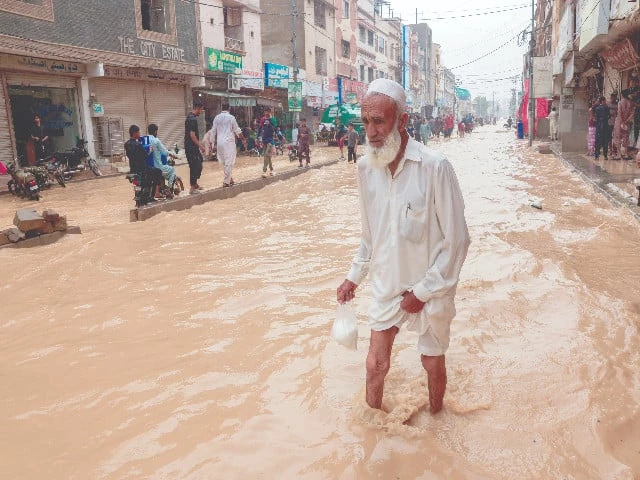
The southern Punjab faces the emergency worsening of the floods while the rivers overflow and the embankments collapsed, threatening to move tens of thousands of residents.
In the cosmopolitan city of Karachi, the streets and houses in the low areas were flooded on Wednesday while the metropolis endured a third consecutive day of Moiszon Lourdes, the rivers overflowing and moving hundreds of residents in security.
The Punjab Disaster Management Authority (PDMA) has led urgent evacuations of the districts subject to floods, notably Muzaffargarh, Lodhran, Rajanpur, Liaqatpur and Rahim Yar Khan, stressing that residents of the river beds must be moved to safe areas without delay.
Chenab has reached dangerous levels in Multan, where water has crossed the brand of 394.5 feet, forcing massive evacuations and disturbing daily life.
The flood waters have entered villages including Basti Gagran Kachor, Mirza Pure and Hasan Kachor, leaving the families blocked. The authorities have diverted intense traffic through vehicles and Khanewal because the key roads near Sher Shah and Chef Muhammadla have become dangerous.
The officials said that the pressure rose to the Sher Shah dam and the nearby dikes, where a controlled violation is being studied to relieve the pressure on the embankments.
If he is executed, more than 8,000 houses and 30,000 people may be affected. Warnings have already been issued for neighboring colonies, urging residents to move to the rescue camps.
Downstream, India has released additional water in Sutlej, intensifying flows in Harike and Ferozepur.
At the head of Panjnad, the discharge reached 530,000 brackets, classified as an “extremely high flood”. The Ministry of Pakistan Water Resources has placed all emergency alert services.
In Muzaffargarh, 138 villages are overwhelmed, affecting more than 135,000 people. Rangpur reported that 50,000 others moved after 28 villages were flooded.
In Lodhran, violations left several communities underwater, while in Alipur, eight people were carried away; Three were confirmed dead and five remain missing. Bahawalpur officials said 150,000 residents were affected by the increase in 98 places.
Authorities fear that the crisis could get worse in Jalalpur Pirwala, where 500,000 bikes released from chef Trimmu have jumped downstream.
Emergency measures are in place for the next 24 hours while thousands of people continue to flee low areas. Local officials said more than 235,000 people and 180,000 livestock had been moved to safer land.
The province of disaster management (PDMA) said that 2.1 million people had already been moved through Punjab this monsoon, with nearly two million acres of submerged agricultural land. Cotton, corn and sesame crops have been destroyed in several districts, aggravating economic losses.
Public health problems are also increasing. The Punjab health service said that more than 158,000 people affected by the floods had contracted diseases, including respiratory infections, skin conditions, diarrhea and eye infections.
Snake bites and dog bites have also been reported in the emergency camps. In Arifla, stagnant water has also triggered flambés of water -borne diseases.
The provincial government has deployed more than 300 boats, 400 inflatable rafts and thousands of life jackets in Multan, Muzaffargarh, Bahawalpur, Lodhran and Rahim Yar Khan. The army and rescue 1122 help evacuations and efforts to connect violations.
According to the National Disaster Management Authority, the Punjab alone recorded 246 deaths this season, while national tolls are 929 with more than 1,000 injured.
Crue waters have now pushed into the Sindh, where Indus, Sutlej and Chenab continue to increase. At the GUDDU dam, the flows exceeded 500,000 CSUCs on Wednesday, with warnings that an increase in even higher floods could arrive within 12 hours.
The Sukkur dam has recorded more than 440,000 CSUCs upstream while all the doors were opened to mitigate the pressure.
Despite the continuous relief, the villagers of Bhawana, Ahmedpur Sial, Uch Sharif and Kabirwala remain cut, using an urgent rescue.
Officials warn that the next few days will be decisive. The continuing entries of India and the dams upstream under tension, southern Punjab and Sindh remain on alert for what experts call one of the most serious emergencies of recent memory floods.


