
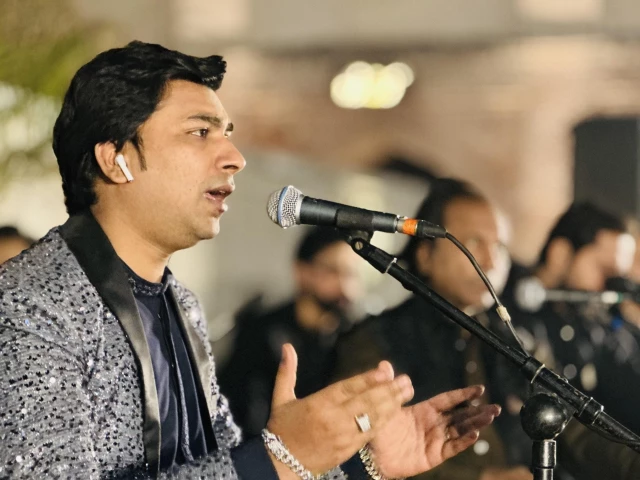
Faraz Khan granted interim bail as case sparks debate on art, politics and expression
An additional sessions judge granted interim bail to Faraz Khan till January 13. PHOTO: FACEBOOK/Faraz Amjad Khan
LAHORE:
A case was filed against Qawwal Faraz Khan for singing a song related to “Prisoner 804” at a government-sponsored musical evening at Lahore’s Shalimar Gardens, while the singer was granted interim bail, police and court officials said.
An additional sessions judge granted interim bail to Faraz Khan till January 13. The qawwal, whose full name is Faraz Amjad, appeared in court and said he would never have sung the song if he had known that a criminal case would be registered. “If I had known that singing this song would lead to an affair, I would never have sung it,” he told the court.
According to the police report, the World City Authority of Lahore organized a musical and cultural evening at Shalimar Gardens, where Faraz Khan and his fellow artists presented qawwali. During the show, the singer performed a song associated with ‘Prisoner 804 of Adiala Prison’, prompting authorities to register an FIR against him.
The FIR was lodged at Shalimar police station following a complaint by Zamir, manager of Shalimar Gardens, and includes various sections of the Pakistan Penal Code.
Read: Adil Raja and six others sentenced to double life in prison for “digital terrorism”
In the FIR registered at Baghbanpura police station, the complainant said that the event, titled ‘Chandni Raatain’, was a purely cultural program aimed at promoting culture, music and harmony. It clearly prohibited political content or slogans.
The complainant said that on February 3, during the qawwali evening, Faraz Khan and his fellow performers “deliberately and without permission sang a politically provocative song with the lyrics ‘Adiala Jail Qaidy 804′”, after which the administration stopped the performance.
The FIR said the song aroused crowd enthusiasm, sparked fears of public order disturbances, undermined the apolitical and cultural objective of the event and caused “serious damage to the credibility, neutrality and dignity of a government institution”.
He further said that Faraz Khan’s act was “highly irresponsible, reprehensible and beyond legal limits”, describing it as an attempt to incite the public, disrupt public order and create controversy within a state institution, which he said was a punishable offence.
Faraz Khan maintained that he sang the song on public demand, but was still reserved.
The event at Shalimar Gardens was open to the public. The incident raised questions about the rules governing cultural programs and sparked a new debate over artistic expression.
Learn more: A satirist “recaptured” as tolerance diminishes
Police said an investigation has been launched and the case is being examined from different angles in accordance with the law.
The case adds to a growing list of actions against artists and content creators for works deemed controversial.
In August 2024, YouTuber Aun Ali Khosa was reportedly arrested at his residence in Lahore after posting a parody video titled “Bill Bill Pakistan” criticizing the government. His whereabouts have been unknown for several days, despite an order from the Lahore High Court ordering his recovery.
Following Khosa’s disappearance, Amnesty International called on the government to reveal his whereabouts “as quickly as possible” and ensure his safe return.
Similarly, in May 2024, Kashmiri poet Ahmad Farhad disappeared from his residence after posting poems on social media criticizing the establishment. The case led Justice Mohsin Akhtar Kayani of the Islamabad High Court to summon the defense secretary and order the police to seek statements from intelligence officials.
The court observed that alleged officials sent messages while claiming that the person was not in their custody, questioning whether the country would be run by spy agencies or in accordance with the law.


