
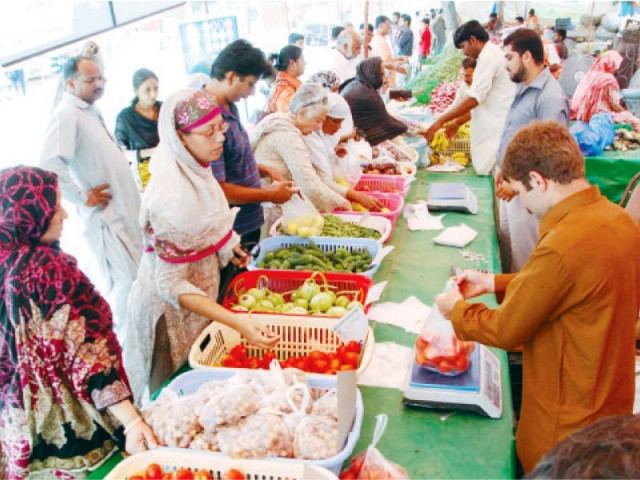
Ramazan Bazaar. PHOTO:EXPRESS
LAHORE:
More than halfway through the month of Ramzan, the widely publicized market inspection campaign in Lahore appears to have brought little significant relief to consumers, with prices in many markets continuing to deviate sharply from government-notified rates.
Despite regular visits from officials – including the deputy commissioner, deputy commissioners and special assistant to the Punjab chief minister on food safety and consumer protection – residents say essential commodities remain well above the official price list in much of the city.
Authorities maintained a visible presence at open markets, supermarkets and government-run Ramazan Sahulat bazaars throughout the month of fasting, projecting an image of strict law enforcement. But buyers and market observers say those efforts have largely failed to translate into lasting price controls.
Staples commonly consumed during the month – particularly meat, milk and curd – attracted the most complaints. Consumers say these items are often overlooked during official inspections, even as overcharging continues openly in many markets.
The government’s Sahulat bazaars, established to provide subsidized essential goods, provided only limited assistance. With relatively few outlets for a city the size of Lahore, access remains patchy. Shoppers in several locations also raised concerns about quality, citing substandard meat, inconsistent produce, and fruits and vegetables that don’t meet expectations at subsidized markets.
Enforcement measures have included fines against sellers, but traders in several markets say these penalties are often seen as a common cost of doing business. Many providers recognize that fines are quickly offset by passing on higher costs to customers. Inspections are carried out, penalties are imposed and prices often return to previous levels within hours.
Recent price data illustrates the growing gap between official prices and what consumers actually pay.
Live chicken has been revised upward in the official list by Rs15 per kilogram, setting the rate between Rs329 and Rs343 per kg. However, in many markets it was difficult to find chicken at these prices. Chicken meat, officially pegged at Rs 497 per kg after an increase of Rs 22, was commonly selling for between Rs 540 and Rs 610, while boneless chicken in several areas exceeded Rs 850 per kg.
Vegetable prices followed a similar trend. New soft-skinned potatoes, officially sold at Rs 18-20 per kg, were widely sold at Rs 30-40. Tomatoes, despite a reduction of Rs5 in the official rate to Rs60-65 per kg, retailed at Rs120-Rs160. Onions, officially priced at Rs 48 to 52 per kg, were generally sold at Rs 80 to 100.
Other products showed even greater disparities. Local garlic, discounted to official Rs 190-200 per kg, was selling at Rs 280-300, while imported Chinese garlic ranged between Rs 600-700 despite an official rate of Rs 505-530. Thai ginger, priced at Rs 277-290 per kg, fetched Rs 400-450 in many markets.
Brinjal, officially Rs76-80 per kg, sold up to Rs150-200. Bitter gourd, quoted at Rs152-160 per kg, reached Rs350-400. Spinach, officially priced at Rs23-25 per kg, was generally sold for Rs60-80. Ladyfinger, priced at Rs200-210 per kg, sold for Rs350-400. Chinese carrots, despite an official reduction to Rs 76-80 per kg, were retailing at Rs 250-300.
Other vegetables – including zucchini, cucumbers, peppers, cauliflower, cabbages, peas, turnips and mustard greens – showed similar discrepancies between official and market prices.
Fruit markets offered little relief. Apples, whose official price is between Rs 250 and Rs 420 per kg depending on quality, are sold between Rs 350 and Rs 600. Dates varied between Rs 800 and Rs 2,200 per kg on retail markets despite an official price of Rs 385 to Rs 490. Guava, priced between Rs 138 and Rs 145 per kg, sold between Rs 250 and Rs 490 per kg. 300 Rs, while grapes priced between Rs 420 and 440 fetched between Rs 800 and 1,000.
Kinow, at the official price of Rs220-335 per dozen, sold between Rs350-500 in several markets. Pomegranates, priced between Rs 601 and 630 per kg, were widely sold for between Rs 800 and 1,000.
For many residents, the gap between official policy and everyday reality has become increasingly difficult to ignore.


