
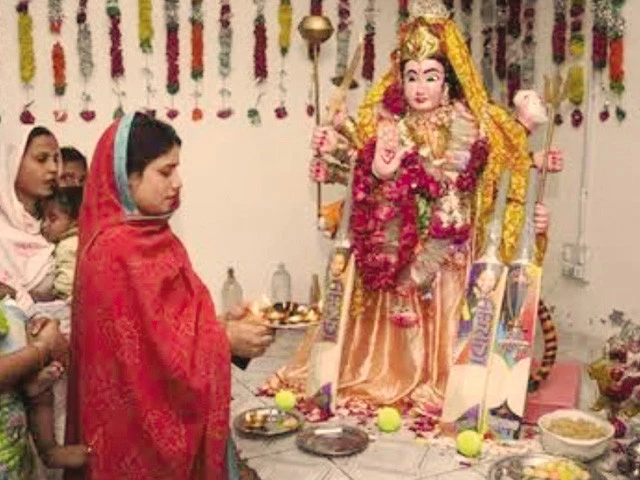
Once home to temples and thriving neighborhoods, the city’s Hindu population is now in decline.
RAWALPINDI:
The ancient city of Rawalpindi, over 1,000 years old and filled with remains of vanished settlements, was dominated by the Hindu community until 1947.
After the departure of Hindus, Sikhs settled in the region, while Muslims and Parsis have been present since ancient times. Today, the Parsi population has almost disappeared, with most migrating to Iran and Karachi.
Until the creation of Pakistan on August 14, 1947, Hindus had a strong presence in Rawalpindi. According to the 1943 census, the city had 82,178 Hindus, 47,963 Sikhs and 22,461 Muslims.
The city had 39 temples, 14 gurdwaras, 12 cremation grounds and 11 dharamshalas. Hindus mainly lived in Dingi Khoi, Purana Qila, Jamia Masjid Road, Nehru Road (now Ghazni Road), Saddar and Railway Road. The Sikhs later settled in Bagh Sardaran, Bhabra Bazaar, Kasira Bazaar, Mohalla Shah Nazar and Kucha Sabooniyan, with Sardar Sohan Singh constructing several buildings for the Sikh community.
Today, only 5,113 Hindus reside in Rawalpindi district, while Islamabad has only 141 Hindu families. Only three temples remain functional in Rawalpindi, including Krishna Temple (Saddar), Valmiki Temple (Gracey Lines) and Lal Kurti Temple. All three are over a century old and in used condition.
The closed temples include Kalyan Das Temple, Devi Temple (Kohati Bazaar) and Purana Qila Temple. There are currently no dharamshalas or cremation grounds for the Hindu community.
Although there is an 80-year-old cremation ground near Tipu Road, opposite the medical college, the Muslim population in the area does not allow cremations.
A massive police deployment is necessary when a cremation takes place. Before 1947, nine major Hindu and Sikh schools operated in the city; all are now under government control.
Once ruling Rawalpindi for almost a century, the Hindu community has now dwindled and is airing its grievances to the government.
Sardar Hira Lal, president of the Hindu-Sikh Welfare Board, said funds were needed for renovation of temples. He added that the biggest problem is the lack of cremation grounds.
“We are demanding that 4-5 kanals of land be allotted outside the city where we can build a cremation ground, a dharamshala and a small temple for worship. We are loyal Pakistanis; our ancestors were born here. After 1947, India made attractive offers, but we refused. Rawalpindi is our birthplace; we cannot abandon our soil.”
Om Prakash Narain, caretaker of Lal Kurti Temple and president of Hindu-Muslim-Sikh Union, said the community should get 7-10 per cent quota in employment and education.
He demanded that the closed temples be reopened and handed over to the Hindu community for maintenance.
He added that the Muslim community has shown exemplary respect and cooperation, especially during festivals like Diwali and Holi.


