
Rights advocates say national security laws increasingly used to curb criticism
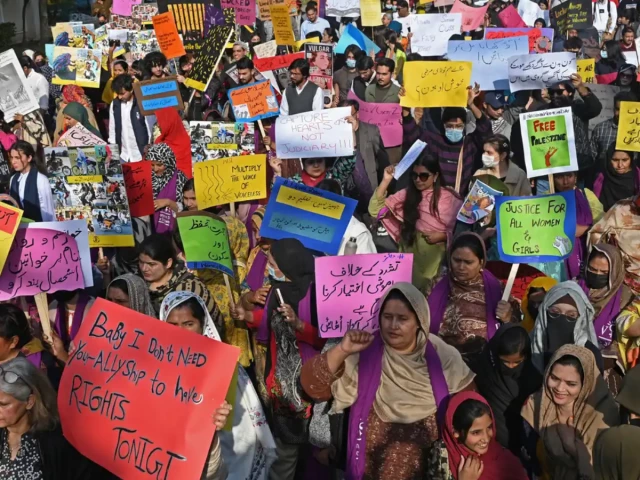
FILE: Activists from the “Aurat March” group take part in a rally to mark National Women’s Day in Pakistan, in Lahore on February 12, 2025 PHOTO: AFP
Participants in a march to mark International Women’s Day in the Pakistani capital say they were arrested and mistreated by police, as rights groups warn of a growing crackdown on dissent.
Mavra Bari, a 36-year-old sociologist, said she had planned to join the celebrations in Islamabad on March 8 but instead spent about 12 hours in detention.
“What was supposed to be a celebration turned into a horrible experience,” she said, describing a cramped detention area with poor sanitary conditions and dozens of detainees, including women, men and children. “We were beaten.”
More than 30 people were detained, according to testimonies from those present. A AFP The reporter saw detainees upon their release, some appearing shaken and with visible bruising and swelling.
Outside the police station, a man said his daughter had come only to watch the march. “She didn’t do anything wrong,” he said.
Official position and rights concern
These detentions took place despite public support for women’s empowerment expressed by Prime Minister Shehbaz Sharif, who declared on March 8 that women’s rights were essential to national development.
Human rights organizations, however, say such incidents reflect a broader trend. Amnesty International has warned of a “shrinking space for dissent”, citing arbitrary detentions and restrictions on peaceful assembly.
Authorities often do not clearly explain the reasons for arrests, activists say.
National security concerns cited
Rights advocates say national security laws are increasingly being used to suppress criticism.
Usama Khilji said authorities often view dissent as a security issue. “Anyone can be punished,” he said.
Human Rights Watch has documented cases of intimidation, enforced disappearances, and legal pressure against activists, journalists, and lawyers.
Among the high-profile cases is Imaan Mazari, known for handling sensitive human rights cases, who is currently imprisoned alongside her husband for alleged anti-state activities on social media.
Media under pressure
Press freedom groups say journalists also face growing risks.
The Committee to Protect Journalists reported that at least seven journalists were killed in Pakistan in 2024, while others were harassed or detained.
Sehrish Qureshi said she was arrested when she went to the police station to inquire about her colleagues detained during the march. “I was detained for no reason,” she said.
Read: Government urges public to adopt new austerity measures, cooperate to save energy amid Middle East oil crisis
Reporters Without Borders is also concerned about the growing pressure on independent media and the strengthening of information controls.
Harris Khalique of the Human Rights Commission of Pakistan called the recent restrictions “draconian.”
Activists do not let themselves be discouraged
Police then told the detainees they had violated a law restricting gatherings of more than four people.
Days after the arrests, a large rally marking Al-Quds Day took place in Islamabad without similar intervention, according to activists.
Despite the risks, many participants say they remain committed to speaking out.
“It was scary at first,” Bari said. “We didn’t know why we were arrested or what they were going to do to us. »
Others echoed this sentiment, saying this experience would not deter them from pursuing activism in the future.


