
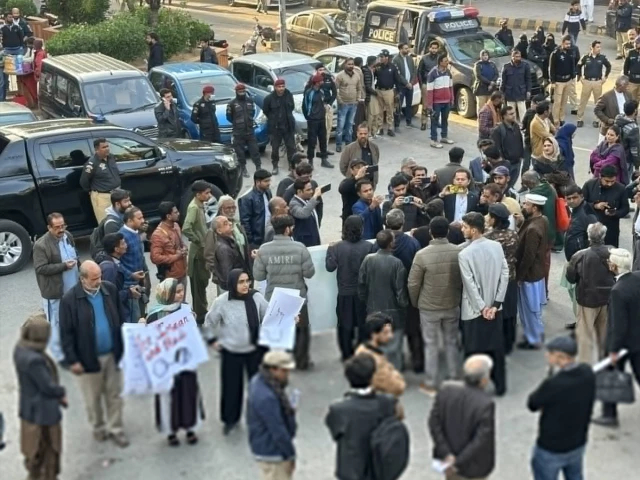
Lawyer Jibran Nasir criticizes Sindh government, says containers were placed to block protests
Police blocked roads outside the KPC to protest the sentencing of Imaan Mazari and Hadi Ali Chattha. Photo: Twitter
All roads leading to the Karachi Press Club (KPC) were blocked on Monday as traffic in the city center came to a standstill following a protest against the conviction of lawyer-activist Imaan Mazari and her husband, lawyer Hadi Ali Chattha, in a case linked to controversial social media posts.
Mazari and Chattha were arrested in Islamabad on Friday while they were reportedly on their way to the district courts. An anti-terrorism court then remanded them for 14 days. The next day, a district court and a magistrate court found the couple guilty in a case related to controversial social media posts and sentenced them to 17 years in prison.
Learn more: Lawyers Imaan and Hadi sent to 14-day remand by Islamabad ATC after arrest
The case focuses on alleged posts and reposts about X, which authorities have described as “anti-state.” The National Cybercrime Investigation Agency registered the case in August last year under the Prevention of Electronic Crimes Act (Peca) 2016, alleging that the content was intended to incite divisions and portray a negative image of state institutions.
The Karachi Traffic Police said in a post on
Human rights activist and lawyer Jibran Nasir accused authorities in a post on X of blocking access to the Karachi Press Club in an attempt to suppress protests against the couple’s convictions.
Nasir said all roads leading to the press club had been closed using containers and parked buses. “The state wants to deny journalists, lawyers and civil society the right to protest and denounce the sham trial and conviction of lawyers Imaan Mazaari and Hadi Ali Chatha,” he said.
All roads leading to Karachi Press Club were blocked by placement of containers and parking of buses. The state wants to deny journalists, lawyers and civil society the right to protest and denounce the sham trial and conviction of lawyers Imaan Mazaari and Hadi Ali Chatha.
Nope…
— Mr. Jibran Nasir 🇵🇸 (@MJibranNasir) January 26, 2026
Nasir further criticized what he described as increasing state repression, saying such measures would not silence dissent. “No number of disappearances, arrests and convictions will rid the state of its fear of the truth,” he added.
He also accused the Sindh government and law enforcement agencies of violating fundamental rights. “The Sindh Police are once again being used and misused as a tool by the government and the PPP establishment to trample on fundamental rights,” Nasir said.
The call to protest comes after lawyers in Islamabad began a three-day strike earlier today following the arrest and conviction of lawyers Imaan Mazari and her husband, Hadi Ali Chattha, with boycotts halting legal proceedings in the capital.
Islamabad High Court Bar Association secretary Manzoor Jajja confirmed that lawyers had been asked not to appear in court. “Today, lawyers staged a strike outside the Islamabad High Court. The lawyers did not appear in court as requested,” he said.
Jajja said lawyers must remain united against what he described as police oppression and announced they would travel in convoy to district courts to formally register their protest. A rally then moved from the deputy commissioner’s office to the nearby office of the chief superintendent of police, where lawyers chanted slogans against the police. The lawyers ended their protest when they arrived at the district court complex.
Read also: Lawyers begin three-day strike following arrest
The Islamabad Bar Association also barred police from entering the court premises. The lawyers expelled the police officers who were stationed in the court canteen. Earlier in the day, a separate protest took place outside the Sessions Judge East court, where additional police officers were deployed to maintain order.
The strike also surfaced during a hearing of a civil case in the Islamabad High Court. Lawyer Qaiser Abbas Gondal, appearing for one of the parties, informed the court that the strike was being observed in response to the detention of lawyers. He added that the bar secretary was also supposed to appear in the matter, but was not present due to the strike.


