
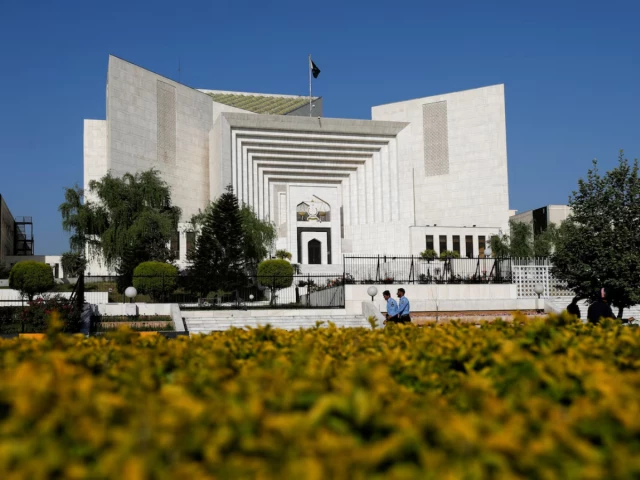
Police officers walk past the Supreme Court of Pakistan building, in Islamabad, Pakistan April 6, 2022. REUTERS
ISLAMABAD:
For the first time in its history, the Supreme Court recorded a marked decrease in its backlog of pending cases – not due to expedited disposition, but due to the transfer of tens of thousands of cases to the newly constituted Federal Constitutional Court (FCC).
The backlog at the SC, which had exceeded 56,000 cases, fell to approximately 33,700 following the transfer of more than 22,900 cases to the FCC after the 27th Amendment took effect.
According to official data, between January and November 2025, a total of 19,370 new cases were introduced to the SC, while 20,665 cases were resolved during the same period. Although transfers slightly exceed new filings, the overall number of pending files stood at 56,608 files as of November 2025.
However, following the constitutional changes, 22,910 cases were transferred from the SC to the FCC, bringing the number of cases pending before the apex court to 33,698.
The data further shows that judicial capacity was expanded in 2024 and 2025 through 31 meetings of the Judicial Commission of Pakistan (JCP), resulting in the appointment of 53 judges across the higher judiciary.
The appointments included eight judges to the SC. Two judges and one chief justice have been at the IHC, three judges and two chief justices at the BHC, ten judges and one chief justice at the PHC, twelve judges and one chief justice at the SHC and thirteen judges at the LHC.
At present, 18 judges, including the Chief Justice of Pakistan, are exercising judicial functions in the SC, against the authorized strength of 34 judges.


