
Islamabad:
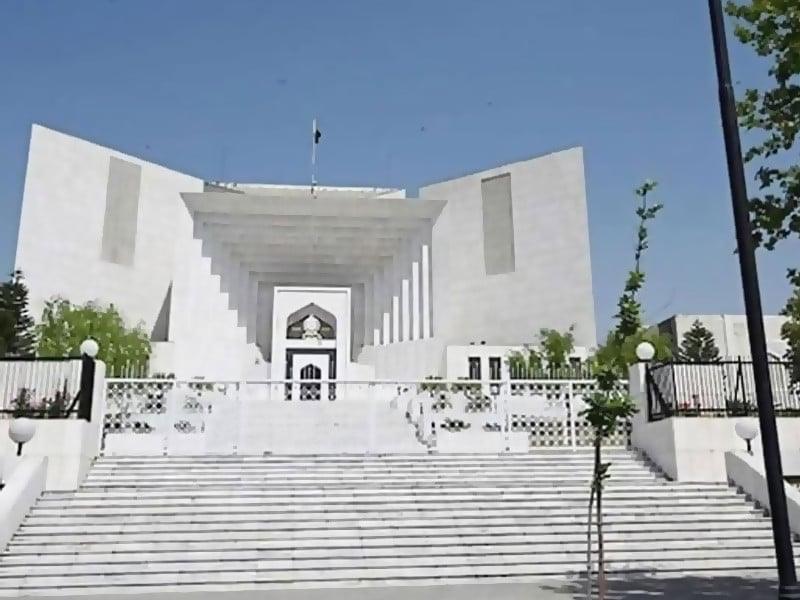
The highest court in the country has gone around in unexplored waters when it started to hear examination examination against its July 12 judgment – a verdict which had given the seats reserved for Pakistan Tehreek -E -insaf (PTI) to the national and provincial legislatures – but without six of the judges of origin, including the author of the judgment.
The hearing inaugurated a new reason in more than one way, marking several first in legal history.
The examination petitions, deposited by the PML-N and the PPP in power alongside the electoral commission of Pakistan (ECP), are heard by a 13 members wider.
Curiously, the majority of the new bench in the Supreme Court was not part of the initial decision, and no explanation was explained to explain why the Court Constitutional Committee did not recommend including the six judges of the previous decision.
For the first time since the 26th constitutional amendment was adopted, the procedure of the Supreme Court was disseminated live, a decision welcomed as a step towards transparency, although the absence of key judges has thrown a shadow.
Despite the high issues, no judge has proposed observations in favor of the majority judgment in progress. Even judge Muhammad Ali Mazhar and judge Hasan Azhar Rizvi – the two signatories of the initial decision – remained unusually tight, adopting a marked reservoir.
On the other hand, two judges who had not been part of the original bench raised a fundamental question: if the PTI was not part in the initial case, how could it receive relief?
They wondered how the reserved seats had been given to PTI when they were not a part, neither before the ECP nor the High Court of Peshawar (PHC).
Judge Amicin Khan observed that it was a fact admitted that all the return candidates supported by PTI had joined the Sunni council, who had not challenged the general elections.
He supported more, asking if a return candidate supported by PTI had approached a forum to declare himself as a PTI candidate.
“Should SC be looked at?”
The elephant of the courtroom, however, remained the role of the ECP during controversial surveys of February 2024, most of the judges bypassing the discussion on this subject. Although the majority judgment has held the accounting of the ECP, only judge Jamal Khan Mandokhail underlined the failures of the electoral organization.
Judge Mandokhail – Part of the minority who thought that PTI was entitled to reserved seats – said that the presidents and return officers had not fulfilled their functions in accordance with the law and the constitution during the general elections of February 2024.
He challenged the opposing council, Makhdeom Ali Khan, asking: “Should the Supreme Court are looking at?”
Commenting on the question, lawyer Abdul Moiz Jaferii pointed out what he considered a blatant lance in reasonable judicial diligence.
“What I found the most astonishing was how some of the judges who were not part of the initial procedure clearly had not read the review. You are seated to determine a floating error on the back of the file.”
“You do it extraordinarily without the author’s judge and many other judges being aged to you who were part of the initial procedure. You can surely read the judgment for yourself and not count on the lawyer’s arguments to update the most basic principles of the case for you,” he added.
Observers have also noted that the government team appeared in the precipitation to attach the loose ends. The advice of PML-N, PPP and ECP are all online behind the arguments presented by Makhdomo Ali Khan, despite the criticism of the original verdict of the ECP conduct.
The initiates suggest that the next hajj of judge Aminuddin Khan could cause this emergency. There are speculations according to which the management coalition is eager to see the case set before its departure.
On the other side of the aisle, PTI and its Sunni Council Allied Ittehad (SIC) initiated four superior councils to defend the majority decision. The Siddiqi Faisal of SIC should present its arguments today (Tuesday).
Legal circles believe that the current impasse stems from the erroneous reading by the CEC of the Verdict of the Supreme Court of January 13, which declared illegal the intra-party polls of PTI.
In addition, the court under the former chief Qazi Faez Isa was also criticized for dragging his feet on the PTI revision petition – a delay which, according to many, left the troubled political domain in uncertainty.
Even the majority judgment had reported constitutional tensions at the heart of the question.
The majority verdict asked how the question of intra -party elections – a question of internal governance of a party – could prevail over the fundamental rights of citizens to vote and political parties to participate effectively in the elections and challenge the elections by obtaining a common symbol for their candidates, guaranteed by articles 17 (2) and 19 of the Constitution.


