
If the employee was in paid employment after his or her dismissal, he or she is not entitled to reimbursement of benefits for that period.
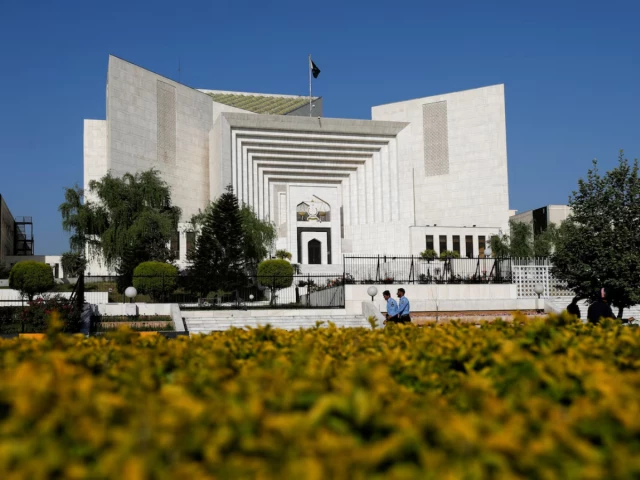
Police officers walk past the Supreme Court of Pakistan building, in Islamabad, Pakistan April 6, 2022. REUTERS
ISLAMABAD:
The Supreme Court has ruled that the granting of full salary arrears to employees reinstated in the civil service structure, as well as under labor law, is limited to those who remained unemployed during the period of dismissal or dismissal.
The court further held that a petitioner must clearly state in his or her petition or appeal that he or she remained unemployed and did not engage in any gainful employment with any other employer during the relevant period.
According to the facts of the case, an investigation was conducted against the petitioner over allegations of leaking of question papers for the NUST-2011 entrance test.
He was found guilty of misconduct and was subsequently removed from the post of Deputy Controller of Examinations with effect from March 30, 2012.
The applicant filed an appeal before the Federal Service Tribunal, which was dismissed for lack of jurisdiction.
He then filed a petition before the Islamabad High Court (IHC), which was decided based on the respondent’s statement that the petitioner’s case would be considered on merits and humanitarian grounds.
Therefore, the IHC ordered the respondent to decide the petitioner’s appeal sympathetically and in accordance with law.
Pursuant to these directions, the petitioner’s pending appeal was allowed by the Department and he was reinstated as Deputy Director (BPS-17) with effect from March 30, 2012. He was also paid his full salary and allowances for the period from March 30, 2012 to December 20, 2012.
However, the respondent university did not award the full salary and allowances for the subsequent period as the petitioner had been gainfully employed at the University of Engineering and Technology (UET), Taxila, from December 21, 2012 to September 5, 2016.
This period was considered extraordinary leave without pay.
Justice Muhammad Ali Mazhar, in the written judgment, observed that the record clearly showed that the petitioner was gainfully employed in UET Taxila as Deputy Director (QEC) after his dismissal.
The judgment notes that the concept of restitution of benefits in public service and labor law aims to compensate an employee who remains unemployed during the period of dismissal or redundancy.
She further reiterated the well-established legal principle: if a legal proceeding establishes that the employee was engaged in gainful activity after his or her dismissal or redundancy, he or she is not entitled to claim benefits for that period.
The court also emphasized that in proceedings challenging a dismissal or dismissal, the petitioner must explicitly state in his pleadings that he remained unemployed and did not engage in gainful employment elsewhere.
Referring to the case of Abdul Hafeez Abbasi, the court observed that to be entitled to return benefits, an employee must demonstrate before the competent court that he has not earned any income from employment, business or any profit-making activity during the pendency of the appeal.


