
.
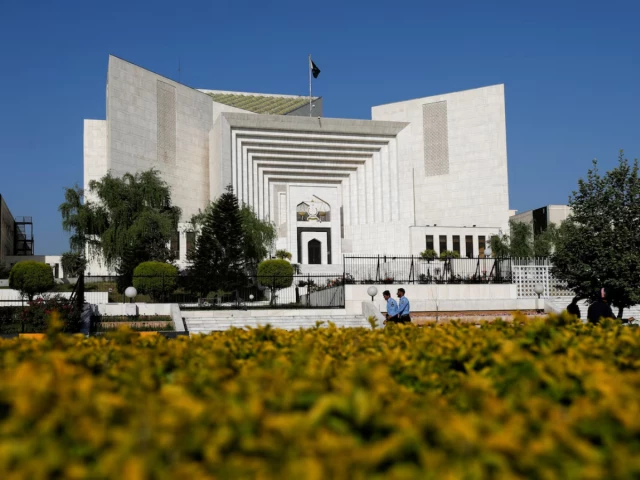
Police officers walk past the Supreme Court of Pakistan building, in Islamabad, Pakistan April 6, 2022. REUTERS
ISLAMABAD:
The Supreme Court on Wednesday rejected a request by PTI founder Imran Khan’s lawyer to arrange a meeting with his client during proceedings in the Toshakhana case. The court also issued a notice to the Election Commission of Pakistan (ECP) in the matter.
A three-member bench, headed by Justice Hashim Khan Kakar and comprising Justice Salahuddin Panhwar and Justice Ishtiaq Ibrahim, heard several petitions related to Imran, including applications for cancellation of bail in the encryption case, the Toshakhana case and the defamation case.
When Imran’s lawyer Latif Khosa asked the court to facilitate a meeting between him and Imran Khan, Justice Kakar firmly refused, saying politicians had already taken away suo motu power from judges.
“How can we order a meeting in a criminal case? Political matters should be brought before Parliament and not in court,” he said. Justice Panhwar also asked how the court could pass orders on a matter which had not even been disposed of before it.
The hearing witnessed an entertaining and somewhat unusual exchange when Khosa, while asserting that Imran’s three-year sentence in the Toshakhana-I case had been suspended but not the judgment itself, inadvertently cited an SC ruling that contradicted his own position.
Khosa argued that even though the two members of the Islamabad High Court (IHC) had suspended the sentence, the judgment itself had not been suspended – and this distinction prevented the PTI founder from contesting the elections despite the suspension.
Judge Kakar questioned this reasoning: “If a sentence is suspended on appeal, there should be no obstacles, including running for office. When a sentence is suspended, the person is free. Please read the relevant order of the High Court. »
When Khosa read aloud the relevant paragraph of the IHC order, Justice Kakar pointed out that he had only requested suspension of the sentence from the IHC and the court had granted exactly what he had requested.
When Khosa cited a 2019 SC judgment in support of his argument, Justice Kakar asked him to read paragraph 13 of the same judgment. It then became clear that in this case the sentence and judgment had been suspended simultaneously – the opposite of what Khosa claimed. The courtroom erupted in laughter.


