
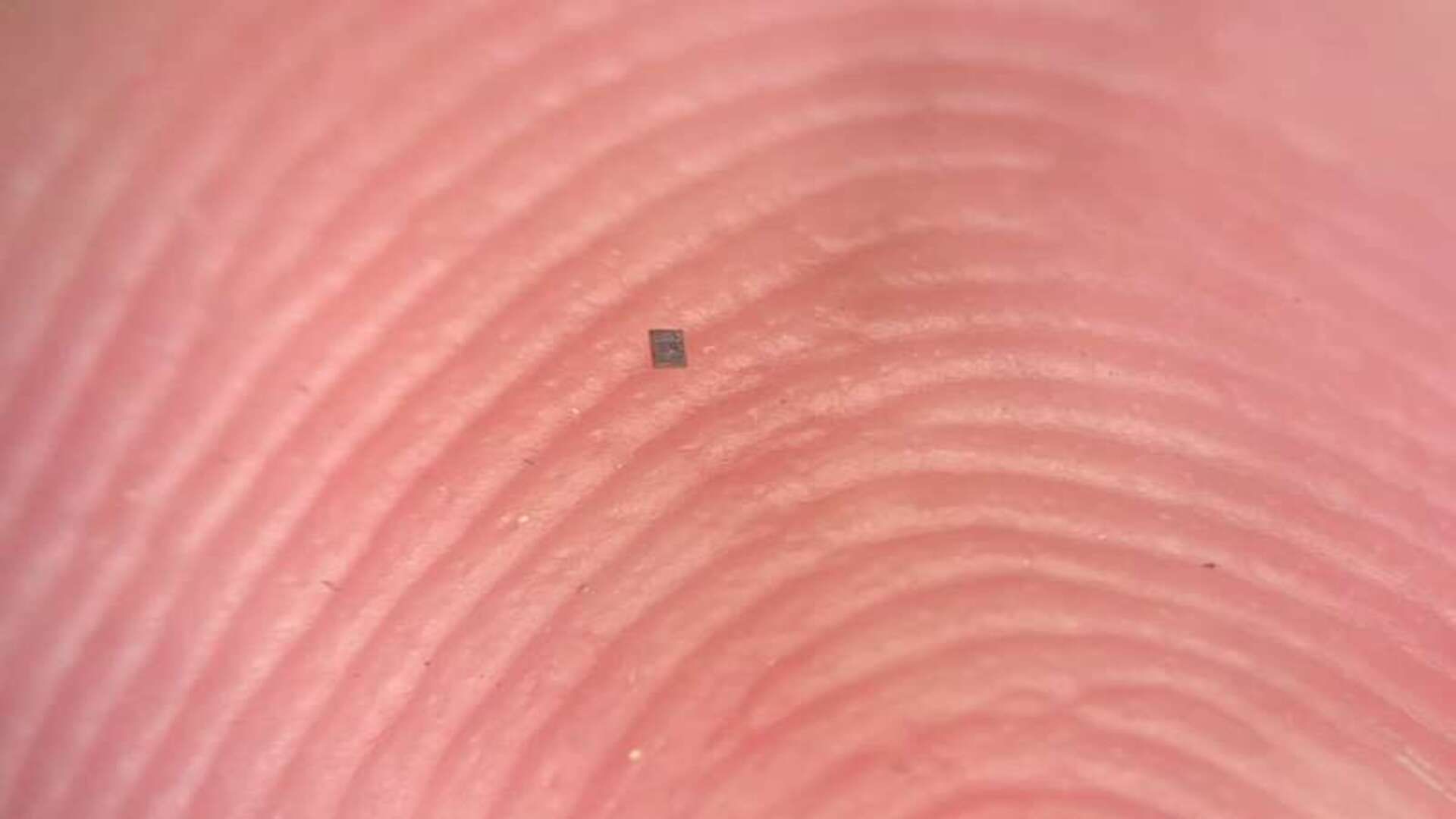
- Researchers have created fully autonomous robots, smaller than a grain of salt
- Robots swim using electric fields to manipulate ions in the surrounding fluid
- The propulsion system allows for coordinated movements and accelerates up to one body length per second
Researchers at the University of Pennsylvania and the University of Michigan claim to have created the world’s smallest fully programmable autonomous robots.
Each robot measures approximately 200 x 300 x 50 micrometers, smaller than a grain of salt, and operates on the scale of biological microorganisms.
The robots operate without tethers, magnetic fields or external joysticks, making them the first truly autonomous devices of this size.
Swimming through microscopic physics
The team faced challenges in creating propulsion systems suitable for such small robots: at this scale, forces such as drag and viscosity dominate, making conventional limb or body flexions ineffective.
Instead, the robots use electric fields to manipulate ions present in the surrounding fluid. These ions, in turn, push the water molecules, creating movement.
This approach allows robots to swim in complex patterns and even coordinate in groups, reaching speeds of up to one body length per second.
Because the field-generating electrodes have no moving parts, the robots are extremely durable and can be repeatedly transferred between samples without damage.
Integrating a computer, memory, sensors and tiny solar panels into a submillimeter chip presented another challenge.
Solar panels take up most of the robot’s surface area, producing just 75 nanowatts of power, more than 100,000 times less than a smart watch.
To operate under such severe energy constraints, the Michigan team condensed the program’s instructions into highly efficient circuits, reducing power consumption by more than a thousand times.
This allows each robot to store a program, sense its environment and adjust its movements autonomously for months.
The robots are equipped with electronic sensors capable of measuring temperature to the nearest third of a degree Celsius.
They can move to warmer areas or report measurements, with data encoded in the “movements” of a little dance.
Researchers observe these movements under a microscope and decode the signals, in the same way that bees communicate.
Each robot can be programmed with light pulses, enabling unique instructions for individual robots and enabling coordinated, multi-robot tasks.
This submillimeter robotics platform provides the basis for future advancements: its propulsion, electronics, and energy systems can be scaled to include more complex programs, additional sensors, faster movement, and operation in more challenging environments.
This achievement shows that it is now possible to integrate calculation, detection and actuation at microscopic scales.
This could also have implications in medicine, allowing individual cells to be monitored, and for manufacturing micro-scale devices.
Via Techxplore
Follow TechRadar on Google News And add us as your favorite source to get our news, reviews and expert opinions in your feeds. Make sure to click the Follow button!
And of course you can too follow TechRadar on TikTok for news, reviews, unboxings in video form and receive regular updates from us on WhatsApp Also.


