
- Seagate NVME HDDS can unify storage protocols, but do not expect speed records
- Company systems could like NVME hard drives, but players and creators will not benefit anytime soon
- NVME provides coherence of storage, but SAS holds its field in terms of raw performance
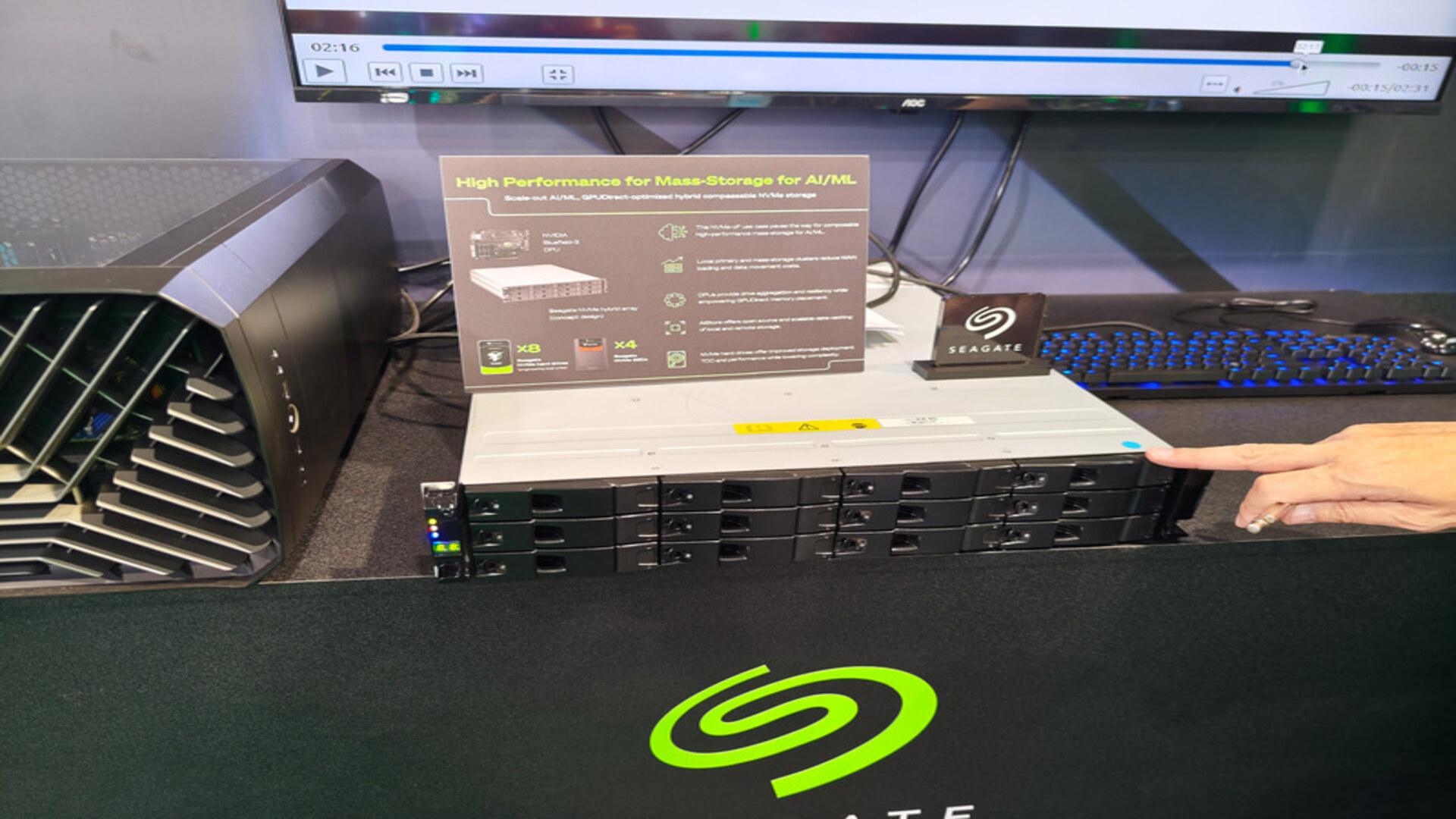
Seagate Technology has demonstrated a hard drive prototype with Computex 2025 which uses NVME, a storage protocol generally found in the SSDs.
According to PcwatchThe demonstration included a combination of SSDs and NVME hard drives using NVME-OF (NVME on the fabrics) to communicate on Ethernet.
Although the hybrid interface has a potential for data centers, it is not clear if this change will be possible for personal computers.
NVME integration marks a change in storage interfaces, not performance
Colin Pressley, responsible for the success of the Seagate client, noted: “We have already natively integrated PCIe into our hard drive controllers”, pointing out a major architectural change.
The prototype reader supports NVME and SAS connections, offering flexibility during what could be a long transition.
However, Pressley was quick to manage expectations: “There is almost no advantage in terms of performance. The latest SAS offers sufficient performance, and it is not because it becomes NVME that there is a major improvement. ”
For consumers looking for the best hard drive, or even the fastest external hard drive, NVME support offers few immediate advantages.
The real promise does not reside in speed, but in unification. With SSDS already being executed on NVME, the creation of hard drives under the same protocol simplifies the requirements of the pilot and software architecture.
Above all, the NVME compatible hard drive is not based on a proprietary standard. Instead, it follows a formalized version of the NVME specification, which now includes controls suitable for mechanical discs, such as spin-up protocols.
This membership of open standards increases the larger adoption probability of industry, in particular in corporate environments where consistency is crucial.
However, it is unlikely that the NVME hard drives become available to the general public as soon as it is. According to Pressley and Seagate, he can take five to ten years for hard drives to go fully from SATA / SAS to NVME.
This chronology reflects the previous transitions, such as the passage from the IDE to Sata, where new standards have gradually replaced the inherited interfaces.
Although this progression seems inevitable for data centers, office computers and consumer laptops are another story.
Today, most consumption systems are still counting on SATA for bulk storage, often combining the largest hard drive available with a faster SSD for start -up and application performance.
Until the motherboard chipsets completely eliminate the SATA support, a quarter of work is not expected for at least another decade, it is unlikely that NVME hard drives become common in domestic PCs.


