
Rana Sanaullah claims criminal negligence if Imran’s medical treatment was deliberately withheld
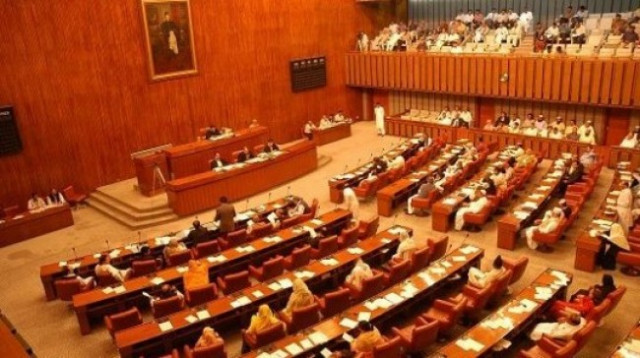
The Senate witnessed an uproar on Friday after the government blocked a resolution seeking a discussion on the health of incarcerated Pakistan Tehreek-e-Insaf (PTI) founder Imran Khan, prompting opposition lawmakers to protest and accuse authorities of negligence.
PTI lawyer Salman Safdar on Thursday submitted a Supreme Court-mandated report after meeting the former prime minister in Adiala jail earlier this week. Imran informed Safdar that his right eye was now functioning at only 15 per cent capacity after undergoing a medical procedure at the Pakistan Institute of Medical Sciences (PIMS) last month.
Accordingly, the two-member bench, comprising Chief Justice of Pakistan Yahya Afridi and Justice Shahid Bilal Hasan, ordered that Imran be given access to his personal doctors in Adiala jail and be allowed to have telephone contact with his sons. The revelations about Imran’s eye sparked an outcry from the ranks of the opposition and other politicians.
The issue of Imran’s eye health and vision was also discussed in today’s Senate session with Prime Minister’s Advisor on Political Affairs Rana Sanaullah, who said that any deliberate denial of medical care to Imran would amount to criminal negligence and would be indefensible.
“If someone failed to provide treatment, such conduct would be unacceptable,” he said, adding, however, that projecting the problem for political purposes would also be wrong if the facts suggested otherwise.
He said the opposition was seeking to highlight Imran’s health problems, but claimed the issue had already been clarified in the Supreme Court.
The work began in the absence of the president, the vice-president and the members of the college of presidents. The House approved a motion to appoint Senator Shahadat Awan as speaker, who then opened the session.
Read: Row over Imran’s health sparks PTI-govt showdown in Senate
The controversy erupted when PTI senator Aon Abbas Buppi moved a resolution calling for a debate on Imran’s health. The government opposed the motion, with Sanaullah questioning the need for a formal resolution if discussion was already allowed.
The resolution was rejected by a majority, triggering protests by PTI senators, who gathered in front of the President’s dais and chanted slogans.
Lawmakers from the Pakistan People’s Party (PPP) said there was no objection to the medical treatment of prisoners, with Senator Sherry Rehman saying access to healthcare should not be politicized.
Providing a timeline of medical care, Sanaullah said Imran first complained of eye pain in the first week of January. “Following the complaint, the prison doctor gave him eye drops which he used for three to four days,” he said.
He added that Imran was examined on January 16, while a medical board examined his condition and conducted tests on January 19. “An injection was administered on January 24,” he said, noting that these details were part of official medical records.
Sanaullah rejected claims that Imran had been suffering from the problem for several months, saying the PTI founder was regularly examined. He said Imran was examined by prison doctors every two days and by external doctors 25 times. According to him, Imran did not raise any complaints about his eye during previous examinations, including that of a medical board in December.
“These details are available in official documents,” Sanaullah said, adding that he was ready to share the medical file with the opposition if necessary.
He further said that no application had been filed in the Supreme Court seeking admission of the PTI founder in any private hospital, but assured that the government would comply with all directions issued by the apex court and facilitate the examination by doctors of Imran’s choice.
Opposition MPs, however, rejected the government’s explanation, alleging negligence and demanding transparency over the former prime minister’s treatment.
Opposition leader Allama Raja Nasir Abbas rejected the government’s version, saying the eyesight did not deteriorate suddenly and alleging negligence in handling the matter.
He questioned why Imran’s family and legal team had not been informed and proposed a joint visit by government and opposition members to assess the situation.
Jamiat Ulema-e-Islam Fazl Senator Kamran Murtaza urged the government to adopt a humanitarian approach, stressing that potential and permanent loss of eyesight could be a legal ground for release on bail.
He suggested that a government member and an opposition member should visit Imran to report to the House. Referring to late Kulsoom Nawaz, he said past political rivalries should not dictate current conduct.
Murtaza also noted that legal avenues such as parole, bail or house arrest were available.


