
Prime Minister Muhammad Shehbaz Sharif condemned the unilateral suspension of India from the Indus Water Treaty on Thursday (IWT), calling it “blatant violation” and an act of “water aggression” which will receive a resolute response.
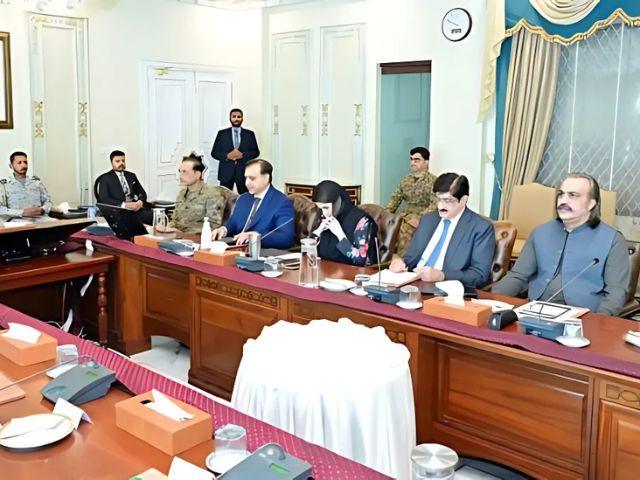
Chairing a high -level meeting on water safety, Sharif warned that any threat to Pakistan water rights would be respected under the national security decisions taken on April 24.
He compared the dispute on water to a battle for justice and swore unity in the face of increasing regional tensions.
The high-level meeting brought together the Deputy Prime Minister, Ishaq Dar, Marshal Coas, General Syed Asim Munnir, the federal ministers, the chief ministers of the four provinces, the Prime Minister of Azad Jammu and the cashmere, the chief minister of Gilgit-Baltistan and high federal and provincial officials.
“This is a battle of justice, and like each battle that we have fought with unity, we will overcome the aggression of India water with resolution and wisdom,” said the Prime Minister.
He stressed that living nations are faced with front challenges and make strategic and sustainable decisions to protect their future generations.
Addressing a high -level meeting on water safety at the Prime Minister’s house, Shehbaz Sharif said that India’s alleged attempts to arm the water would intensify and stressed that the 1960 treaty, being a binding international agreement, does not allow any signatory to leave unilaterally.
He described the position of India as “politically and legally hollow”.
The meeting was marked by a unified political front, with the four provincial chief ministers, the Prime Minister of Azad Jammu and the Kashmir, and the chief minister of the Gilgit-Baltistan jointly rejecting what they described as Indian threats.
The Prime Minister praised this collective response, describing it to “reflect our collective national resolution to protect the safety of water in Pakistan”.
In response to the situation, the Prime Minister led the training of a high-level committee under the Darrier Minister Ishaq Dar.
Read more: Modi says that Pakistan will not get water from the rivers controlled by India
The organization was responsible for designing funding strategies for new dam projects and includes the representation of all the provinces, the AJK and the federal ministries concerned. The committee was invited to present its conclusions within 72 hours.
“We will prioritize the construction of non -controversial tanks. Wherever there is unanimously, we must act without delay.
These dams are not political – they are a national necessity, “said the Prime Minister. He clearly indicated that any project with an inter-provincial consensus will be accelerated and completed as a priority.
A technical briefing during the session detailed the current capacity for the storage of water from Pakistan and the current projects. The Diamer-Bhasha dam should be completed in 2032, while the Mohmand dam should end by 2027.
Read also: Pakistan warns India: do not have water arms
Pakistan currently has 11 operational dams with a cumulative capacity of 15.318 million acres. As part of the public sector development program, 32 dams are under construction and 79 other projects are underway thanks to annual development plans.
Stressing the challenges of infrastructure, Shehbaz Sharif has drawn attention to the accumulation of sediment in existing dams such as Tarbela and Mangla, which has seriously reduced their effectiveness. He urged leadership to make daring choices, warning that future generations would judge them for inaction.
“We owe our 240 million people to act decisively. It is not a question of politics-it is survival. Future generations must remember this leadership with respect for the choices we make today,” he said.
Read: Pakistan will never accept Indian hegemony, explains Marshal Munnir
The Prime Minister also welcomed the efforts of the Ministries of Finance and Economic Affairs, as well as key officials, to obtain loans from the World Bank and the Asian Development Bank. He said Indian lobbying efforts to derail Pakistan’s financing plans to the BAD had failed.
“India tried to sabotage our projects at the BAD for three days, but failed. Our diplomatic victory testifies to the position of principle of Pakistan and the growing credibility, “he noted.
While the meeting ended, Shehbaz Sharif reiterated confidence in the solidarity of political and military leaders in Pakistan. “Just as our brave armed forces stood firm on the battlefield, we must now unite to obtain each drop of water for our people,” he said.
Among the people present in Reunion were the Dar-Prime Minister Ishaq Dar; The chief of staff of the army, the Marshal General Syed Asim Munnir; Defense Minister Khawaja Muhammad Asif; The Minister of Planning Ahsan Iqbal; The Minister of Law Azam Nazir Tarar; The Minister of Information Attaullah Tarar; The Minister of Power Owais Leghari; The Minister of Water Resources Muneeb Wattoo; and other federal senior officials.
Read: will not allow India to cross the Red Line IWT: PM
The chief ministers Maryam Nawaz (Punjab), Murad Ali Shah (Sindh), Ali Amin Gandapur (Khyber-Pakhtunkhwa) and Sarfraz Bugti (Balutchistan) also participated, with Prime Minister Ajk Anwarul Haq and the chief minister of GB Gulbar Khan.


