
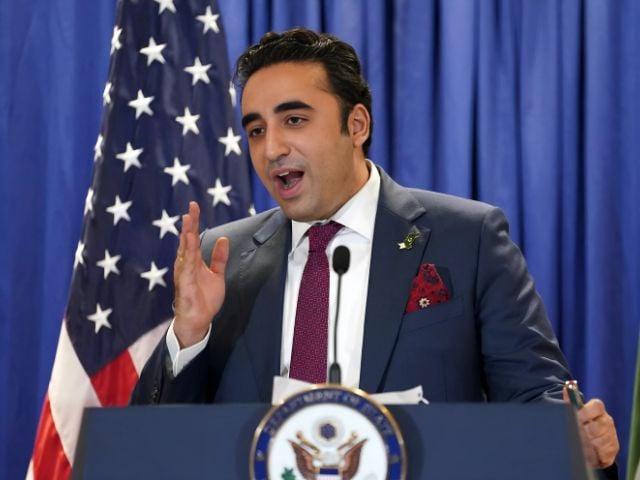
A high -level parliamentary delegation of Pakistan, led by Mr. Bilawal Bhutto Zardari, president of the Pakistani peoples party (PPP) and former Foreign Affairs Minister of Pakistan, today held a series of important meetings with members of the US Congress on Capitol Hill.
The delegation’s visit underlines Pakistan’s commitment to peace, dialogue and partnerships based on justice, in particular in the context of recent escalations in South Asia.
The delegation includes several eminent members of the Pakistani Parliament and former senior officials such as Mr. Musadik Masood Malik, Minister of Climate Change and Environmental Coordination; Senator Sherry Rehman (PPP), president of the climate change committee, former Minister of Climate Change and former ambassador to the United States; Senator Bushra Anjum Butt (PML-N); Ms. Hina Rabbani Khar (MNA, PPP), president of the Standing Committee of the National Assembly on Foreign Affairs and former Minister of Foreign Affairs; Senator Faisal Sabzwari (MQM); Engineer Khurram Dastagir Khan, former Minister of Foreign Affairs and Defense; Ambassador (R) Jalil Abbas Jilani, former Minister / Secretary of Foreign Affairs; And Ms. Tehmina Janjua, former Minister of Foreign Affairs.
The delegation has engaged with a bipartite group of American legislators, including a key meeting with the Caucus of Pakistan of Congress, co -chaired by the representative Jack Bergman and the representative Tom Suozzi.
During these discussions, Mr. Bilawal Bhutto Zardari informed the members of “recent acts of uninsured aggression of India, including the targeting of civilians and the deeply worrying unilateral suspension of the industrial waters, a clear violation of international law”.
He expressed his appreciation in the United States, in particular “President Donald Trump, for his constructive role to help defuse tensions and support efforts to a cease-fire”.
The former Minister of Foreign Affairs stressed that “sustainable peace in South Asia depends on the dialogue, the restraint and a fair resolution of the dispute from Jammu-et-Cachemire, rather than unilateralism or intimidation”.
During distinct meetings with other influential members of the congress, the delegation also met with Senator Elissa Slotkin (D-Mi), the deputy Sydney Kamlager-Dove (D-CA), a member of the South Foreign Affairs in South Asia and Central Asia; The member of the Congress Tom Kean Jr. (R-NJ), member of HFAC; The member of the Congress John Moolenaar (R-Mich), member of the Credit Committee of the Chamber; Senator Jim Banks (R-Ind), member of the Armed Services Committee; Senator Van Hollen (D-MD); and Senator Cory Booker (D-NJ).
Throughout these commitments, the Pakistani delegation reiterated the position of Pakistan’s principles on regional peace, efforts to combat terrorism and recent Indian aggression.
They reaffirmed “Pakistan’s commitment to peace, responsible conduct and the rejection of baseless allegations”.
The delegation underlined “the urgency of dialogue on Jammu-et-Cachemire, an unfinished United Nations program”, and underlined the “compliance with international law, the resolutions of the CNSC and the industrial water treaty, a rescue buoy for 240 million Pakistanis, now threatened by the dangerous preceding of water”.
Tensions between India and Pakistan, two nuclear weapons neighbors, increased significantly after the fatal attack on April 22 in the Pahalgam region, Jammu and Kashmir occupied illegally. India quickly blamed Pakistan activists for the attack, without providing proof to support its allegations. Pakistan strongly denied any involvement in the attack and called for an independent probe.
India has increased the situation taking into account a series of hostile measures, in particular the closure of the key border crossing, the revocation of all Pakistani visas and taking the unprecedented measure to suspend the 1960s water Treaty – an agreement that governs water sharing between the two countries. The Pakistan Ministry of Foreign Affairs condemned the suspension, calling it as a “war of war”. In retaliation, Islamabad sealed its side of the border.
The situation deteriorated in early May, when India launched an attack on the Pakistani cities on May 6 to 7. Pakistan, in response, launched Operation Bunyan-Un-Marsoos to counter the Indian threat. The military conflict seemed to reach a boiling point until the American president Donald Trump negotiates an “immediate and complete ceasefire”.
Although violence has decreased since the announcement of the ceasefire, the actions of India, in particular with regard to Pakistan water rights, remain a discord and continue to fuel hostility between the two nations.
President Bhutto highlighted the importance of trade between countries, calling it “a bridge for a constructive commitment and the improvement of our people”.
The members of the Congress welcomed the Pakistani delegation, urging the two countries to demonstrate restraint and prioritize regional peace and stability.
They reiterated American support to the inhabitants of Pakistan and its commitment to help the economic development of the country.


