
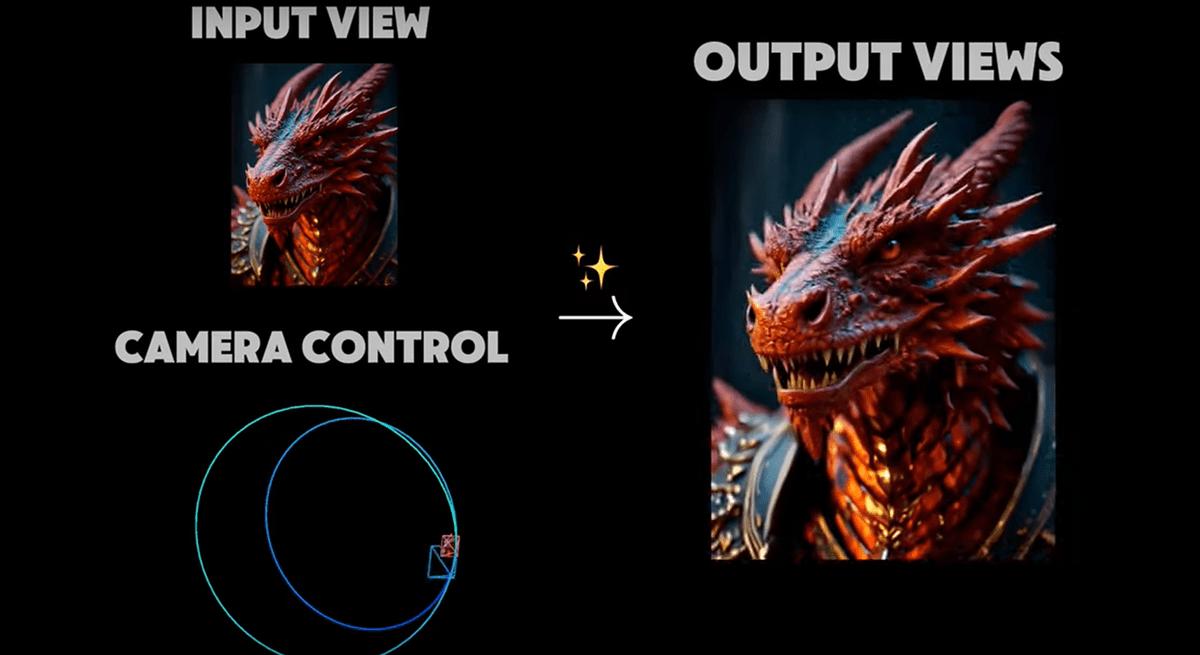
The AI stability videos have infused text and images with movement and life for a few years, but now literally add a new dimension by transforming two -dimensional images into three -dimensional videos.
The new stable virtual camera tool is designed to process even a single image in a multi-personal movement video, which means that you can shoot around and visualize the film from any angle.
It is not entirely a new concept, because virtual cameras have long been a must for cinema and animation, allowing creators to navigate and manipulate digital scenes. But stability AI took this concept and thrown into a high dose of generative AI. The result means that instead of requiring detailed 3D scene reconstructions or meticulously calibrated camera settings, a stable virtual camera allows users to generate a fluid and precise 3D movement of a single image, all with a minimum effort.
What makes it different from other video tools generated by AI is that it does not guess simply through animation and is based on huge data sets or frame reconstructions by frame. The stable virtual camera uses a multi-visual diffusion process to generate new angles based on the image provided so that the result looks like a model that could really exist in the real world.
To watch
The tool allows users to control the trajectories of the camera with cinematographic precision, by choosing from movements such as zoom, rotary orbit or even a spiral. The resulting video can be in vertical form for mobile devices or the wide screen if you have a cinema. The virtual camera can work with a single image but will manage up to 32.
AI stability has made the model available under a non -commercial license for research purposes. This means that you can play with it if you have a technical capacity by entering the Github code. Going to the open source because stability AI generally means that the AI developer community can refine and extend the capacities of the virtual camera without the company needing to pay.
3D AI
Of course, no AI model is perfect, and the stability AI is frank on the folds which are always developed. If you hoped to generate realistic people, particularly chaotic animals or textures (such as water), you could end up with something that belongs to a low -budget horror film.
Do not be surprised if you see videos with it with prospects that are awkwardly traveling through objects or have changes in perspective leading to flickering ghostly artifacts. Whether it is a widely adopted tool or another AI gadget ignored by dedicated filmmakers remains to be seen.
Not to mention the competition he faces among the Ai Openai video tools, the dream machine of Sora, Pika, Runway, Pollo and Luma Labs. The stable virtual camera will have to show that it works well in the real world of cinema to go beyond another funny demonstration video.


