
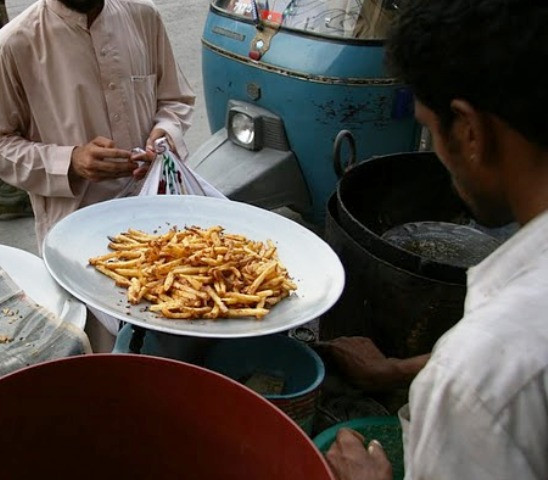
Lax inspections and unsanitary environment at popular food hubs have led to an increase in foodborne illnesses
KARACHI:
As thousands flock to Karachi’s bustling food streets, many find themselves in overcrowded emergency wards, as doctors increasingly link rising cases of diarrhea, gastroenteritis and food poisoning to the mouth-watering and deadly street foods.
Food is the identity of a city, and few cities in Pakistan are as famous for their street food as Karachi. From samosas, chaat and pani puri to bun kebab, falooda, khow suey and layered biryanis, the city’s culinary culture revolves around affordable roadside stalls that attract hundreds of customers daily. Yet behind the aromas and flavors lies the bitter reality, a growing public health crisis that authorities remain unaddressed.
Across Karachi, unregulated and poorly monitored food streets have sprung up along potholed roads and open sewers. In areas like Lyari,
Lee Market and Ranchhor Line, stalls selling ready-to-eat foods, sat next to overflowing gutters carrying untreated sewage. Similar conditions are visible in some of the city’s most popular foodie destinations, including Burns Road, Boat Basin, Tariq Road and MA Jinnah Road.
Although these places are often presented as organized food hubs, large sections continue to operate in an unsanitary environment. In several places where street food stalls are located, stagnant sewage accumulates near the cooking areas, producing a strong foul odor. Despite these conditions, many outlets prominently display valid licenses from the Sindh Food Authority, highlighting the disconnect between regulatory approval and actual food safety.
Under the Sindh Food Authority Act, 2016, all food business operators are legally required to obtain a license before selling food to the public, ensuring minimum hygiene standards, safe food handling practices and routine inspections. However, the presence of a permit displayed on a stand or restaurant has done little to improve conditions on the ground.
According to this law, food business operators are required to obtain separate licenses for each outlet, even if they operate under the same brand. Each license is valid for one year and must be renewed each year for a fixed fee. Although official fees are relatively low, the licensing process often involves additional informal costs. Several operators say failure to make these additional payments results in repeated objections or threats of closure.
As a result, licenses are often issued without thorough inspections and, in some cases, without inspectors visiting the premises. Even in areas marketed as organized food streets, food is often prepared and served in the open, without protection from dust, vehicle emissions, or insects. Broken sidewalks and overflowing trash cans create an environment where contamination becomes inevitable.
In the absence of effective enforcement, it is clear that licensing has little relevance to the hygienic aspect of street food. This is strongly linked to foodborne illnesses. Former Pakistan Medical Association general secretary Dr Qaiser Sajjad has warned that food streets established along open drains pose a serious danger to public health.
“The stench that escapes from these pipes carries harmful bacteria and particles that settle on exposed food and enter the human body through ingestion and inhalation.
Dust from broken, unpaved roads further contaminates food, while vehicle emissions add another layer of exposure. Pathogens commonly found in such environments include Escherichia coli, Salmonella and Shigella, which can cause diarrhea, gastroenteritis, dysentery and food poisoning,” said Dr Sajjad.
“Contaminated water is frequently used to wash utensils, plates and spoons at roadside stalls, thereby increasing the risk of disease transmission,” added Dr Sajjad, who further revealed that high levels of air pollution in Karachi, combined with dust deposited on food, also contributed to respiratory problems such as asthma, bronchitis and allergies. “In this scenario, increased antibiotic prescribing also raises concerns about antibiotic resistance, which is a secondary public health challenge,” Dr. Sajjad noted.
Hospitals have reported a steady influx of patients, especially during the warmer months, when food spoils more quickly and bacteria multiply more quickly. The situation has placed additional pressure on already overburdened public health facilities. Dr Khalid Bukhari, medical director of Karachi Civil Hospital, pointed out that cases of diarrhea increased between May and October and continued to increase every year.
“Substandard foods sold on streets where food is unsafe cause an increase in diarrhea. Stomach diseases among children are largely caused by colorful syrups and drinks sold at roadside stalls in summer, while adults mainly fall ill from unhealthy foods,” said Dr Bukhari, who appealed to parents and the general public to prevent children from eating and drinking on streets where food is unsafe. unsanitary.
It is hospital emergency departments that absorb this daily burden. For example, at the Civil Hospital in Karachi, 22-25 patients suffering from diarrhea are brought to the ward every day. This translates to more than 750 cases per month and more than 9,000 per year. From January to December 2025 alone, the hospital recorded 6,527 cases of diarrhea and gastroenteritis among children.
According to the records of Sindh’s Liaquatabad Government Hospital, 50-60 patients suffering from diarrhea and gastroenteritis arrive daily, especially from areas such as Nazimabad, Golimar and other parts of the central district. This represents more than 1,800 cases per month and more than 21,000 per year.
Speaking to the Express PK Press Club, Dr Atiq Qureshi, medical director of the hospital, said, “The increase in cases is directly linked to contaminated water consumed in hotels and unsafe food sold on streets where unsafe food is found. »Similarly, at Sindh’s Saudabad Malir Government Hospital, 60-70 diarrhea patients are reported every day.
Dr. Agha Amir, medical director of the hospital, confirmed that the number of such patients almost doubled during the busiest summer months of April, May and June. “Diarrhea patients are treated with infusion and ORS,” mentioned Dr. Amir, emphasizing that dehydration remained a major complication in such cases.
Data from Jinnah Postgraduate Medical Center revealed that 80 to 90 patients suffering from gastrointestinal disorders were treated daily. Even though the numbers declined during the colder months, doctors maintained that contaminated food and water remained contributors throughout the year. The new hospital in Karachi receives 20-28 such patients every day, while Lyari Hospital reports 30-32 cases of diarrhea and gastroenteritis daily. In all hospitals, school children are identified as particularly vulnerable, according to The Express PK Press Club investigation.
A 2023 study on foodborne illness risk provides scientific evidence of how unsanitary environments and practices lead to harmful illnesses. The research was conducted by the Institute of Environmental Sciences at the University of Karachi, in collaboration with the School of Public Health at Dow University of Health Sciences, and examined the microbiological quality of street foods sold near major public hospitals.
Food samples were collected from vending stalls within 0.5 kilometer radius of the facilities including Jinnah Hospital, Civil Hospital and Landhi Korangi Hospital. The study focused on commonly consumed street foods such as kebab bun, chaat, samosa, chicken rolls and pakoray. Laboratory analysis revealed widespread bacterial contamination.
Gram-positive and Gram-negative bacteria were isolated, including E. coli, Enterobacter, Pseudomonas, Salmonella, Bacillus subtilis, Staphylococcus aureus, and Enterococcus faecalis. E.coli was the most common organism and was detected even in fried foods, indicating contamination after cooking.
The study found that water quality played a significant role in this contamination. Street vendors rely on water to wash their hands, clean utensils and prepare chutneys and sauces. Due to limited access to tap water, many vendors reuse water throughout the day, thereby redistributing microorganisms into food products. Poor handling practices further increase the risk.
The study also found that most vendors lacked basic training in food hygiene. Aprons, gloves and caps were rarely used and food was handled with bare hands. Items were often served in polythene bags, old newspaper or reused paper. Inadequate waste disposal was widespread, with food waste discarded near stalls, attracting flies identified as carrying disease-causing microorganisms. Despite licensing requirements, enforcement of hygiene standards remained weak. With infrequent food inspections and inconsistent monitoring, consumers bear the consequences on their health. The Express PK Press Club attempted to contact Sindh Food Authority Director General Shahzad Fazal Abbasi regarding the number of licenses issued in Karachi and the inspection mechanism, but received no response despite multiple call-backs.


