
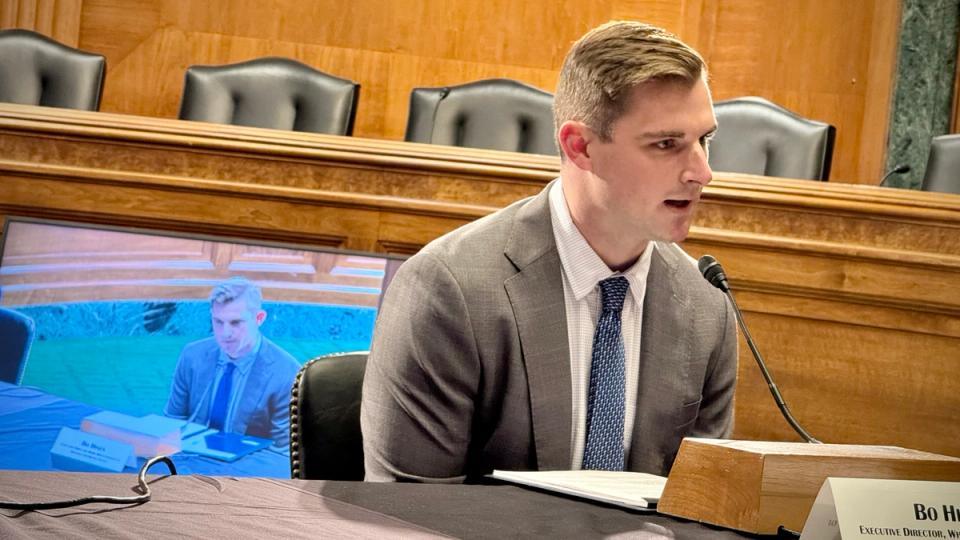
The crypto industry’s new political action committee, Fellowship, disclosed its first contribution ahead of the 2026 congressional midterm elections, and the $300,000 spent went to a company co-founded by President Donald Trump’s former crypto advisor Bo Hines, now chief executive of Tether US.
The Fellowship super PAC had billed itself as a crypto campaign finance heavyweight last year, but had yet to participate in the U.S. midterm elections until a new federal disclosure indicated it had signed its first check. From the time the PAC was announced, the effort was reportedly linked to Tether, although the company declined to confirm the connection. On April 1, the PAC named US Tether executive Jesse Spiro as chair.
Days later, Fellowship quietly filed its first expense report with the Federal Election Commission, reporting that it had purchased advertising for Georgia Republican Clay Fuller through the Nxum Group — a company co-founded by Hines, his father Todd Hines and a third business partner. The PAC, which says it is “rooted in transparency,” did not respond to questions from CoinDesk about its formation and funding, nor about the payment that could benefit Tether’s U.S. CEO and his inner circle.
Creating a super PAC and paying for its services yourself is not against U.S. campaign finance rules, as long as the service is provided at an appropriate market value, said Michael Beckel of the political reform organization Issue One.
“There is no blanket ban on self-dealing when we talk about political committees like this,” he said in an interview. “The general rule is that services rendered must be bona fide services – real services – and the rates paid must be fair market rates.”
Fellowship’s advertising effort on behalf of House candidate Fuller is not yet clear, aside from the PAC’s disclosure to the FEC that money was given to the advertising provider for its primary election effort. The funds changed hands just as Fuller was winning his special election, according to the filing.
However, the PAC’s disclosures do not yet demonstrate a stockpile of contributions to support other candidates, still showing its checking accounts at zero, despite announcing last year that it would be created with pledges of $100 million.
An outside Tether spokesperson who was asked about Fellowship’s activity responded that Tether International has no affiliation or oversight over Fellowship PAC. The representative provided no response to additional questions regarding Tether US, deferring requests for additional information to the PAC, which did not respond.
Attachment links
The PAC only became active again this month when it announced that its chairman would be Spiro, vice president of regulatory affairs for Tether’s US arm. Fellowship also began listing endorsements for Republican politicians seeking House and Senate seats, as well as South Carolina gubernatorial candidate Alan Wilson, on its feed on the social media site X. The PAC said it supports supporters of emerging digital asset technology.
The Fellowship PAC “will begin actively supporting candidates aligned with this vision – leaders who recognize the importance of fostering economic growth and strengthening the United States as a global leader in next-generation financial infrastructure,” it said in a statement, although Spiro did not respond to an attempt to reach it via social media.
The first recipient of financial support from the PAC, Fuller, is a new Republican member of the House of Representatives after winning a special election to replace the firebrand Marjorie Taylor Green. Even after this victory, the Georgia politician – who is not an announced Fellowship supporter – will still need campaign support for the upcoming primary and general elections in that state. The money spent by the Fellowship super PAC was an independent expenditure, meaning it had to be managed without strategizing with Fuller’s campaign.
As a candidate, Fuller has not released a position on crypto and does not have a rating with Stand With Crypto, an advocacy group that evaluates candidates’ views. He has the support of Trump, who called him a “wonderful and talented man” in an article on Truth Social.
CEO’s former company
The company paid by Fellowship PAC, Nxum, counted Bo Hines among its owners when he filed ethics disclosures last year as a White House official, working as a senior adviser trying to advance crypto legislative advancements. It is unclear whether any financial ties remain between Hines and Nxum.
There is no federal record for Nxum as a regular service provider for additional policy efforts. Before that, the company’s main claim to fame was when it contributed $1 million worth of MAGA Inc. billboards in support of Trump in 2024. Less than two months later, the White House hired Hines as executive director of the President’s Council of Advisors on Digital Assets. After less than a year in which he helped shape the 2025 Stablecoin Act, Hines left the chairmanship to take a role at leading stablecoin issuer Tether, which was setting up shop in the United States.
The PAC treasurer who approved its first spending, Mitchell Nobel, is an executive at Cantor Fitzgerald, a company that manages the assets of Tether’s global operations and was headed by Trump’s Commerce Secretary, Howard Lutnick, before joining the administration.
When the Fellowship was announced as a new PAC last year, it was presented as a contrast to previous political engagement. Without naming Fairshake, he said that unlike past efforts, it would be “defined by transparency and trust,” aimed at helping the broader crypto ecosystem and not “narrow or individual interests.”
It’s possible that some or all of the promised $100 million is already in the PAC’s coffers, as federal disclosures typically lag far behind the movement of money. When contributions are made public, they will identify the origin of the money, which must come from U.S. sources.
Tether US’s relatively young stablecoin, USAT, has a market capitalization of around $37 million so far, suggesting that the company may not yet have the independent resources needed to fund a major PAC.
“Sometimes these types of super PAC threats are paper tigers that never materialize,” Beckel said. “But we see these days that massive spending by an industry is something that lawmakers take seriously and take note of.”
The rival
So far, the amount spent by the Fellowship PAC is still a drop in the ocean compared to the revenue of the main crypto super PAC, Fairshake.
The midterm elections in the United States are already well underway, and many hotly contested primaries have already passed or are about to take place. Fairshake spent millions in early competitions.
If the U.S. House of Representatives is won by a Democratic majority (87% chance according to Polymarket betting), committees will likely shift their agendas to challenge Trump’s legislative efforts and investigate the administration’s actions. Even the tough slate of races for Senate Democrats has shifted toward better-than-even odds, suggesting the likelihood that the crypto industry will need plenty of friends from both parties.
It’s not too late for Fellowship to make a splash in an area of Congress likely to have major significance for future crypto legislation. So far, the PAC is focusing its support only on Republicans, almost all of whom political analysts say are in deep red areas. If they win, they could face a tough change on Capitol Hill next year.
Read more: A $100 million crypto campaign fund with a pro-Trump vibe has yet to be introduced


