
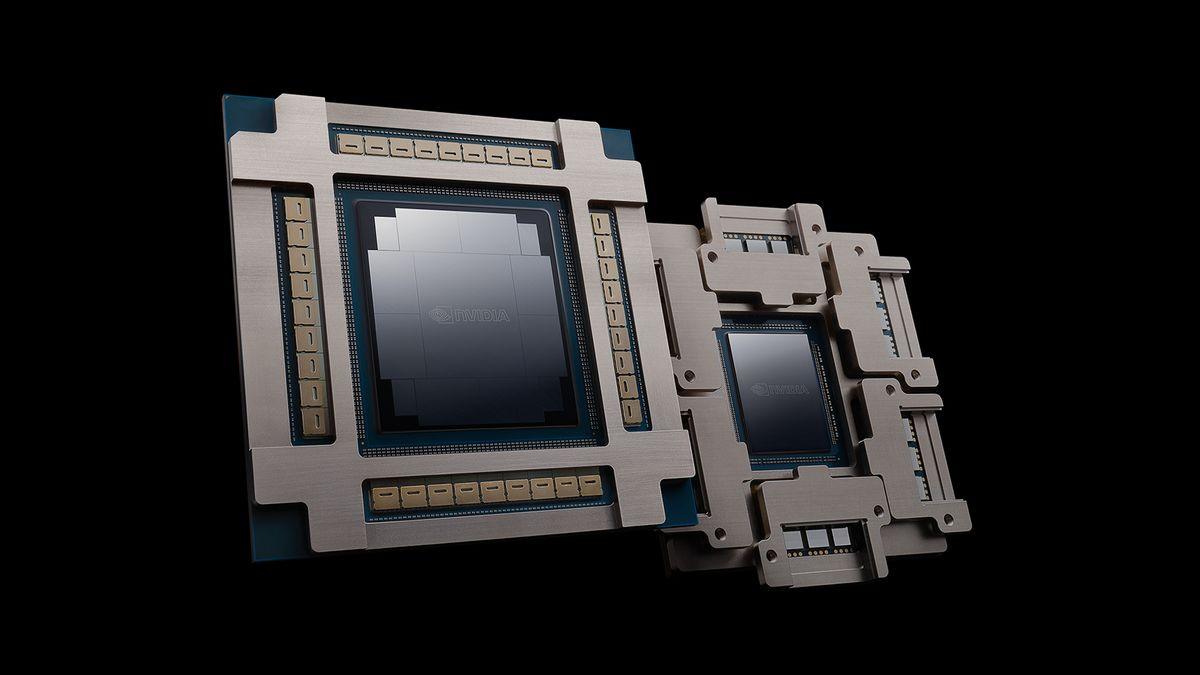
- NVIDIA Quantum-X and Spectrum-X switches reduce dependence on traditional optical emitters
- Silicon Photonics increases the efficiency of the Nvidia network by 3.5x
- Quantum-X and Spectrum-X switches provide up to 400 TBPS for hyperscal factories
NVIDIA increases its networking technology by integrating Co-Embacles Optics (CPO) into its Quantum Infiniband and Spectrum Ethernet switch, a decision that should reduce energy consumption and the cost of AI data centers.
During its GTC 2025 event, NVIDIA detailed its plans to deploy silicon photonics, which will improve efficiency by reducing the need for traditional optical transcenders.
Instead of relying on traditional plug-in-laws, NVIDIA incorporates photonics directly into the ASIC switch, energy consumption and minimization of signal loss. These advances benefit the IA hyperscal and could also improve small businesses with similar efficiency gains.
Nvidia seeks to reduce the power of the AI data center by more than 50%.
NVIDIA Spectrum-X and Quantum-X switches use silicon photonics to provide higher bandwidth and lower energy consumption, supporting up to 1.6 terabits per second (TBP) per port to effectively connect millions of GPU.
Quantum-X photonic switches and Spectrum-X offer configurations ranging from 128 ports to 800 GB
While the Ethernet Spectrum-X platform improves multi-local hyperscal deployments, the infiniband quantum-X switches offer integrity and resilience of the upper signal, which makes them pretending to the best network switch.
“AI factories are a new class of extreme scale data centers, and networking infrastructure must be reinvented to keep up. By integrating silicon photonics directly into switches, Nvidia breaks the old hyperscal limitations and corporate networks and the opening of the door to the AI million-GPU faculties, “said Jensen Huang, founder and CEO of Nvidia.
The new NVIDIA switches improve the energy efficiency of a factor of 3.5, while reducing signal degradation. In a typical AI data center with 400,000 GPUs, conventional networking configurations require millions of optical emitters, consuming significant power.
Nvidia’s approach reduces the total power of the 72 megawatts network to 21.6 megawatts, considerably improving sustainability. These gains could also improve commercial smartphones, allowing faster and more reliable connectivity.
While Nvidia is going to an optical networking, Copper remains relevant in specific configurations.
Systems like the GB200 NVL72 still use thousands of copper cables to connect GPUs and CPUs via NVLink 5, offering lower energy consumption at rack level.
However, As Nvidia progresses to NVLink 6, Copper’s limits will become more apparent, strengthening the need for photonic solutions in large -scale AI tool deployments.
The new NVIDIA switches are defined for the end at the end of 202 and 2026. The first model, the infiniband quantum 3450-LD switch, launched at the end of 2025, will provide 144 800 GB / sec connectivity ports and a total bandwidth of 115 TO / SEC.
In 2026, the SNS SMPS SN6810 Ethernet Switch will start with 128 ports at 800 GB / SEC and a global bandwidth of 102.4 TB / SEC. An larger SN6800 Spectrum SN6800 model will also arrive in 2026, with 512 800 GB / sec ports and a total flow of 409.6 TB / sec.
Via NextPlatform


