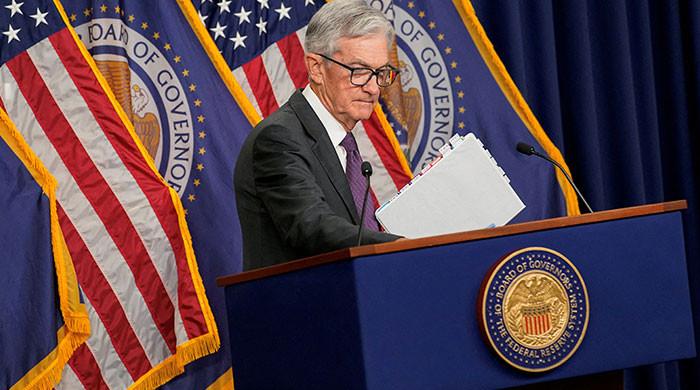
Chicago: The head of the American central bank said that he would keep any interest change for the moment, because economic prospects are becoming increasingly uncertain following major changes in commercial policy under President Donald Trump.
The president of the American federal reserve, Jerome Powell, said on Wednesday that the Fed would expect more data on the direction of the economy before modifying interest rates and characterized the recent market volatility as a logical reaction to the dramatic changes of the Trump administration in the tariff policy.
“For the moment, we are well placed to wait for greater clarity before considering any adjustment to our political position,” Powell said in remarks prepared for the Chicago Economic Club. His remarks noted a situation potentially difficult to develop for the Fed, in which inflation is pushed above by prices while growth – and potentially use – weakens.
The Fed tries to maintain stable inflation at 2% while also supporting maximum use.
“I think we will get away from these objectives, probably for the balance of this year. Or at least will not progress,” said Powell, referring to the impact of prices that have proven to be more important – at least as announced – that even the most serious scenarios in the Cars of the Planning of the Initial Fed. He noted that the United States began the year around full employment and with inflation which should continue to fall to the objective of the Central Bank.
The prospects have now become extremely uncertain, said Powell, with “fundamental changes” of the policy that provides companies and economists without clear parallels to be studied.
In his first public remarks on the recent financial volatility, Powell said he thought that bonds and stock markets were working well, fluctuations in security values reflecting investors that adapt to the new landscape.
When asked if there was a “Fed power” – where the central bank would intervene if the markets drop – Powell said: “No, with an explanation … The markets deal with what is happening … The markets are in difficulty … conditionally to be in a difficult situation, the markets do what they are supposed to.
American shares, already down the session before Powell spoke, then extended their losses.
“I think people expected Powell to be neutral and he was Belvédois instead,” Jim Carroll, heritage advisor at Ballast Rock Private Wealth, told Charleston, in South Carolina, on the additional actions in action following the appearance of Powell. “When asked if there was one thing such as Fed for the stock market, his answer was” no “.”
Increased uncertainty
In his prepared remarks, Powell said that the economic growth of the United States seems to slow down, consumer expenditure that increases modestly. An import rush to avoid prices is also likely to weigh on raw domestic product estimates, with a worsening of feeling.
“Despite increased uncertainty and downward risks, the American economy is still in a solid position,” said Powell. But “hand data so far suggest that growth has slowed down in the first quarter compared to the solid rhythm of last year”.
External analysts see growth continue to slow down during the year, while “households and businesses report a sharp drop in feeling and high uncertainty about prospects, largely reflecting trade policy problems,” said Powell, referring to the rapid changes in import taxes imposed by President Donald Trump.
The FED’s benchmark interest rate is currently set between 4.25% and 4.5%, where it has remained since December following a series of rate drops at the end of last year.
Since then, progress in the restoration of inflation towards the target target of the Fed has slowed down.
Despite the uncertainty and nature of the back and forth of Trump’s pricing announcements, a judgment on their probable impact will be at the heart of the Fed’s future debate on the advisability of leaving the unchanged reference interest rate, to reduce IT-or even to consider rate increases.
“Prices are very likely to generate at least a temporary increase in inflation. Inflationist effects could also be more persistent,” said Powell. “Avoiding this result will depend on the size of the effects, the time they need to switch fully at prices and, ultimately, the maintenance of long -term inflation expectations well anchored”, the Fed managers of objectives have started to emphasize.
Although inflation expectations of short -term periods “have increased significantly” due to prices, Powell has declared that the longer -term expectations that the FED looks at the most closely remain consistent with the Fed inflation objective.
The Fed also keeping an eye on employment, Powell said that the job market had remained “in solid state” and “or almost a maximum job”.
But if the Fed is caught between an increase in inflation and an increase in the unemployment rate, “we would consider how far the economy is from each objective, and the potentially different time horizons on which these respective gaps would be planned.”