
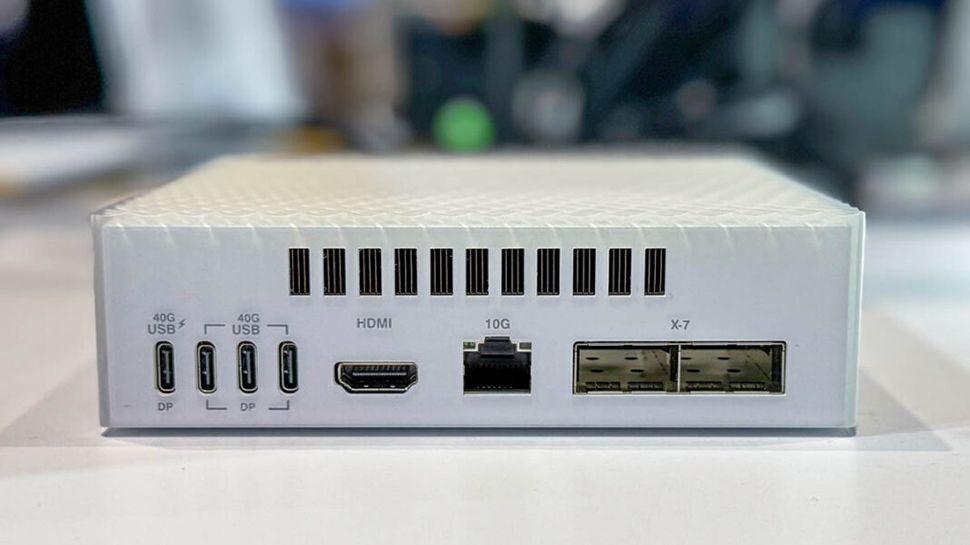
- ASCENT GX10 is Asus’ point of view on the DGX SPARK AI Supercalculator of NVIDIA
- Servethehome spotted the GTC 2025 product and handed over
- The site has taken photos and noted that the AI computer is lighter and cheaper
NVIDIA recently shown DGX Spark, its AI Mac mini supercomputer, Mac size built around the GB10 Superchip Grace Blackwell.
Initially called Project Digits, the device has been created to provide advanced development and inference directly to office computers. Although it looks like a mini PC, it is incredibly powerful and designed to manage the working flows of the demanding AIs such as fine adjustment, inference and prototyping without counting entirely on an external infrastructure.
Intended for developers, researchers, data scientists and students working with increasingly complex AI models, it comes with 128 GB of unified memory LPDDR5X and up to 4 TB of SSD NVME storage. The DGX Spark is not cheap at $ 3,999, but if you are looking to save money without cutting the corners, there are alternatives.
The lighter choice
The Dell pro Max with GB10 and the ZGX Nano HP station of HP are DGX Spark clones, built around the GB10 Grace Blackwell Superchip. Asus also has its own GB10 AI supercalculator clone, the GX10 ascent, at a price of $ 2999, much less than the NVIDIA offer.
Mounted at the NVIDIA GTC 2025, (as, of course, was the own DGX spark of NVIDIA), the GX10 ascent is delivered with 128 GB of unified memory and the Blackwell GPU with fifth generation tensor hearts and an FP4 precision support. While DGX Spark A 4 TB of storage, the version of Asus has only 1 TB.
Serve was at the conference and spotted the GX10 ascent on the Asus stand where he took some photos of the product.
The site also noted: “The front of the system has the ASUS logo and a power button. want to group it. “”
At the back of the system, Sth Said there is an HDMI port, four high-speed USB4 40 GBPS ports, a 10 GBE network card for basic networking and a double-port NVIDIA Connectx-7, which NVIDIA described as an Ethernet version of the CX7 designed for the RDMA clustering.
SthPatrick Kennedy noted: “For a little context here, an NVIDIA Connectx-7 network card today is often sold from $ 1,200 to unique quantities, depending on the functionality and the supply of parts. At $ 2999 for a system with this integrated cluster which is great.


