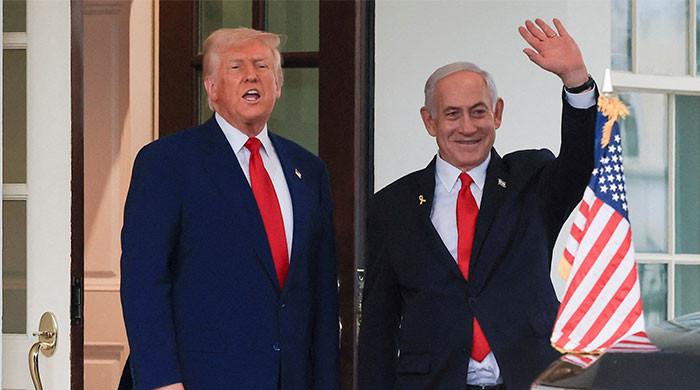
For US President Donald Trump, few goals on the world stage have been more explicit – he will not hang out the country in another “war forever”.
However, the massive strikes of Israel on Iran will test this promise like never before, setting up a confrontation with its base while Trump decides on the support that the United States will offer.
Trump had publicly called on Israel not to strike when he was looking for a negotiated solution, and his traveling envoy Steve Witkoff was to meet Iranian officials for the sixth time on Sunday.
Trump, who a few hours earlier, warned that an attack would cause a “massive conflict”, then praised the Israeli strikes as “excellent”.
It boasted that Israel had “the best and deadliest military equipment all over the world” thanks to the United States – and planned more strikes unless Iran concludes an agreement.
The Secretary of State, Marco Rubio, insisted that the United States was not involved in strikes and warned Iran not to retaliate against the thousands of American troops stationed in neighboring Arab countries.
An American official, however, confirmed that the United States helped Israel have cut off reprisals licensed on Friday by Iran on Friday.
“The United States has calculated that it can help Israel and that the Iranians will obviously be aware of it, but ultimately, at least in public level, the United States remains outside,” said Alex Vatanka, founding director of the Iranian Middle East Institute program in Washington.
Hope is that “the Iranians will carry out a rapid analysis of costs / advantages and will decide that this is not worth the fight,” said Vatanka.
He said Iranian leaders are currently focusing on staying alive, but could decide either to swallow a difficult agreement – or to internationalize the conflict more by causing chaos in the Gulf rich in oil, potentially sending oil prices that skyrocketing and putting pressure on Trump.
“ America first skeptical base ”
Most key legislators from Trump’s republican party quickly joined Israel, including Prime Minister Benjamin Netanyahu, is a hero for many from the American right and has long qualified Iran as an existential threat.
But Trump’s populist base “America First” was skeptical.
Tucker Carlson, the eminent media commentator who advised Trump against an American strike on Iran in the first mandate, called the fears that Tehran built an exaggerated nuclear bomb, saying that Iran nor Ukraine justify American military resources.
Carlson wrote on X after the Israeli strike that there was a fracture in the orbit of Trump between “those who casually encourage violence, and those who seek to prevent it – between bellicists and craftsmen”.
Trump directly brought non-interventionists directly to his administration.
In an unusual political video this week, Trump’s national intelligence director Tulsi Gabbard warned after a visit to Hiroshima that “fellow workers” put the world in danger of nuclear disaster.
In a speech to Riyadh last month, Trump denounced decades of American interventionism in the Middle East and said: “My greatest hope is to be a peacemaker and to be a unifying. I do not like war”.
Support for Israel
Daniel Shapiro, who was an American ambassador to Israel under former President Barack Obama, said it was certain that the United States would support Israel for Iranian reprisals.
But Trump will be faced with a more difficult decision on “if it is necessary to use the unique capacities of the United States to destroy the underground nuclear installations of Tehran and prevent an Iranian nuclear weapon,” Shapiro told the Atlantic Council.
“The decision will divide its advisers and its political base, in the midst of the accusations, and perhaps its own doubts, that Netanyahu tries to drag it in the war.”
The legislators of the Rival Democratic Party largely revise Netanyahu, especially on the bloody offensive of Israel in Gaza.
“This Netanyahu attack is pure sabotage,” said Democratic representative Joaquin Castro.
“What does” America first “mean” if Trump allows Netanyahu to drag the country in a war that Americans don’t want? ” He wrote on social networks.
Sina Tossi, a main person in the progressive Center for International Policy, said that China – identified by Trump as the main threat – could grasp the moment, perhaps by moving to Taiwan because he considers the United States as even more distracted.
“Even without direct involvement, Washington is now faced with the prospect of an indefinite replenishment, information and diplomatic support for Israel, just as the war in Ukraine is intensifying and the global crises are multiplying.
“The wars are easy to ignite, but once unleashed, they tend to slip beyond control and rarely end under those who start them,” added Tossi.