
The first total lunar eclipse of the year will take place on Tuesday and will be visible in Pakistan as well as various parts of the world.
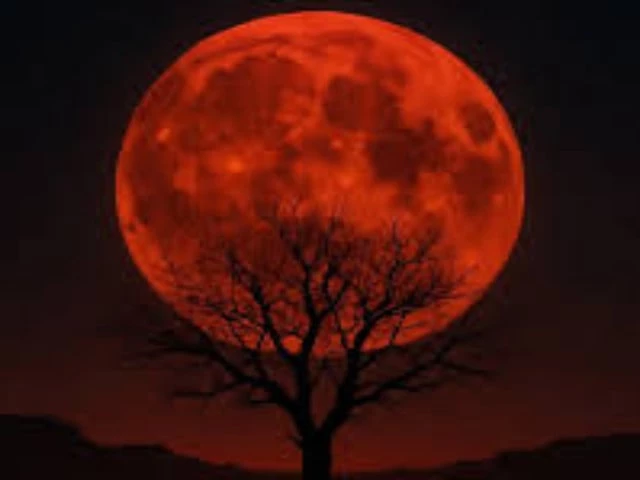
According to the Meteorological Department, the celestial event will be a spectacular sight, with the moon taking on a reddish hue – commonly known as the ‘Blood Moon’.
In Pakistan, the eclipse will begin at 1:44 p.m., while the partial phase will begin at 2:50 p.m.
The total lunar eclipse will begin at 4:05 p.m. and reach its peak at 4:34 p.m., when the Moon is completely in Earth’s shadow.
The meteorological department said the total phase would start ending at 5:03 p.m., while the partial eclipse would end at 6:17 p.m. The lunar eclipse will end completely at 7:23 p.m.
Read: Slop AI, lab-grown skin, and the tech show that shapes tomorrow
Experts say the eclipse will appear partially visible at moonrise in various cities of Pakistan, providing citizens with a unique astronomical spectacle.
According to NASA’s “What’s Up: March 2026 Skywatching Tips,” a total lunar eclipse only occurs during a full Moon, when Earth passes directly between the Sun and Moon, casting its shadow on the lunar surface.
The US space agency explained that during a total lunar eclipse, the Sun, Earth and Moon align precisely, leaving the Moon entirely enveloped in the umbra (shadow) of the Earth.
NASA further noted that the Moon appears red – the so-called Blood Moon – because Earth’s atmosphere scatters sunlight and bends reddish wavelengths onto the lunar surface rather than leaving it completely dark.
The eclipse will also be visible in Asia, Australia, North and South America and several other regions.
Learn more: A total lunar eclipse will be visible in Pakistan on March 3
Separately, NASA noted that March will feature other notable celestial events, including a close conjunction of Venus and Saturn on March 8 and the spring equinox on March 20, which marks near equality between day and night around the world.
Astronomers say no special glasses are required to view a lunar eclipse and it can be viewed safely with the naked eye.
Citizens have been advised to enjoy this magnificent natural phenomenon under the open sky.


