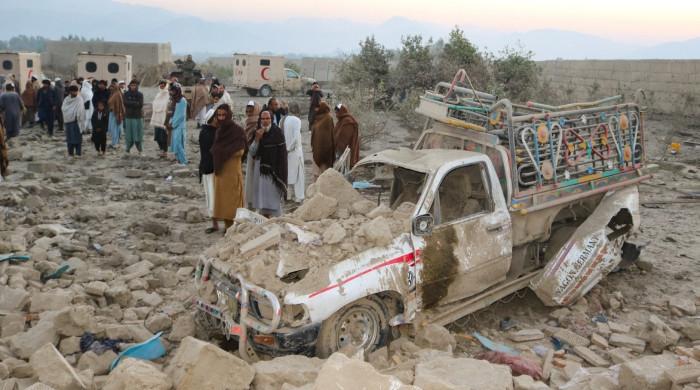
The latest round of cross-border strikes between Pakistan and Afghanistan was quickly absorbed into a familiar vocabulary of sovereignty violations and regional instability.
These descriptions are incomplete and inaccurate. For Pakistan, militancy emanating from Afghanistan is not a distant geopolitical abstraction. It is an immediate security threat, shaped by geography, history and a border that remains porous despite decades of militarization.
In recent years, Islamabad has repeatedly said that anti-Pakistan groups, including the TTP, have found space to regroup across the border. The Afghan authorities rejected this characterization.
No state can indefinitely absorb violence that arises beyond its formal jurisdiction by relying solely on diplomatic assurances. Pakistan’s security services operate under domestic pressure. Civilian casualties from militant attacks are recorded not as abstract political debates but as institutional demands for response. In such an environment, cross-border strikes become a tool of signaling as well as disruption, demonstrating that tolerance thresholds have been reached.
This does not mean that air power alone can neutralize sanctuary dynamics. Activist networks that straddle borders are supported by terrain, local alliances, and ideological overlaps. The Afghan authorities, for their part, are faced with internal constraints. Dismantling groups with shared histories or intertwined loyalties risks fragmenting a political order that continues to consolidate after decades of war.
Yet Pakistan’s calculus is influenced less by Kabul’s internal difficulties than by the immediacy of its own exposure. The Durand line has long been more than a demarcation; it is a corridor through which commerce, kinship and activism passed in equal measure. To expect strategic patience in the face of repeated attacks is to misunderstand how states prioritize domestic order.
International commentary often presents such strikes as escalation by default, as if restraint were a neutral basis. This assumption does not take into account cost asymmetry. Afghanistan does not see the same volume of attacks originating from Pakistani soil. In recent years, the burden of fallout has fallen disproportionately on Pakistan. In this context, Islamabad’s calibrated use of force is an assertion that territorial lines cannot serve as shields for non-state actors.
Critics frequently invoke international law in isolation, ignoring the continuing failure to neutralize armed groups operating in ungoverned or under-governed spaces. Legal principles cannot replace effective territorial control.
This approach carries risks. Repetition without resolution can normalize cross-border action as a routine political instrument. Each episode shrinks diplomatic space and deepens mistrust. It also reinforces a cycle in which activist actors take advantage of the lack of sustainable coordination between the two governments.
A lasting solution would require intelligence sharing, verifiable commitments, and a political understanding that militant groups targeting one state cannot be compartmentalized as peripheral concerns by the other.
Such coordination remains difficult to achieve, in part because broader diplomatic relations are unstable. Questions of recognition, sanctions and international legitimacy continue to shape Kabul’s external position. Pakistan’s engagement has oscillated between cautious accommodation and visible frustration.
The resulting ambiguity has limited the development of institutional mechanisms to manage cross-border threats more effectively.
Pakistan cannot distance itself from Afghanistan, nor protect its western provinces from developments across the border. In terms of security, adjacency reduces reaction time and amplifies the perceived threat. When militant attacks accumulate, strategic restraint is weighed against national expectations for response, and the balance shifts accordingly.
The stabilization or intensification of the current cycle will depend less on rhetorical condemnations than on concrete actions against groups operating in border regions. Without credible measures to address concerns about the sanctuary, episodic military measures are likely to recur. They are imperfect instruments, but they reflect a state facing a security environment in which passivity carries its own risks.
For Pakistan, the question is one of practical containment. The sustainability of any alternative approach will rely on evidence that cross-border activism is measurably reduced. Until such evidence materializes, Islamabad’s actions will continue to be shaped by the logic of proximity and the imperative of internal security rather than an external preference for restraint.
The writer is a non-resident member of the Consortium for Asia-Pacific and Eurasian Studies. He tweets/posts @umarwrites
Disclaimer: The views expressed in this article are those of the author and do not necessarily reflect the editorial policies of PK Press Club.tv.
Originally published in The News