
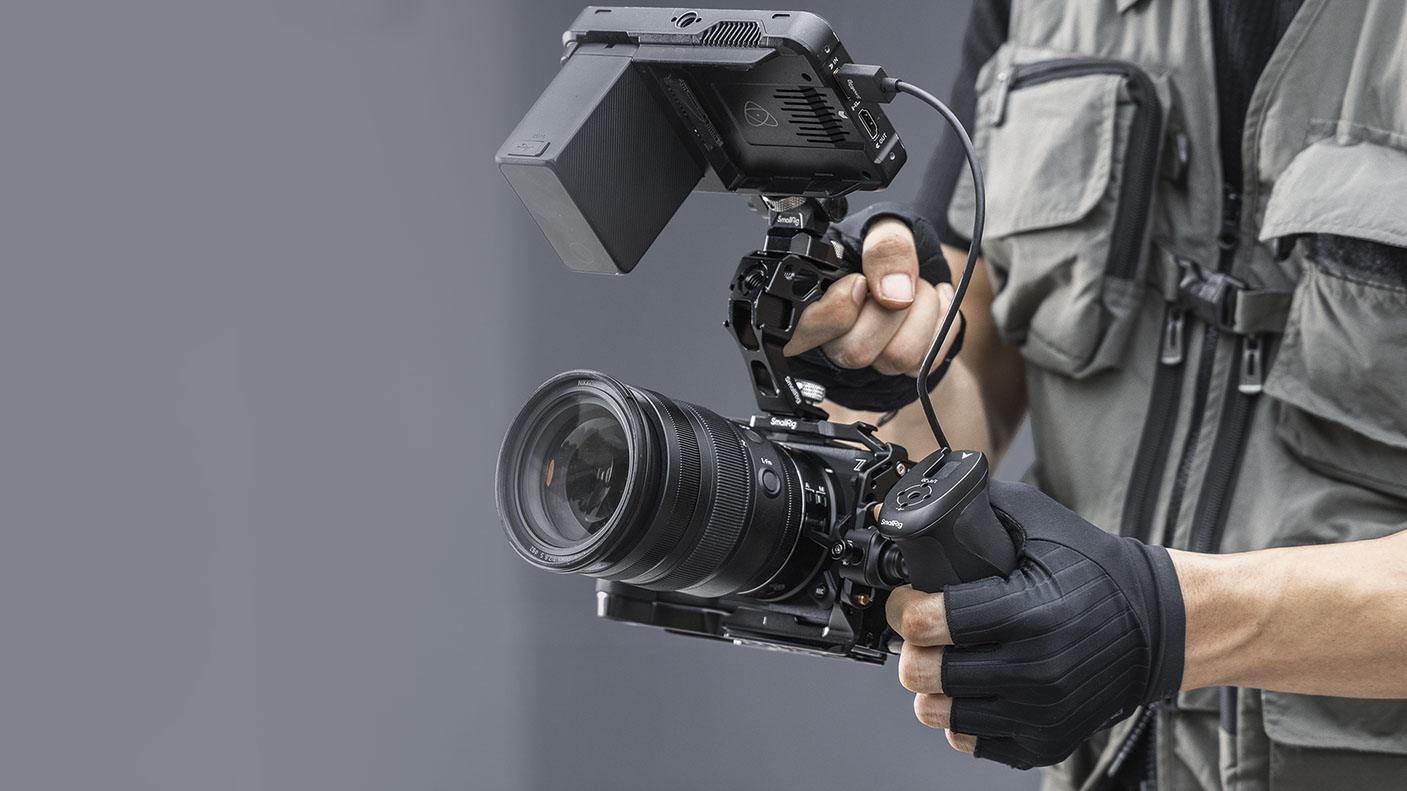
Nikon launched his first film’s first movie camera this week, the Nikon ZR, barely 18 months after acquiring red digital cameras – Consult my practical Nikon ZR review for my first impressions. And hot on its heels, we now have the first essential accessory for the camera, in the form of the Smallrig cage kit.
Most of my practice is that, even if I should test the Nikon / Red model on a longer period, I already think that it is a highly capable video camera, thanks to its partially stacked 24 MP sensor, image stabilization in the body, internal video profiles of 6K 60FPS, internal to 12 -bit MICs, internal mics and internal offenses.
He is a major instant player in a new space for Nikon, with the skills necessary to make a pro-lame quality video in a compact bad weather package, for a rival price of $ 2,200 / £ 2199 £ 3,499 at.
That said, the ZR is clearly not a high -end model. Nikon has prioritized the compact dimensions compared to the design of pure and simple pro -grade cinema cameras, and it is not a bad thing – I think there is a place for small stripped cameras that you can develop with accessories to meet your needs.
Modifying a small camera can serve several ends – you can keep it bare to adapt to tight spaces, or add accessories to improve its handling.
I like the foundations that the ZR has established, but to be a very good Run-And Gun camera, it needs an additional hand, and this has just taken the form of the advanced Smallrig cage kit.
Take a handle
Unlike larger alternatives, the Nikon ZR omits a viewfinder, while its flat facade body offers only a small purchase. In addition, there are no assembly points for accessories like you get with other movie cameras, or space to involve a full-size HDMI port, just a micro-HDMI. All this looks like a passionate level design rather than pro.
My first thought when I got my hands on the ZR is that it would benefit from better grip and an easier way to mount accessories – walk in Smallg.
The advanced cage kit, which costs £ 149.90 and is available now in the United Kingdom (pricing and availability of the United States and Australia are TBC), has four main components: the L, the cage, the upper handle and the side handle. If you don’t want the lot, you can save money by opting for the L -shaped handle kit, the base cage kit or the upper handle kit.
With the four components at stake, the ZR looks infinitely more comfortable to hold, and the L handle will certainly make the vertical shot comfortable. The ZR has vertical video skills that you want to use – its user interface changes when you hold the camera vertically, and any videos shot this way is automatically recognized as files 9:16 when you arrive at the editing.
The ZR already has an image stabilization in the body but, like the Nikon Z6 III, which has identical sensor specifications, it is not the best I used – the stabilization of the Lumix S1 II for the video is another level. This is why the upper handle and the side handle are useful: they will offer a more secure grip for smoother helping hand, reducing the need for a cardan.
Personally, I am not making assembly points for an external monitor-the 4-inch ZR screen is large and fairly brilliant for the recording of Run-And-Gun. However, it is useful for accessories such as a wireless micro receiver and compact continuous lighting panels.
Of course, the Smallrig cage kit cannot change the ZR equipment, such as the fact that we have a micro-HDMI and clumsy access to memory cards through the battery door, but it transforms the ZR into a video and ultimate canon video. Add the cage, forget using a cardan and external monitor, and you have an ultra -compact and easily transported package – it is certainly the first ZR accessory that I would try to buy.


