
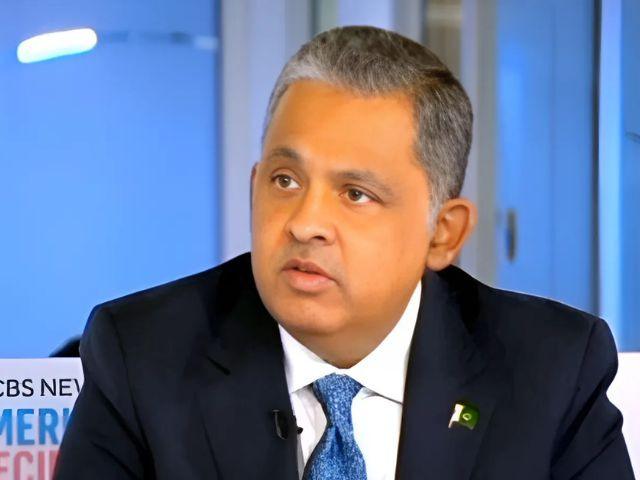
Pakistan ambassador to the United States, Rizwan Saeed Sheikh, warned that the recent rhetoric and the actions of Indian Hindutva leadership, which reflects a “terrorist state of mind”, threatens regional stability.
Addressing several media in Washington, Rizwan Saeed Sheikh said that India Management of the Industry Water Treaty has shown contempt for international law.
“The Treaty does not contain any provision for termination or unilateral suspension,” said the ambassador. “India’s attempt to use water as a weapon is both illegal and inhuman, and the international community will not support such actions.”
He also criticized the recent remarks and the visual displays of the Indian Leadership, including a map of Bharat Akhand in the Indian Parliament, calling it “hegemonic mentality and claims”.
The ambassador said that the use of anti-Pakistani rhetoric for internal political gains in India was a “dangerous strategy” that risked inflamed nationalism. “The involvement of India in Balutchistan is no longer a secret,” added Rizwan Saeed Sheikh.
Ambassador Sheikh also congratulated the United States for his role in maintaining the ceasefire agreement between India and Pakistan. He congratulated former American president Donald Trump for promoting peace in the region and called for a continuous American commitment on the issue of cashmere.
“We appreciate President Trump’s peace efforts and hope that they will continue in the context established to resolve the cashmere dispute.”
The Industry Water Treaty, signed in 1960 under the supervision of the World Bank, governed water sharing between India and Pakistan.
Earlier, Indian Prime Minister Narendra Modi declared that Pakistan would not get water from the rivers on which India has rights by increasing rhetoric in an impasse on access to water triggered by a deadly attack in Jammu and the cashmere of Indian origin (IIOJK).
The legal director of Pakistan, in an interview with Reuters, replied that Islamabad remained willing to discuss the sharing of water between the neighbors, but said that India had to stick to an old decades.
“Pakistan will have to pay a high price for each terrorist attack … The army of Pakistan will pay him. The economy of Pakistan will pay him,” Modi told Rajasthan.
India-Pakistan Standoff
The last escalation between Pakistan and India began on April 22, when an attack in the pahalgam seaside resort of the Iiojk killed 26 people. India immediately blamed Pakistan for the incident, despite no public evidence.
In response, India has undertaken a series of hostile actions the next day on April 23, including the suspension of the 65-year-old Industry Water Treaty (IWT), canceling visas for Pakistani citizens, closing the border crossing of Wagah-Attari, ordering the closure of the Pakistani High Commissioner in New Delhi and reducing diplomatic staff in the embassies of Pakistan.
Pakistan firmly rejected the accusation, calling it not supported, but has taken reciprocal measures through its National Security Committee (NSC). These include the cessation of trade with India, the closure of the Pakistani airspace to Indian planes and other counters.
Tensions also degenerated in the early hours of May 7, when the missile strikes reached six cities in Punjab and Azad Jammu and Cashmire (AJK), destroying a mosque and killing dozens of civilians, including women, children and the elderly.
In a rapid military response, the armed forces of Pakistan have shot down Indian war planes, including three Rafale planes, widely considered as a key asset of the Indian Air Force. Over the next two days, India launched waves of Israeli manufacturing drones, which were also neutralized by the Pakistani army.
The confrontation was again intensified in the early hours of May 10, when India targeted several Pakistani air bases with missile strikes. In retaliation, Pakistan launched Operation Bunyanum Marsoos, damaging Indian military facilities, including missile storage sites, air bases and other strategic targets.
On Saturday evening, US President Donald Trump announced that a cease-fire had been reached following intense diplomatic efforts overnight. A few minutes later, the agreement was confirmed separately by the Minister of Foreign Affairs of Pakistan Ishaq Dar and the Indian Minister of Foreign Affairs.
But despite the military ceasefire, the war of the stories led.
While Pakistan has publicly credited US President Donald Trump – with China and the Gulf States – for playing an essential role in defusing tensions, India has minimized foreign participation.
Indian officials insisted that the truce was the result of direct bilateral talks.
Trump, however, reiterated his position twice after the initial announcement.


