
As Chabahar wobbles, geography reaffirms Pakistan’s central role in regional connectivity
ISLAMABAD:
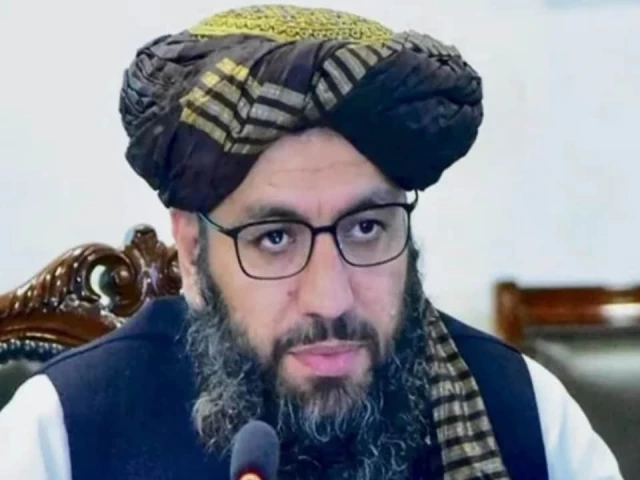
The arrival last week of Noor Ahmed Noor in New Delhi – the first Afghan charge d’affaires appointed under the Taliban government – marked a quiet but important moment in regional diplomacy, signaling a subtle recalibration of India’s engagement with Kabul at a time of shifting geopolitical alignments.
Soon after landing, Noor Ahmed Noor met senior officials of the Indian Ministry of External Affairs (MEA). The MEA then released a photograph showing Noor Ahmed Noor standing alongside India’s Joint Secretary for Pakistan, Afghanistan and Iran, a carefully choreographed image that speaks volumes.
This lens has highlighted a quiet but significant change: the steady warming of ties between India and the Afghan Taliban regime.
Once seen in New Delhi as Pakistan-backed proxies, the Taliban are now embroiled in India’s evolving regional calculus. With relations between India and Pakistan frozen and ties between the Taliban and Pakistan sharply deteriorating, New Delhi and Kabul appear to be testing a tactical reset to advance their respective strategic interests.
For India, engagement with the Taliban at a time when Kabul and Islamabad are at loggerheads offers leverage against Pakistan and a new foothold in Afghanistan. For the Taliban, closer ties with India promise diplomatic diversification and less overreliance on Pakistan.
However, this convergence comes up against a difficult geopolitical constraint: geography.
Afghanistan is a landlocked country and extremely dependent on Pakistan for access to global markets. Although Pakistan has historically allowed transit of Afghan goods to India, it has never allowed Indian goods to transit to Afghanistan through its territory. This structural reality has long frustrated Kabul and New Delhi and pushed them to seek alternative routes.
The most ambitious of these alternatives was the Iranian port of Chabahar.
Under Ashraf Ghani’s administration, Afghanistan, India and Iran signed a trilateral agreement to develop Chabahar as a gateway bypassing Pakistan. After relations between Pakistan, India and Afghanistan further deteriorated, efforts to operationalize Chabahar intensified.
Just last year, an Indian state-owned company signed a new 10-year deal to operate the port, and the Taliban subsequently joined the deal, rekindling hopes that the long-delayed project would finally produce strategic dividends.
These hopes now seem to be fading.
According to a recent report by The Economic Times, India has quietly withdrawn from its active participation in Chabahar due to fears of possible US sanctions against Iran.
Notably, India’s foreign ministry has not directly refuted the report. Instead, the MEA spokesperson offered carefully worded responses that neither confirmed nor denied an Indian exit, a silence that only reinforced speculation that New Delhi was recalibrating under external pressure.
Johar Saleem, Pakistan’s former foreign minister, sees the development as symptomatic of a deeper contradiction in India’s foreign policy.
“While these are media reports rather than political signals, they reinforce what many have long pointed out: that Chabahar was politically oversold without being commercially promising,” Johar said.
“Given US sanctions, India’s economic engagement with Iran has always been suspect. What we are witnessing today is another manifestation of India’s strategic hypocrisy in the name of strategic autonomy, where narrow interests trump any principled policies; which is why, when things go wrong, New Delhi gives in.”
The Chabahar episode also reveals the limits of India and Afghanistan’s long-standing ambition to circumvent Pakistan. Johar says the whole idea was flawed from the start, according to experts.
“This idea of bypassing Pakistan has always been more political than practical. Geography cannot be removed,” he said.
“Pakistan offers the shortest, cheapest and most viable sea route to Afghanistan and to Central Asia as well. Chabahar was only presented as an alternative, but it could never match the logistical advantages of Gwadar.”
He also highlighted Iran’s regional perspective, noting that Tehran has repeatedly emphasized that Chabahar and Gwadar are complementary rather than competing projects.
“The latest developments simply underline that Pakistan remains central to regional connectivity, regardless of New Delhi’s political preferences,” Johar added.
Asif Durrani, former Pakistani ambassador to Iran, echoes this assessment and places particular emphasis on the connectivity economy.
“India used the Chabahar port as a ruse to denigrate Pakistan’s geographical advantage in Central Asia,” Durrani said.
“However, upon completion, India found that this route was not economical and was 40 to 45 percent more expensive than the Karachi port or the land route through Wagah. Until now, the Indian private sector has been reluctant to use Chabahar due to its high cost and long distance.”
For Afghanistan, the consequences are serious. If India reduces its participation in Chabahar, Kabul’s already limited trade options narrow further, pushing it to depend once again on Pakistan’s ports, roads and transit infrastructure.
“Afghanistan has the right to pursue various options, and we want to see Afghanistan connect with Central Asia and its other neighbors,” Johar said.
“But geographically and historically, Pakistan has always played a vital role in its trade and connectivity. Our ports, road networks and transit infrastructure provide Afghanistan with the most efficient access to global markets.”
He stressed that this should not be seen as a dependency but as an opportunity for mutually beneficial regional integration provided that Kabul addresses Pakistan’s key security concerns.
“For this, Kabul will have to adopt a more responsible attitude and ensure that there is no flow of terrorism from its soil to Pakistan,” he added.
The quiet unfolding of the Chabahar project also raises uncomfortable questions for India. If New Delhi’s vaunted strategic autonomy collapses under the weight of sanctions, its ability to support independent regional initiatives will be called into question.
For all the symbolism surrounding India’s engagement with the Taliban, harsh geographic, economic realities and external pressures continue to shape outcomes, analysts say.


