
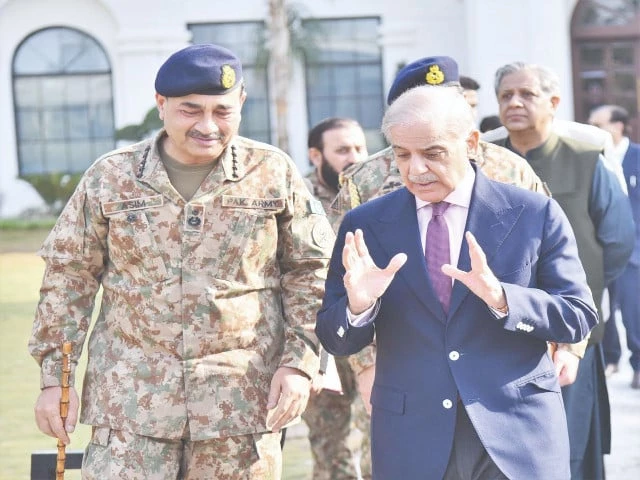
Prime Minister Shehbaz Sharif speaks with Chief of Army Staff and Chief of Defense Force Field Marshal Syed Asim Munir during a visit to GHQ in Rawalpindi.
ISLAMABAD:
Friendly nations and world leaders on Friday called for calm between Pakistan and Afghanistan after overnight border clashes and Pakistan’s punitive retaliation against Kabul that killed hundreds of Taliban members and destroyed several checkpoints.
Senior diplomats from several countries took to social media to call for restraint, dialogue and respect for international law, while Foreign Minister Ishaq Dar contacted his counterparts from key regional partners to update them on developments.
Pakistan launched Operation Ghazab Lil Haq soon after the Taliban attacked Pakistani posts along the Pakistan-Afghan border in several places. In retaliation, the troops repelled the Taliban attackers, and later, the Pakistan Air Force’s (PAF) blitzkrieg hit and destroyed several targets.
According to the Ministry of Foreign Affairs, Deputy Prime Minister and Foreign Minister Ishaq Dar had a telephone call with Egyptian Foreign Minister Dr Badr Abdelatty and stressed that Pakistan’s response to the unprovoked Afghan aggression had been “measured but decisive”.
He said that Pakistan Armed Forces successfully carried out actions under Operation Ghazab Lil Haq to protect the territorial integrity of the country. Both sides stressed the importance of peace and stability in the wider region and agreed to remain in close contact as developments evolve.
A similar message was conveyed to Saudi Foreign Minister Prince Faisal bin Farhan Al Saud. According to the Saudi Press Agency (SPA), the two men discussed “the evolving situation in the region and ways to reduce tensions” while preserving security and stability.
Turkey also intervened diplomatically. Turkish Foreign Minister Hakan Fidan discussed the conflict with Dar, a Turkish diplomatic source told Reuters. The foreign ministry said Dar stressed that Islamabad had responded “appropriately” to unprovoked aggression.
World powers, including Russia and China, were increasingly working to prevent further escalation. Russia called on both sides to immediately stop cross-border attacks and resolve their differences through diplomatic means.
Russian Foreign Ministry spokeswoman Maria Zakharova said Moscow was concerned about “an unusual and rapid escalation” involving regular military units, combat aircraft and heavy weapons. She called for a resumption of talks and said Russia would consider mediation if requested.
Iran also offered to facilitate dialogue. Foreign Minister Abbas Araghchi said Tehran was ready to provide all necessary assistance “to facilitate dialogue and strengthen understanding and cooperation” between Islamabad and Kabul, according to AFP.
From Beijing, China has expressed its deep concern about the intensity of the clashes. Foreign Ministry spokesman Mao Ning said the current round of fighting exceeded previous incidents and warned that continued escalation would harm both sides.
She confirmed that China was mediating through its own channels and was ready to play a constructive role in de-escalation, while urging both countries to ensure the safety of Chinese personnel and projects.
At the United Nations, Secretary General Antonio Guterres is closely monitoring the situation. His spokesperson said he had urged both countries to fulfill their obligations under international law, particularly international humanitarian law, and to prioritize the protection of civilians.
UN High Commissioner for Human Rights Volker Turk also called for urgent political dialogue, warning that an escalation of force would only worsen the crisis. UN special rapporteur Richard Bennett also called for calm.
Bennett, the UN special rapporteur on human rights in Afghanistan, called for respect for human rights and international humanitarian law, stressing that immediate de-escalation was essential as tensions escalated into violence.
Britain joins the growing list of affected capitals. Foreign Secretary Yvette Cooper said London was “deeply concerned by this significant escalation” and urged both sides to take immediate steps towards de-escalation and resume a mediated dialogue.
Malaysian Prime Minister Anwar Ibrahim expressed regret over the loss of life and called for maximum restraint. He said Pakistan’s legitimate security concerns must be addressed, adding that reconciliation can only be achieved at the negotiating table.
Meanwhile, Saudi Arabia and Qatar have taken the lead in efforts to end deadly fighting between Pakistan and Afghanistan, a source close to the talks told AFP on Friday.
“Saudi Arabia, in coordination with Qatar, is making efforts to reduce tensions between Pakistan and Afghanistan,” the source said, requesting anonymity to discuss sensitive issues.
The goal is to “defuse the situation and prevent it from getting out of control,” they added.
Acting Afghan Foreign Minister Mawlawi Amir Khan Muttaqi called Qatar’s chief negotiator Mohammed Al-Khulaifi on Friday, Doha said.
“Riyadh and Doha have been in contact at the highest levels with both sides, and we hope that the confrontation will end as quickly as possible,” the source added.
(WITH INPUTS FROM AGENCIES)


