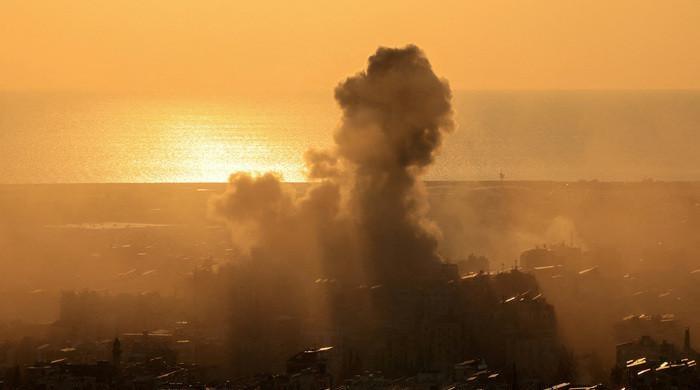
Israel and the United States’ illegal invasion of Iran may have sparked a wave of enthusiasm among warmongers in the corridors of power in Washington and Tel Aviv, but it appears to be pushing the Middle East toward a conflagration that could engulf other parts of the world.
The conflict exposed the hypocrisy of the Western world, in addition to calling into question the credibility of European leaders who immediately gave their support to Israel, accused of having committed war crimes in the occupied territories of Palestine and elsewhere in the region. British Prime Minister Keir Starmer, French President Macron and the West’s vaunted new leader, Canadian Prime Minister Mark Carney, all issued statements suggesting that the aggression was not carried out by Washington and Tel Aviv but by Tehran. Although their statements expressed concern over Iranian attacks on Arab states, they made no comment on the decimation of Iranian civilians, including more than 160 schoolchildren.
Critics say the United States has once again resorted to outright lies to justify the invasion, with US President Donald Trump and his tedious acolytes claiming that Iran poses a security threat to the sole superpower and its allies. This was the same excuse used in the past by George Bush Junior and former British Prime Minister Tony Blair during the Iraq War. Reports from international institutions and independent global bodies have proven that their claims were completely fabricated and used to seize Iraqi oil.
The Trump administration used Iran’s nuclear program as a pretext to impose this illegal invasion, essentially refuting its own claim that Iran’s nuclear infrastructure was dismantled during last year’s 12-day war. Many people believe that in reality, it is Iran’s resources that the United States and its companies dream of seizing. Enormous pressure was put on the Iranian government to open its markets to the vultures of the capitalist world, something Iran has always resisted. The military power of the Islamic Republic is believed to be the second factor that pushed Israel and the United States to invade the country, plunging it into death and destruction.
In order to achieve this goal, Washington and Tel Aviv are attempting another regime change, which could prove to be a recipe for disaster not only for the region but also for the world’s only major power. The United States has succeeded in installing compliant rulers in Libya and Syria by indirectly interfering in those countries’ affairs or through limited intervention in the case of Syria. However, in Iraq and Afghanistan, the United States and its allies have had to use ruthless force to bring about regime change. Despite this, they were unable to support the new governments.
Sending troops to these countries has proven disastrous. The United States and its allies lost thousands of troops and thousands more were maimed or injured. Washington also had to spend about $8 trillion on the two conflicts, according to the Watson Institute at Brown University. End result: a humiliating withdrawal of both countries.
In all of these countries, local ethnic and sectarian entities have been encouraged by the United States to ally themselves with occupying forces or anti-government elements. This has deepened divisions within these societies, with different sections continuing to fight against each other in countries like Libya and Syria.
It appears that Washington is also trying to apply the same formula to Iran, which has multiple ethnic and sectarian fault lines. The Trump administration has reportedly been in contact with Kurds and other ethnic groups who have faced repression and suppression by the Iranian government in the past and appear ready to fight the theocratic system. Washington could also attempt to involve other non-Persian entities in Iran to weaken the government.
The Baloch in eastern Iran could also be potential collaborators with the Israeli and American invading forces. Dissident Iranian elements based in the United States and other parts of the world could also use this opportunity to make a comeback and lead the anti-government battle with the aim of overthrowing the Iranian government.
But such a U.S. approach would spell disaster for the entire region and may not go down well with some of America’s allies. Any attempt to strengthen the Iranian Kurds risks reviving the desire of the Kurds of Iraq, Turkey and Syria to create their own homeland, which infuriates Baghdad, Damascus and Ankara, who, in one way or another, are American friends. Support for the Iranian Baloch would infuriate Islamabad, which is historically a close ally of the United States.
The United States could bomb Iran mercilessly, but such airstrikes would still not bring about regime change. This would require ground troops, risking American lives and forcing the Iranians to wage guerrilla warfare. Such a situation would jeopardize the popularity of Trump, who won the election on the promise of non-intervention.
Even if some parts of Iranian society are dissatisfied with Iran’s theocratic government, it is also possible that the majority of Iranians will come to despise the very idea of intervention and collaboration with enemies. And, while some ethnic entities like the Kurds and Baloch seek independence from central authority, there are other ethnic entities within the Islamic Republic that share the same sect as Iran’s Persian-speaking majority. Despite their different ethnic origins, these national entities have the same name. They would therefore not be in favor of the idea of destroying a country considered to be the protector of their faith.
Nonetheless, the Israeli and US measures appear to be sowing the seeds of chaos in the region, with far-reaching consequences that could include the disruption of air and sea transportation, as well as skyrocketing prices of energy and other raw materials. Their desire to see the balkanization of Iran would plunge the country into a protracted civil war, which could cause mass displacement, killings and the destruction of infrastructure. Europe saw gas prices rise by 35%. The price of oil is also on an upward spiral, while the global chain and supply faces the risk of major disruptions.
If the situation does not normalize, it would also create a migration crisis for the region and Europe. Therefore, US allies in the region and Europe must act to prevent Israel and America from sowing the seeds of chaos in the region.
The writer is an independent journalist who can be reached at the following address: [email protected]
Disclaimer: The views expressed in this article are those of the author and do not necessarily reflect the editorial policies of PK Press Club.tv.
Originally published in The News