
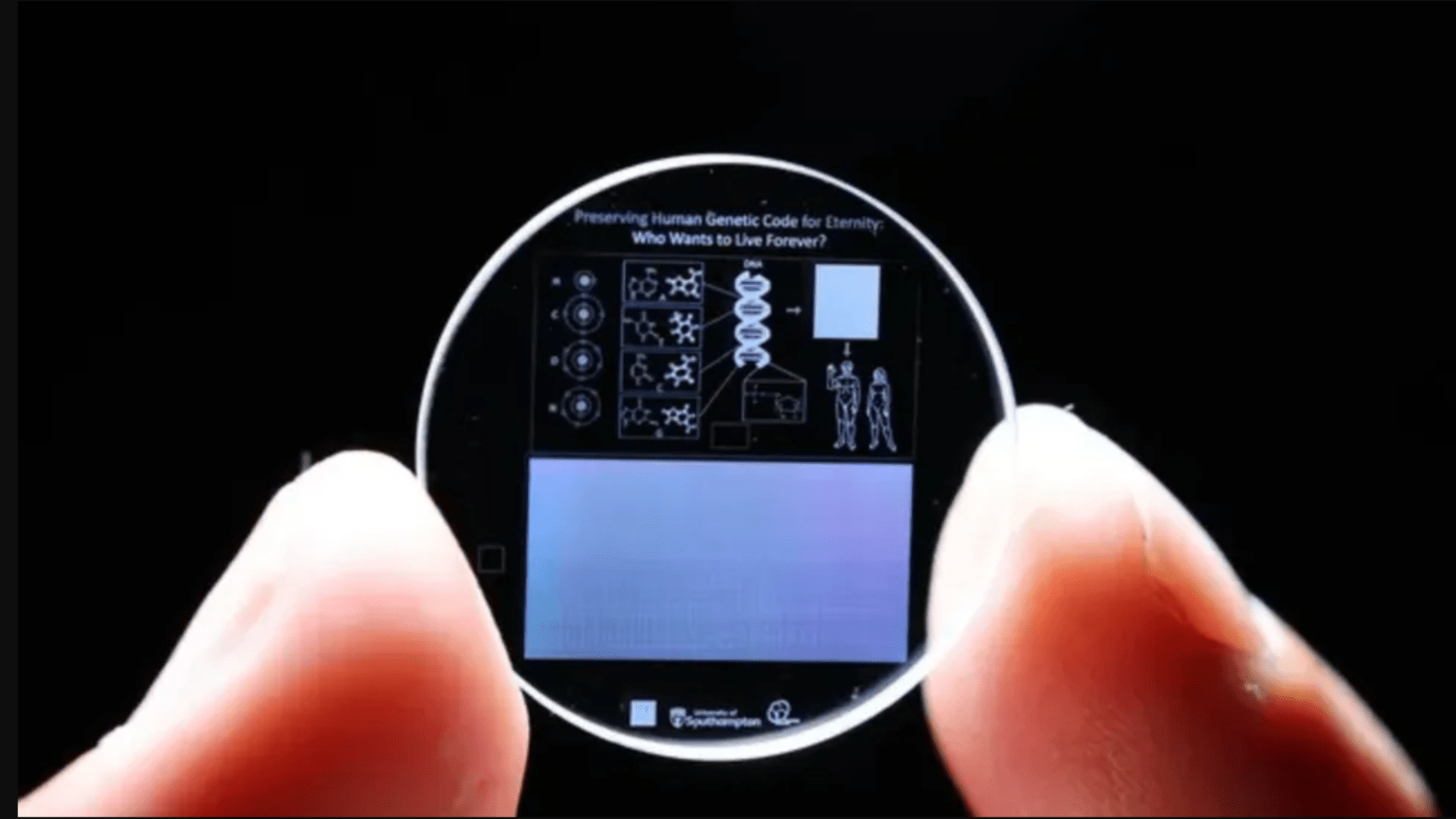
- SPhotonix’s 5D memory crystal on a five-inch glass drive can reliably store up to 360 TB
- Data in 5D crystals remains stable at 190o Celsius indefinitely
- Current prototypes read data at around 30 Mbit/s and write at 4 Mbit/s.
SPhotonix has launched its new 5D Memory Crystal, a storage medium designed for extreme longevity rather than everyday convenience.
The technology relies on molten silica glass etched with femtosecond lasers, encoding information in microscopic structures that change the polarization of light.
These structures store data using three spatial coordinates along with orientation and intensity, thus forming a 5D coding method.
5D data encoding
The company claims stability even at high temperatures, with an estimated lifespan matching the age of the universe.
Such claims rely on materials science rather than real-world operational history, which remains limited.
According to SPhotonix, a single 5-inch glass drive can store up to 360 TB.
SPhotonix describes its 5D memory crystal as a fused silica storage medium intended for extremely long retention periods.
The data is written using a femtosecond laser, forming nanoscale voxels whose position, orientation and intensity encode information across five dimensions.
At temperatures up to 190°C, the data would remain intact for 13.8 billion years, a figure linked to cosmological estimates rather than operational evidence.
Alternative long-term media include optical discs rated between 5 and 100 years, with M-DISC claiming a lifespan of 1,000 years; however, no one alive today can verify this claim.
Current prototypes of the 5D memory crystal reportedly achieve write speeds of around 4 MB/s and read speeds of around 30 MB/s.
Although this is lower than existing archive systems, SPhotonix has a roadmap that targets sustained read and write speeds of 500 Mbps within three to four years.
Such improvements would bring the performance closer to tape archives, although the company has not demonstrated these speeds outside of controlled conditions.
Expectations for access latency remain modest, with recovery times of 10 seconds or more considered acceptable.
SPhotonix structures its technology around cold data use cases, which sets it apart from hot storage that requires response times below 5ms, typically handled by SSD hardware.
Both hot and cold levels operate between 20ms and one second, supporting applications such as streaming and document access.
The company cites projections that by 2028, global data production could reach 394 trillion zettabytes per year, of which 60-80% is classified as cold data.
This framework reinforces the focus on data center integration rather than consumer cloud storage.
Early price estimates for the system place the writer at around $30,000 and the reader at almost $6,000. A field-deployable reader is expected in approximately 18 months.
The company has raised $4.5 million to date and is working to move technology from Technology Readiness Level 5 to Technology Readiness Level 6.
This transition involves validation in relevant environments rather than laboratory testing alone, a step often associated with unforeseen technical constraints.
“Statistics show that between 60 and 80 percent of all data currently stored in the world is classified as cold data,” said Ilya Kazansky, co-founder of SPhotonix.
“However, because of the way humanity is developing, because of all the budgets, AI, etc., a lot of companies have always said, ‘look, we’re just going to use HDDs or SSDs,’ which are expensive.”
“We believe that [5D Memory Crystal] This is the only way for the industry to increase its data storage capacity given the growing demand,” he said.
Follow TechRadar on Google News And add us as your favorite source to get our news, reviews and expert opinions in your feeds. Make sure to click the Follow button!
And of course you can too follow TechRadar on TikTok for news, reviews, unboxings in video form and receive regular updates from us on WhatsApp Also.


