
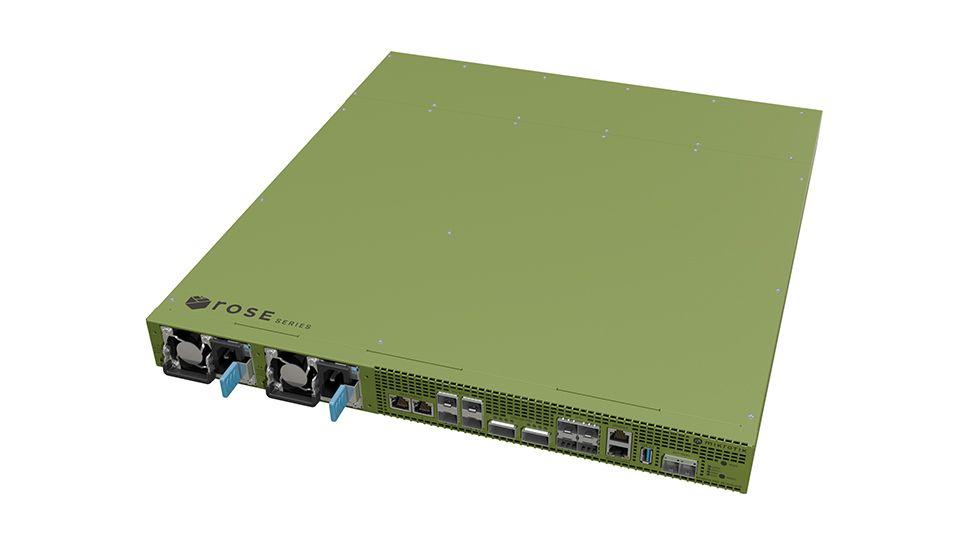
- Mikrotik RDS2216’s pink data server combines storage, networking and containers
- It works on the AWS Graviton 1 to 16 core processor and a 16 ports
- Supports minio, nextcloud and encryption, without subscriptions or payment walls
Microtik, a Latvian company specializing in networking hardware and software, has launched a new business server, fueled by Rose (the company’s Routeros edition for storage and calculation).
Described as a “high-performance storage, networking and networking platform, all-in-one”, the Data Server RDS2216 microtik combines an U.2 NAS, an advanced switch, an ARM CPU with 16 cores with 16 cores and 32 GB of RAM DDR4.
The striking green color server, which has 16 ports, including two 100g QSFP28, four 25g SFP28, four 10G SFP + and two Ethernet 10G ports, also has twenty NVME U.2 storage locations. It supports a number of advanced storage features, such as export of NVME-TCP block device, encryption layers and modular configurations, without subscriptions or payment walls. It is ready for the container, performing in a transparent minio, NextCloud, Shinobi, frigate and other containers in accordance with OIC, with additional USB ports for potentially even greater adaptability.
AWS Graviton 1
The Arm chip that feeds the RDS is certainly one of the most interesting things of the server. The AL73400 is an ARMV8 SOC with 16 cores developed by Annapurna Labs, which happens to be a subsidiary of Amazon. The chip, also known as the AWS Graviton 1 processor, was initially introduced in 2018 to increase Amazon’s cloud infrastructure.
Beyond that, the server has 32 GB of RAM (which is a little stingy) and 128 MB of NAND storage. It also has an IPSEC hardware acceleration, guaranteeing encrypted connections without a bottleneck of performance. Microtik indicates that the device is evaluated over 200,000 hours MTBF at 25 ° C and operates in a temperature range of -20 ° C at 50 ° C.
The suggested uses for the RDS2216 include the storage of mini self-hosted cloud, the Cloud Enterprise NextCloud, high-speed backup and database clusters, containerized infrastructure, branch storage extension, automatic storage and private accommodation of social media.
Writing on the server, Serve said: “MicroTik and Ampère have had publications on work together before. Hopefully this will become the network side of this with the RDDIMM support and more. Assuming that it sells for less than $ 2,000, it could make a really neat option, but it is also the one we want to try before recommending. »»
To watch


