
- QPUs can execute the faster and cheaper inference than conventional equipment could never
- Hybrid nodes combining processors, nvidia GPUs and diamond QPUs could change the way we build quantum software
- From defense to finance, quantum shine bets on diamond tokens to lead adoption
Diamonds have become an essential material in the development of quantum technologies because of their unique atomic properties, and quantum shine, a company based in Germany and Australia, described an ambitious plan to develop portable quantum computers using quantum diamond -based treatment units (QPU).
These devices are designed to operate at room temperature and can possibly be integrated alongside GPUs and high -end CPUs in servers or vehicles.
But while the company’s vision promises a future where quantum IT is as transparent as connecting a GPU for AI inference, several technical and commercial obstacles remain.
Rethink quantum computers with diamonds
Over the past decade, researchers have become more and more focused on high purity synthetic diamond engineering to minimize interference from impurities.
In particular, a collaboration in 2022 between a Japanese jewelry company and university researchers led to a new method to produce 2-inch ultra-pure diamond platelets.
In 2023, Amazon joined the effort through its Center for Quantum Networking, in partnership with the element of Beers Six to develop laboratory diamonds for use in quantum communication systems.
From now on, the brilliant quantum aims to use vacancies in diamond nitrogen to create qubits, offering a more compact and more efficient alternative to cryogenic quantum systems.
“We have a roadmap for tolerance for faults, but we are not worrying at the moment,” said Andrew Dunn, chief of the exploitation of quantum brilliance.
“People think of millions of qubits, but it will be very expensive and hungry. I think I have an understanding of having 100 qubits in a car at a lower cost and simply – the use cases are very different.”
This indicates a gap compared to the dominant trend of quantum computer science, which focuses on construction systems with millions of qubits.
The company targets rather cheap and practical use cases, especially in applications such as IA inference and clear data processing.
Quantum Brilliance is already collaborating with research institutions such as the Fraunhofer Institute for Applied Solid State Physics (IAF).
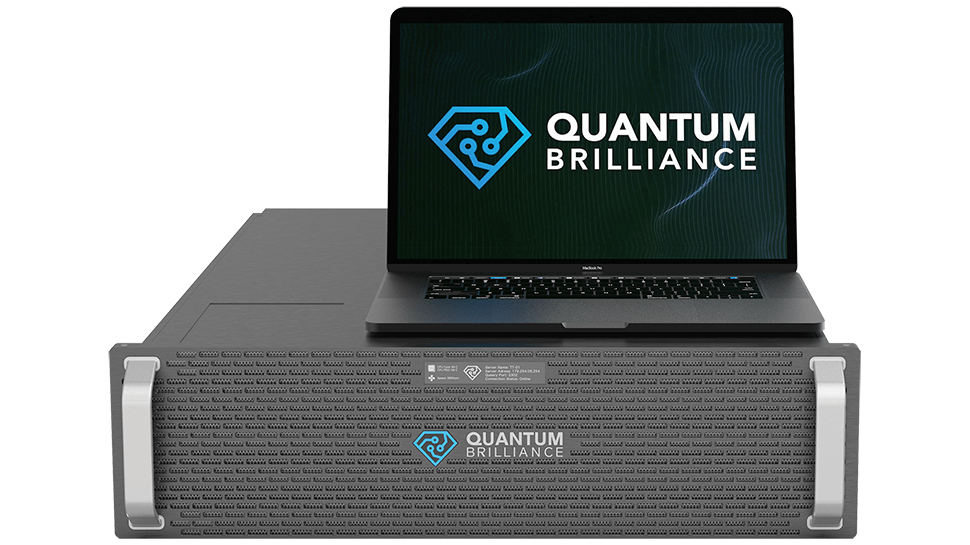
IAF currently assesses the company’s second generation quantum development kit, QB-QDK2.0, which incorporates conventional processors such as NVIDIA GPU and CPU with QPU in a single box.
In parallel, Oak Ridge National Laboratory in the United States has acquired three systems to study scalability and parallel treatment for applications such as molecular modeling.
“The reason they buy three systems is that they want to study the parallelization of systems,” added Dunn.
Quantum Brilliance also works in close collaboration with the IMEC to integrate diamond processes into the manufacture of standard fleas.
Beyond the calculation, the company sees the potential of quantum detection, and technology can also be reused for defense and industrial sensors.
In the end, the company hopes that quantum IT becomes as ordinary as any other chip from a server.
“Personally, I want to make the quantum really boring and invisible, just another chip doing its job,” said Dunn.
Via eenewseurope


