
ISLAMABAD:
British Prime Minister Keir Starmer arrived in Beijing on Wednesday, marking the first visit by a British prime minister to China in eight years. The visit reflects a sea change in Western diplomacy at a time when the U.S.-led alliance system is under strain following President Donald Trump’s return to the White House.
Starmer, who previously described China as a national security threat, is now seeking to engage with President Xi Jinping – a move that underscores growing uncertainty among Washington’s traditional allies.
The British leader is not alone. In recent months, leaders of France, Ireland and Canada have also visited Beijing, while the German chancellor is expected to visit China next month. These diplomatic overtures would have been unthinkable just a few years ago, when Western capitals were largely aligned to confront Beijing on issues of trade, technology and human rights.
The diplomatic upheaval coincides with a major economic realignment. Earlier this week, the 27-nation European Union and India signed a highly anticipated free trade agreement, widely dubbed “the mother of all deals.”
Negotiations on the EU-India free trade agreement began in 2007 but collapsed in 2013 due to sharp differences over tariffs, market access, intellectual property rights and regulatory standards. For more than a decade, the agreement remained frozen, a victim of mistrust and competing economic priorities.
Trump’s return to power changed the situation.
His aggressive economic nationalism, his strong dependence on tariffs and his transactional vision of alliances pushed Brussels and New Delhi to restart negotiations and conclude a historic agreement not only in its scale but also in its symbolism. Covering nearly two billion people and about a quarter of the global economy, the agreement is as much a geostrategic statement as it is a trade pact.
It signals a broader shift: America’s traditional allies are no longer waiting for Washington to set the rules. Instead, they construct parallel economic and strategic frameworks to safeguard their interests.
Europe and India have felt the impact of Trump’s policies. Washington has imposed tariffs on Indian exports of up to 50 percent on some products while accusing New Delhi of exploiting access to the US market and continuing to buy Russian oil. Trump has also repeatedly threatened the EU with punitive tariffs, questioned the relevance of NATO and even floated controversial ideas such as taking over Greenland.
The EU-India agreement must therefore be understood as a strategic hedge against American unpredictability. By reducing their reliance on the U.S. market, both sides hope to strengthen their economic resilience at a time when globalization is increasingly shaped by power politics rather than multilateral consensus.
Washington’s response was swift and firm. The US Commerce Secretary called the deal “insane”, questioning how the EU could sign a free trade deal with India while New Delhi continues to import Russian energy. These criticisms reflect Washington’s growing concern that its allies are no longer aligning their economic choices with American strategic priorities.
The Trump administration is unlikely to take this deal lightly. Trump’s worldview views trade as a zero-sum game, and any deal that dilutes U.S. influence could invite retaliation through tougher tariffs or political pressure.
But the major problem goes beyond trade.
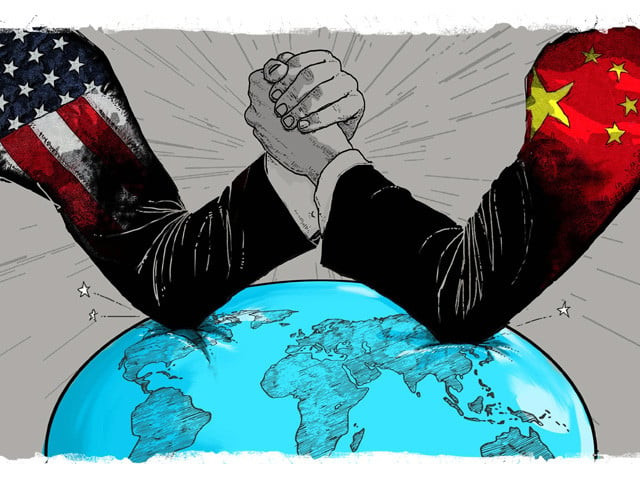
Trump’s return has accelerated a global realignment already underway. Countries once firmly anchored in the U.S.-led order are increasingly exploring alternative partnerships. Ironically, many Western states are now taking on China, the same power long presented as the main challenger to the rules-based international system.
Ideology gives way to pragmatism. Trump’s policies have injected deep uncertainty into the global system. Allies who once relied on Washington for economic stability and security guarantees now fear becoming targets of the same “America First” agenda.
The EU-India agreement is therefore the symptom of a deeper transformation. The post-Cold War order, founded on American leadership, liberal trade, and multilateral institutions, is gradually giving way to a fragmented landscape of overlapping alliances and competing economic blocs.
Trump did not cause this change, but he undoubtedly accelerated it. By weaponizing tariffs and redefining alliances as trade contracts, he has forced America’s partners to rethink their strategies. In this emerging world, alliances are no longer permanent and interests are no longer shaped by ideology. They are driven by necessity.
As Western leaders engage with Beijing and major powers strike mega-deals without Washington’s blessing, the world order has not collapsed but has been fundamentally reconfigured. And in this reconfiguration, the United States’ allies are no longer waiting for approval from Washington; they write their own rules, with China becoming one of the main beneficiaries.


