- Trump welcomes possible regime change in Iran.
- He refuses to say who he wants to lead Iran.
- Second US carrier sent to the region.
US President Donald Trump on Friday welcomed possible regime change in Iran and said “enormous power” would soon be gained in the Middle East, as the Pentagon sent a second aircraft carrier to the region.
Trump’s military moves and tough talk come even as Washington and Tehran seek to revive diplomacy amid Tehran’s long-running nuclear conflict with the West.
A source briefed on the matter told Reuters that U.S. envoys Steve Witkoff and Jared Kushner would hold negotiations with Iran on Tuesday in Geneva, with representatives from Oman acting as mediators.
The source said Witkoff and Kushner would also meet with Russian and Ukrainian officials on Tuesday in Geneva as part of U.S. efforts to end the war in Ukraine.
Asked if he wanted regime change in Iran, Trump said it “seems like it would be the best thing that could happen.” He refused to say who he wanted to take power in Iran, but said: “There are people.”
“For 47 years, they’ve been talking and talking and talking,” Trump said after a military event at Fort Bragg, North Carolina. “In the meantime, we lost a lot of lives while they were talking. Legs torn off, arms torn off, faces torn off. We’ve been going on for a long time.”
Washington wants nuclear negotiations with Iran to also cover the country’s ballistic missiles, support for armed groups in the region and treatment of the Iranian people. Iran has said it is ready to discuss reducing its nuclear program in exchange for lifting sanctions, but has ruled out linking the issue to missiles.
Trump has threatened to strike Iran if no deal is reached, while Tehran has vowed to retaliate, stoking fears of a wider war as the United States rallies its forces in the Middle East. The United States targeted Iran’s nuclear facilities in strikes last year.
When asked what was left to target at nuclear sites, Trump replied “dust.” He added: “If we do it, it will be the least of the mission, but we will probably salvage what’s left.”
Long deployments
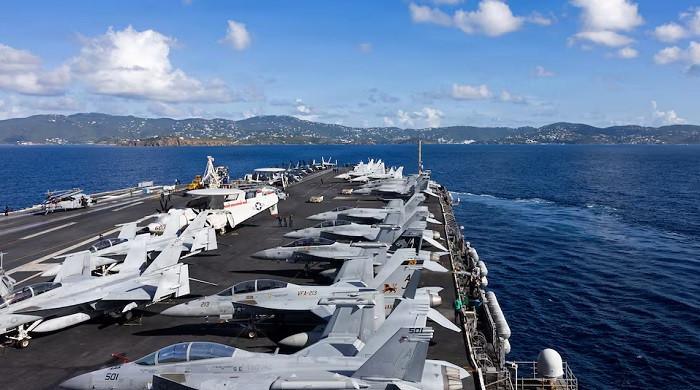
U.S. officials have described the complex process of moving military assets. The aircraft carrier Gerald R. Ford will join the aircraft carrier Abraham Lincoln, several guided-missile destroyers, fighter jets and surveillance aircraft that have been moved to the Middle East in recent weeks.
The Gerald R. Ford, America’s newest carrier and the world’s largest, operates in the Caribbean with its escort ships and participated in operations in Venezuela earlier this year.
Asked earlier Friday why a second aircraft carrier was heading to the Middle East, Trump responded: “If we don’t get a deal, we’ll need it…if we need it, we’ll get it ready.”
One of the officials, who spoke on condition of anonymity, said the carrier would take at least a week to reach the Middle East.
The United States most recently deployed two aircraft carriers to the region last year, when it carried out strikes against Iranian nuclear sites in June.
With only 11 aircraft carriers in the U.S. military arsenal, they are a scarce resource and their schedules are usually set well in advance.
In a statement, U.S. Southern Command, which oversees U.S. military operations in Latin America, said it would continue to focus on combating “illicit activities and malicious actors in the Western Hemisphere.”
The Ford has essentially been at sea since June 2025. It was supposed to operate in Europe before being abruptly moved to the Caribbean in November.
While aircraft carrier deployments typically last nine months, it is not uncommon for them to be extended during periods of increased U.S. military activity.
Navy officials have long warned that long deployments at sea can hurt ship morale.
Officials said the administration had considered sending a separate carrier, the Bush, to the Middle East, but that it was undergoing certification and would take more than a month to reach the Middle East.
The Ford, which has a nuclear reactor on board, can hold more than 75 military aircraft, including fighter jets like the F-18 Super Hornet and E-2 Hawkeye, which can serve as an early warning system.
The Ford also has sophisticated radar that can help control air traffic and navigation.
Support ships, such as the Ticonderoga-class guided-missile cruiser Normandy, Arleigh Burke-class guided-missile destroyers Thomas Hudner, Ramage, Carney, and Roosevelt, include surface-to-air, surface-to-surface, and anti-submarine warfare capabilities.