
Witkoff says president ‘curious’ about Tehran’s challenge despite Washington’s military buildup
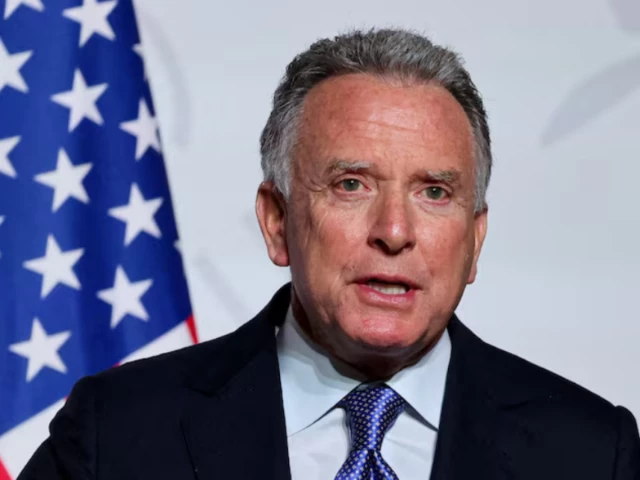
U.S. special envoy Steve Witkoff gives a press conference during the signing of the declaration on the deployment of a force after the ceasefire in Ukraine, during the so-called “Coalition of the Willing” summit, at the Elysée in Paris, France, January 6, 2026. SOURCE: REUTERS
WASHINGTON/PARIS:
U.S. envoy Steve Witkoff said Saturday that President Donald Trump questions why Iran has not “capitulated” to Washington’s military buildup aimed at pushing it toward a nuclear deal.
The United States and Iran resumed Oman-mediated talks in Geneva this week aimed at avoiding any possibility of military action, after Washington sent two aircraft carriers, jets and weapons to the region to back up its warnings.
In a Fox News interview with Lara Trump, Trump’s daughter-in-law, Witkoff said the president was “curious” about Iran’s position after warning them of serious consequences if they failed to reach a deal.
“I don’t want to use the word ‘frustrated’ because he understands he has a lot of alternatives, but he’s curious why they didn’t do it… I don’t want to use the word ‘capitulated,’ but why they didn’t capitulate,” he said.
“Why, under this pressure, with the amount of sea power there, why didn’t they come to us and say, ‘We profess we don’t want weapons, so here’s what we’re willing to do’? And yet it’s quite difficult to get them to this place.”
The US envoy also confirmed in the interview that he had met with Reza Pahlavi, who has not returned to Iran since the 1979 Islamic Revolution that toppled the monarchy.
“I met with him on the orders of the president,” he said, without providing further details.
U.S.-based Pahlavi told a crowd in Munich last week that he was ready to lead the country toward a “secular democratic future” after Trump said regime change would be best for the country.
Witkoff’s comments come after Iranian Foreign Minister Abbas Araghchi said a draft proposed deal with Washington would be ready within days.
Trump said Thursday that Iran had up to 15 days to reach an agreement on concerns over its nuclear program.
As negotiations between the two countries continued in Geneva, Iran’s Supreme Leader Ayatollah Ali Khamenei said on Tuesday that Trump would not succeed in destroying the Islamic republic.
Western countries accuse the Islamic Republic of seeking to acquire nuclear weapons, which Tehran denies, while insisting on its right to enrichment for civilian purposes.
Iran, for its part, is seeking to negotiate an end to sanctions that have proven to be a significant drag on its economy and played a role in sparking anti-government protests in December.
Separately, Araghchi said Sunday that his country would retaliate against U.S. interests in the Middle East if attacked, although he still saw a chance of reaching a diplomatic resolution.
Speaking to US channel CBS, Iran’s foreign minister said he expected further negotiations on the details of a deal “probably” on Thursday, amid fears of a resumption of conflict after Washington made a major redeployment of its military assets in the region.
Iranian students staged competing pro- and anti-government protests at several universities on Sunday, with critics of religious leaders at risk of arrest or worse if arrested.
“If the United States attacks us, then we have every right to defend ourselves,” Araghchi said, referring to American interests in the region as potential targets.
Nevertheless, he added, “there is a good chance of reaching a diplomatic solution.”
After a recent round of negotiations in Geneva, Iran said it was preparing a draft deal proposal that would avoid military action.
“I think when we meet, probably this Thursday in Geneva, we will be able to work on these elements, prepare a good text and quickly reach an agreement,” Araghchi told CBS.
Axios previously reported, citing an unnamed senior US official, that if Iran submitted its proposal within the next 48 hours, Washington was prepared to meet again later in the week “to begin detailed negotiations.”
The United States has sent two aircraft carriers to the Middle East in recent weeks, along with other planes and ships, and has also strengthened its air defenses in the region to support its threats of military intervention.


