
He claims that no country can function without an army and intelligence services, but that their mandate is limited to the Constitution
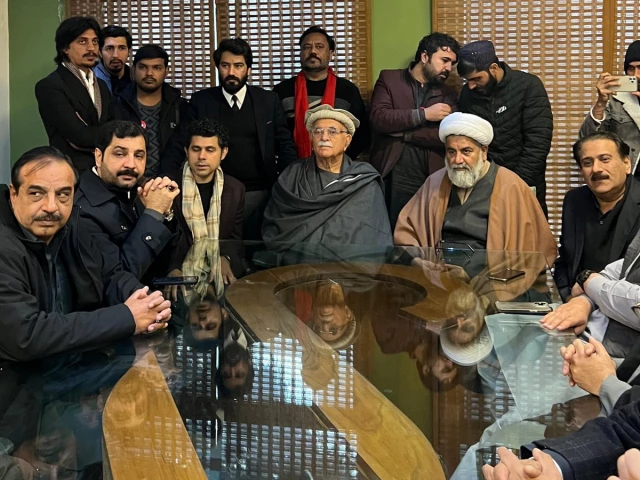
Mahmood Khan Achakzai and Allama Raja Nasir Abbas Jafri were warmly welcomed at the South Asian Media University by leaders of Khidmat-e-Khalq, Kisan Labour, Haqooq-e-Khalq, Awami and Communist parties, as well as representatives of civil society. Photo:X
Tehreek Tahaffuz-e-Ain Pakistan (TTAP) Chairman Mahmood Khan Achakzai said on Saturday that the military must remain within its constitutional framework, warning that if it wishes to engage in politics, it must abandon its security role and seek power through elections.
Speaking at a press conference at the Lahore Press Club, Achakzai said no country could function without an army and intelligence agencies, but stressed that their mandate should be limited to the roles defined in the Constitution. “Our military is competent and professional, but like the armies of democratic countries around the world, it must operate strictly within its constitutional limits,” he said, adding that any political interference was unacceptable.
Dismissing claims that opposition movements posed security threats, Achakzai said the real danger lay elsewhere. “The real security risk is someone who tampers with the Constitution, suspends it or manipulates it for personal or political gain,” he said.
سیکیورٹی رسک وہ ہے جو آئین سے کھلواڑ کرتا ہے، آئین کو چھیڑتا ہے، آئین کو معطل کرتا ہے۔ pic.twitter.com/R4kq37mwtP
– Mehmood Khan Achakzai (@MKAchakzaiPKMAP) January 10, 2026
Responding to questions about clandestine dialogue or meetings with political leaders, including PML-N supremo Nawaz Sharif, Achakzai said the alliance was not “naive” enough to disclose private political contacts. “However, I assure you that we will not compromise at the expense of Pakistan or Parliament,” he said, stressing that true democracy was essential for the country’s stability.
Achakzai said Pakistan’s repeated political crises stemmed from the disruption of democratic continuity and suppression of leadership development. “Pakistan has failed to produce effective leadership, and the people are not responsible for this failure,” he said. He recalled that TTAP was created while the Constitution was still intact and without the support of state institutions, anticipating attempts to amend it to consolidate political power. “Today, the Constitution is rapidly losing its value,” he warned.
حقوق خلق پارٹی کے سربراہ عمار علی جان اپنی پارٹی سمیت تحریک تحفظ آئین پاکستان میں شامل ہو گئے ہیں۔ pic.twitter.com/6Ewpjw32Ul
– Tehreek-e-Tahafuz-e-Ayin-e-Pakistan (@TTAP_OFFICIAL) January 10, 2026
He said TTAP had previously proposed convening a national conference involving all political forces and stakeholders to deliberate on the current crisis, but the proposal had failed to find traction. “We wanted a collective national dialogue, but unfortunately no one took it seriously,” he added.
Calling for a nationwide strike against traffic jams and closures on February 8, Achakzai said the movement for the restoration of the Constitution was gaining momentum. “Everyone who loves Pakistan should stand up and stand with us,” he said, urging traders, workers and professionals to close their businesses and join the protest.
Senator Allama Raja Nasir Abbas, vice president of TTAP, said the country’s constitutional order had been repeatedly undermined by martial laws and amendments that weakened democratic principles. “Under the Constitution, people have the right to choose their leaders, but this right is systematically taken away,” he said. He criticized restrictions on public meetings, including the imposition of Section 144, saying that when all avenues of reform were blocked, people were driven to agitation. “What choice does the people have when all avenues for reform are closed? he asked.
ہم وہ آخری لوگ ہیں جو آئین کی بحالی کی بات کررہے ہیں، اگر آپ نے سارے راستے روک This is a business that is going on with a friend. خدانخواستہ نہیں مانیں گے، پھر آپ کا کیا حال ہوگا؟ ملک کے تمام طبقات کو ظلم کیخلاف نکلنا ہوگا۔ مزدوروں اور کسانوں کے… pic.twitter.com/ZhRO3zc2Fj
– Senator Allama Raja Nasir (@AllamaRajaNasir) January 10, 2026
Leaders of several political and social groups, including the Haqooq-e-Khalq Party, the Awami Workers’ Party, trade unions, farmers’ organizations and workers’ representatives, announced their formal support for TTAP, pledging their solidarity for the supremacy of democracy and the Constitution. Haqooq-e-Khalq party leaders said their participation reflected their commitment to resisting unconstitutional actions and defending fundamental rights.
Later, TTAP leaders attempted to address the media at Minar-e-Pakistan, where they were expected to pass a formal resolution, but authorities sealed the site and barred entry to the public. The closure of the historic venue drew criticism from opposition leaders, who called it an attempt to stifle peaceful political expression.
However, after facing initial resistance, opposition leaders managed to enter the historic Iqbal Park, where they reiterated their stance in favor of the restoration of the Constitution and democracy. They urged the people of Pakistan to take to the streets in support of constitutional supremacy and democratic rule.
The delegation also visited the mausoleums of Allama Muhammad Iqbal and Bibi Pak Daman, where supporters gathered in large numbers and expressed solidarity. TTAP leaders visited various markets in Lahore and distributed pamphlets to mobilize public support for the February 8 protest.
Speaking to reporters again, Achakzai said the opposition movement aimed not to seize power but to save the country from a constitutional crisis. “We don’t ask people to follow us blindly; we ask them to stand with us for Pakistan,” he said. “In such a crisis, it is a sin to stay at home.”
He reiterated that the armed forces must operate within the framework they have set. “Those who play with Pakistan’s Constitution are the real security threat,” he said, adding that the suppression of democratic processes had created deep internal crises.
Achakzai also suggested that Pakistan explore regional dialogue under the auspices of the United Nations, proposing a roundtable discussion involving Pakistan, Iran, Afghanistan and China. “No country can find solutions in isolation,” he said.
Meanwhile, Pakistan Tehreek-e-Insaf (PTI) also called on its supporters to gather at Minar-e-Pakistan, with Punjab chief organizer Aliya Hamza Malik criticizing the closure of public spaces and calling it evidence of fear of peaceful political mobilization.
TTAP leaders said their visit to Lahore was part of a broader national mobilization ahead of the February 8 protests, which they described as a watershed moment for the restoration of constitutional order and democratic governance.


